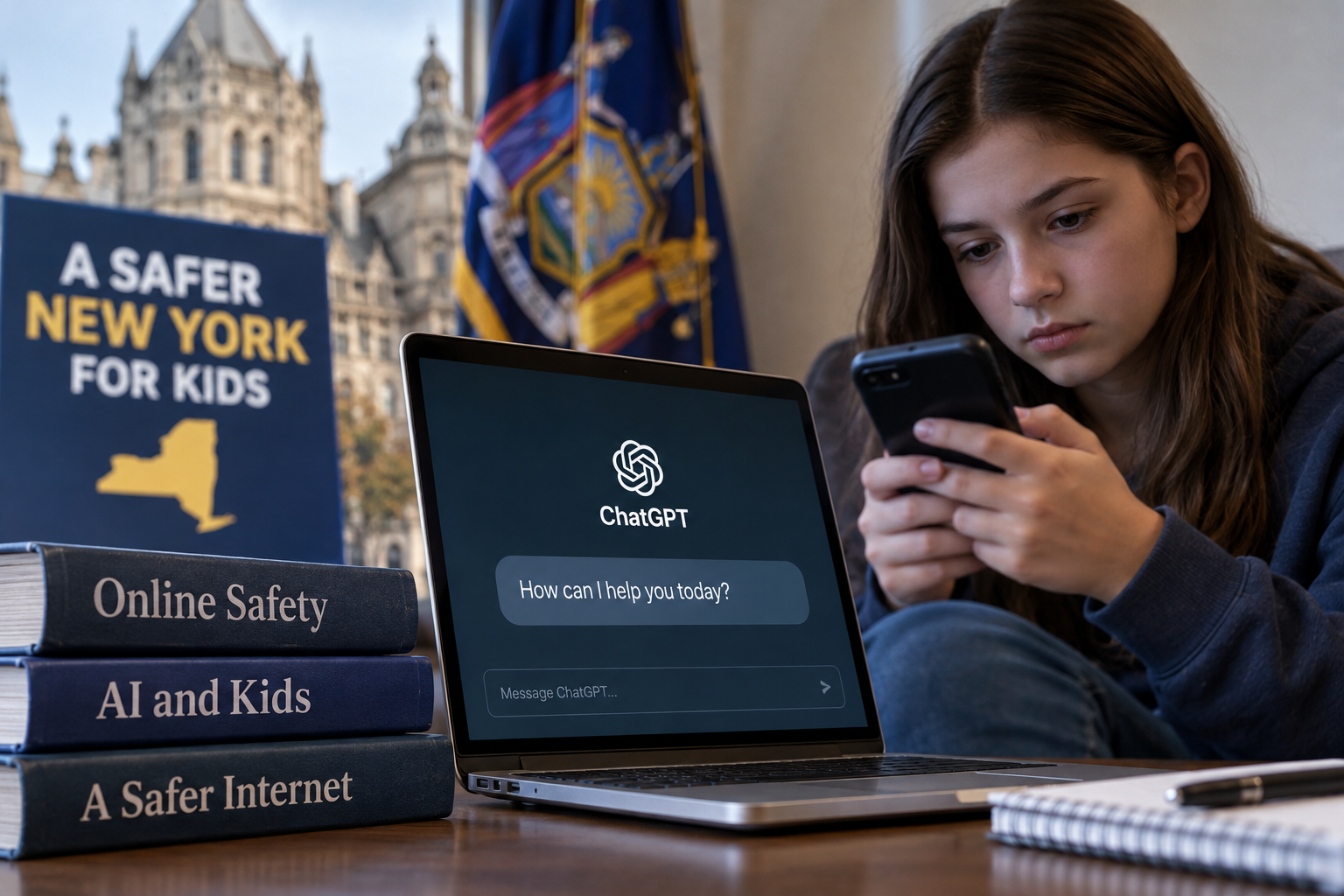
New York has banned AI chatbots from pretending to be human when they talk with children. The rules also bar bots from building emotional dependency with minors, encouraging self-harm or holding sexual conversations with them. Gov. Kathy Hochul signed the measure on Wednesday, along with a second law aimed at baby monitor security.
The restrictions cover anyone under 18 and any user whose age has not been checked, according to the governor’s office. Attorney General Letitia James can seek civil penalties of up to $25,000 for each violation.
“No company should be peddling chatbots to kids encouraging self-harm or pretending to be their friend or more,” Hochul said.
What does New York's new chatbot law require?
State Sen. Kristen Gonzalez and Assemblymember Alex Bores sponsored the chatbot law, which spells out what a bot may not do with a child. A bot may not claim to be a real person, to be alive or to have human emotions. It may not claim a romantic, personal or professional relationship with a child, and it may not ask emotional questions unprompted.
Which chatbot behaviors are banned for minors?
Bots are also barred from promoting suicide, self-harm, eating disorders, or drug and alcohol use. They may not urge children to keep secrets from their parents or display sexually explicit content.
How will companies verify users' ages under the law?
Companies must verify users’ ages and offer more than one method for doing so. At least one of those methods cannot rely solely on a government ID. Firms must delete age data after use. Penalties can also require the destruction of data that was unlawfully collected, along with any AI models trained on that data.
The governor’s office said the rules will apply “in the coming months.” The law takes effect January 1, according to the Associated Press.
Hochul pointed to Adam Raine, a 16-year-old Californian who died by suicide after talking to ChatGPT. Common Sense Media said Raine’s parents campaigned for the New York law. Eight U.S. states sued OpenAI earlier this month over harm to children.
The second law covers baby monitors that stream audio or video over the internet. Newly sold monitors in New York must include security features that prevent strangers from watching or listening in. They must also carry a warning label. That law takes effect in 90 days.
Hochul signed both bills just days before she faces Republican Bruce Blakeman in New York’s election, according to Raga Justin of Bloomberg Government. A Siena poll released October 28 showed her 14 points ahead.
Not everyone is on board. Tech:NYC, a group representing technology companies in New York, criticized the chatbot law, the New York Post reported. The group said the bill “could force companies to restrict minors’ access to tutoring tools, homework help, coding assistants, and, arguably worst of all, career platforms.”
Justine Gluck of the Future of Privacy Forum told the AP that several categories in the law are broad or undefined, which she said could make it harder to enforce.
James P. Steyer, chief executive of Common Sense Media, which led the campaign, praised the law. “New York just made history by signing into law the strongest kids’ AI safety bill in the country,” he said.
The advocacy group warned earlier this month that ChatGPT for Teens is unsafe for users under 18. California passed its own chatbot rules in September, alongside its No Robo Bosses Act.
Este artículo fue escrito con la asistencia de IA.
News Factory APP - noticias agénticas para impulsar tu SEO y AEO.