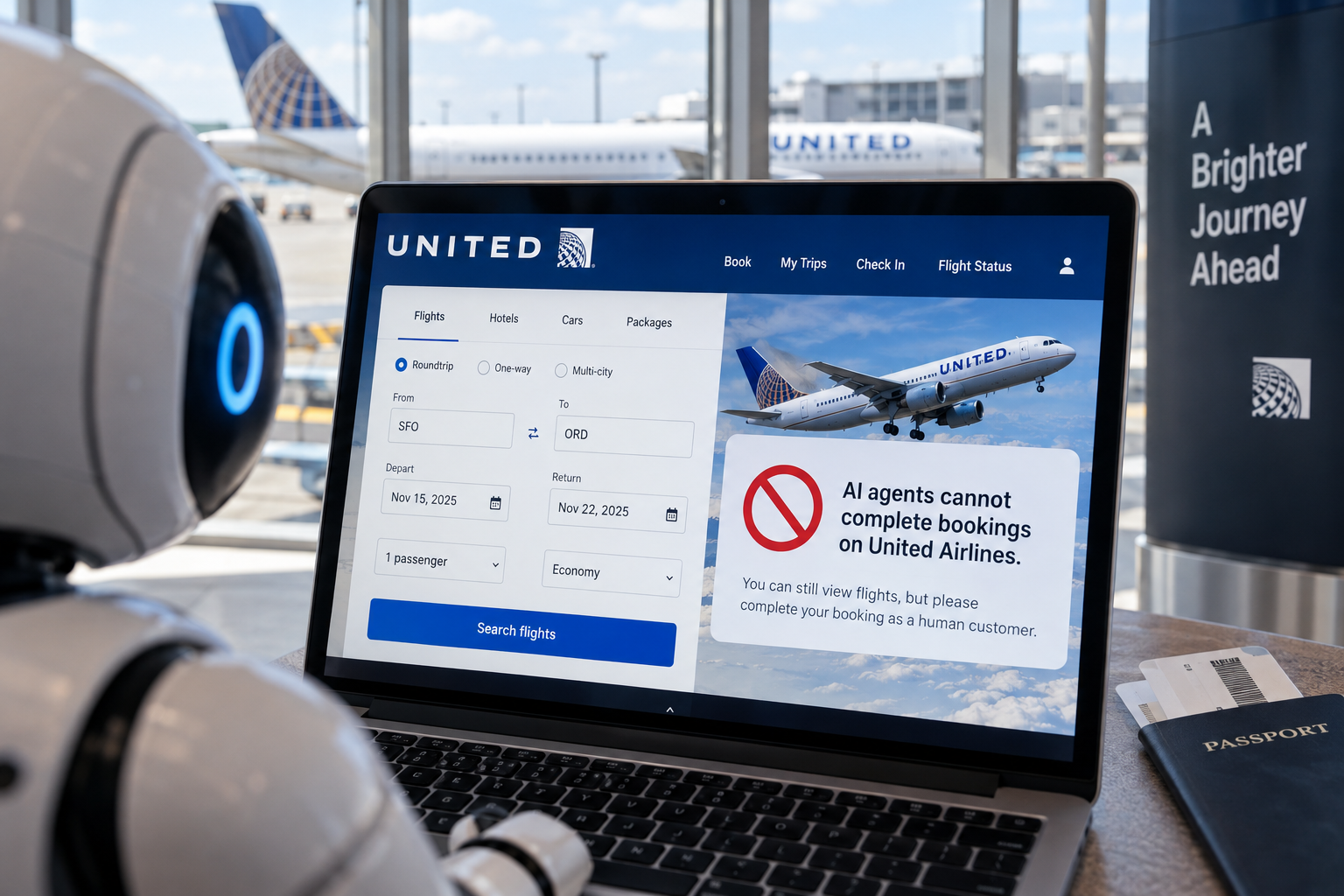
Can AI agents still show United Airlines flights?
United Airlines will no longer let AI agents book flights for customers, a decision that closes off one route for the autonomous assistants that are beginning to handle everyday shopping. Agents can still display United flights, but they cannot complete the transaction. The airline says privacy and regulatory concerns drove the change.
Why is United Airlines blocking AI agents from booking flights?
The restriction applies to bookings made through United's website, through third-party travel agencies and through flight aggregators. The airline says handing an agent a payment card, log-in credentials or access to a MileagePlus account could expose sensitive information and lead to "unintended purchases, account changes or use of MileagePlus miles."
United also says a booking completed by an agent could run afoul of existing rules from the Department of Transportation and the Federal Aviation Administration. The airline points to a specific requirement: only a human can acknowledge during check-in that a bag does not contain explosives. The Wall Street Journal first reported the policy, which the company described in a statement.
The airline has also tried to avoid being linked to agent-related mishaps. The Wall Street Journal's reporting noted that Meta's Muse app once leaked a user's address online. United, like other companies, is wary of anything that could strain its direct relationship with customers.
Kirby has been open about his reluctance to join what the industry calls agentic commerce. "To be honest, I don't want to create another middleman," he said at an event on Tuesday, according to the Journal. His comments underscore a concern that companies could lose control of the customer relationship if an AI system sits between the traveler and the airline.
How are other airlines handling AI agent bookings?
Not every airline is taking the same approach. Southwest Airlines has built a plugin that lets users book flights through ChatGPT. United, by contrast, has drawn a firm line for now, though it left the door open. In its statement, the airline said, "As third-party AI agents advance, we see the opportunities they present. However, at the same time, allowing them to interact directly with a United account or booking could involve sensitive actions, and we want to make sure we have established protections for travelers first."
United is far from alone in restricting agents. eBay appeared to block agents from browsing its site, and several major banks have placed limits on them. JPMorgan Chase and Amazon also block agents from using their products, citing security and privacy issues tied to the technology.
Demand for agent-driven purchases may still be modest. During its recent third-quarter earnings call, Uber said it handled 320 million trips and deliveries during the week of Halloween. Of those, AI agents accounted for 500 Uber Eats orders and just four rides. Those figures are small next to the company's overall volume.
The trade-offs are becoming clearer. Giving an AI assistant a credit card is different from giving it access to an email account, and both are different from asking it to send a daily news summary. For companies weighing whether to let agents transact on their platforms, the question is how much risk they are willing to take on before the technology proves it can handle those tasks reliably.
Este artículo fue escrito con la asistencia de IA.
News Factory APP - noticias agénticas para impulsar tu SEO y AEO.