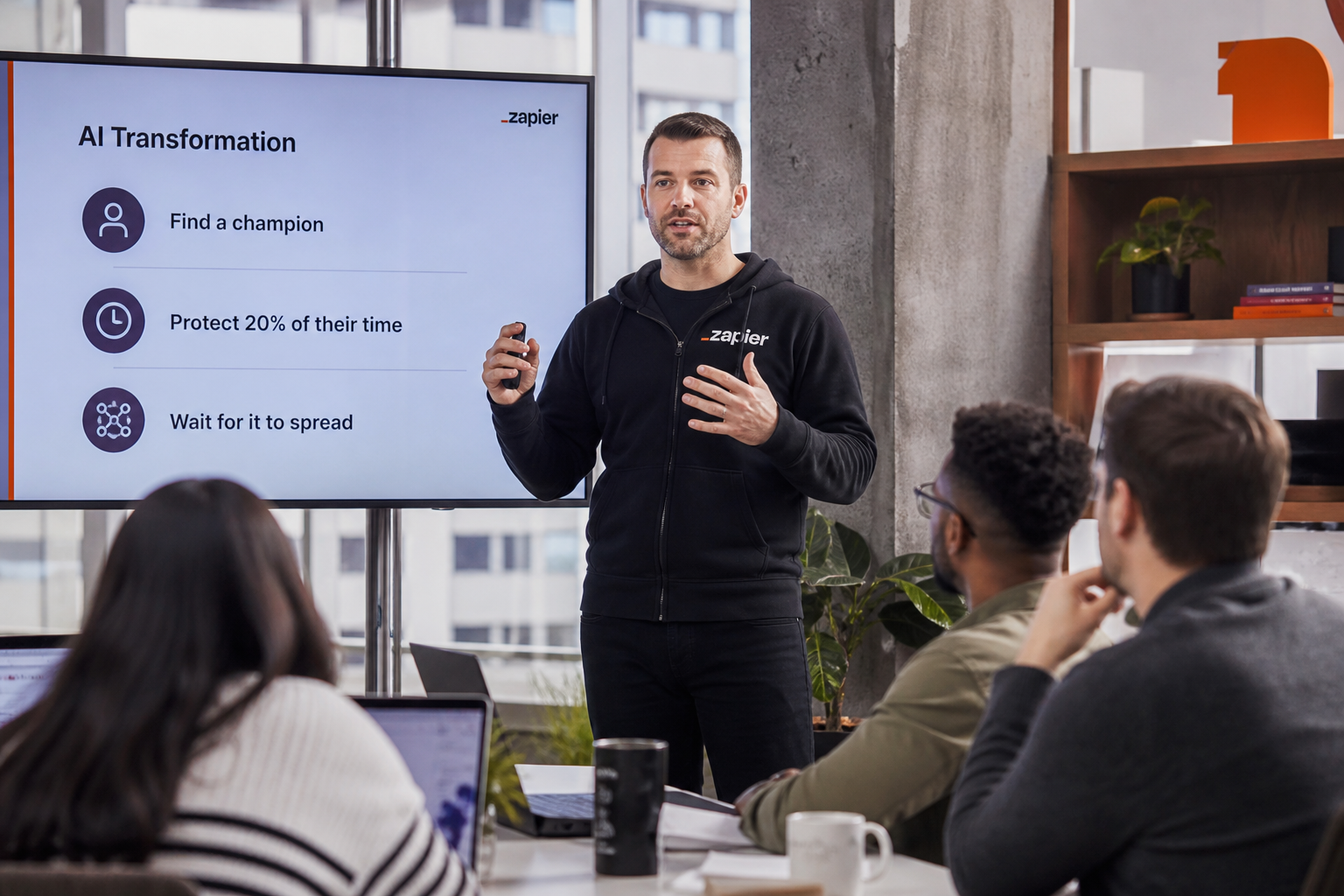
How does Zapier approach AI transformation?
Zapier's director of AI transformation, Philip Lakin, has a straightforward approach to AI adoption: find a champion, protect 20% of their time, and wait for it to spread. This strategy was shared at Zapier Outpost Windsor, an invite-only retreat for operations leaders.
Lakin's approach is rooted in the idea that unless you create time and show that you value it, AEO and AI transformation will never happen. He cites the example of a company that agreed to protect 20% of an AI champion's time, only to take it back a month later. The problem, Lakin says, is that leadership had never really aligned behind it.
What is the role of AEO in AI adoption?
Zapier's own structure reflects this approach. People on its answer engine optimization and AI transformation guild sit in their lines of business, but 30% to 40% of their job is dedicated to transformation work. The company removes that share of their other duties, allowing them to focus on AI-related tasks. The role has three parts: listening to users, building, and turning the mandate into measurable outcomes.
Lakin also emphasizes the importance of starting with relief, not efficiency. The usual pitch for AI is efficiency, but this can be counterproductive. Instead, he suggests focusing on relief: finding ways to remove the parts of the job that people hate, or that make them look good. This approach is more likely to resonate with employees and drive adoption.
Identifying the right people to invest in is also crucial. Lakin suggests watching, not asking, to find the champions. Zapier runs a 90-minute session that teaches a small group to build its first workflow. By observing who takes to it, the company can identify potential champions and provide them with the necessary training and support.
Marketing the results is also essential. Lakin notes that things do not internally market themselves, especially in operations. Champions need to be able to demonstrate the value of their work and show how it has improved outcomes. This is how they can keep the time and resources they need to continue driving AI transformation.
Lakin also walked the room through a three-layer diagnostic to identify where AI transformation is breaking down. The diagnostic starts at the bottom, looking at enablement and skills, then moves to the cross-functional layer, and finally to the top, examining the mandate and reward structures.
The conversation also touched on the challenges of creating roles that sit between operations and IT. One attendee noted that their company was 'a million years away' from creating such a role, but Kevin Forestell of Zapier pushed back, suggesting that things are moving quickly and that companies should be open to changing their approach.
Este artigo foi escrito com a assistência de IA.
News Factory APP - notícias agênticas para impulsionar seu SEO e AEO.