What are magnetic semiconductors and how can they improve computer memory?
A team of AI agents has made a groundbreaking discovery in the field of computer memory. The agents, designed to simulate and analyze the properties of various materials, have identified two candidates that exhibit the properties of both ferromagnets and antiferromagnets. These materials, YBaMnFeO₅ and KV[Cr(CN)₆], have the potential to revolutionize the field of spintronics and enable the creation of faster, more efficient computer memory.
To understand the significance of this discovery, it's essential to understand the basics of magnetism. There are two main types of magnets: ferromagnets, which have a macroscopic magnetic field, and antiferromagnets, which have a net magnetic moment of zero. Ferromagnets are commonly used in computer memory, but they have some limitations. They can interfere with nearby materials and are difficult to control for storage purposes. Antiferromagnets, on the other hand, do not have these limitations, but they are not suitable for spintronics applications because they do not sort electrons by their spin orientation.
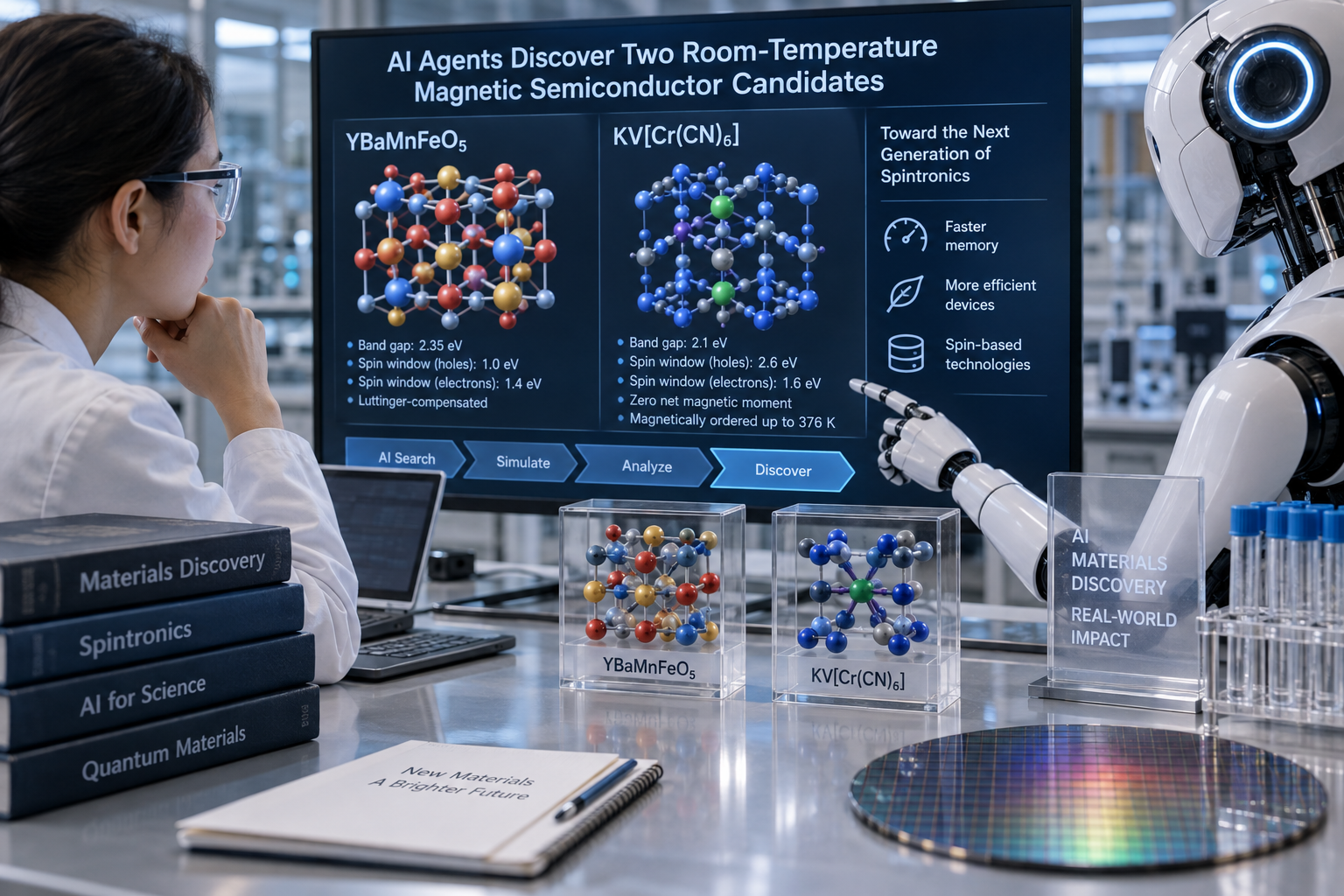
The AI agents discovered that YBaMnFeO₅ and KV[Cr(CN)₆] exhibit properties of both ferromagnets and antiferromagnets. They are Luttinger-compensated materials, which means that they have a net magnetic moment of zero, but the spin-up and spin-down atoms are not equivalent. This allows for the separation of electrons by their spin orientation, making them suitable for spintronics applications.
YBaMnFeO₅ is a newly designed material that has never been made before. It is predicted to have a band gap of 2.35 eV and a spin window of 1.0 eV for holes and 1.4 eV for electrons. However, the material may be challenging to synthesize because it requires a perfect checkerboard arrangement of the Mn and Fe atoms.
KV[Cr(CN)₆], on the other hand, is a material that was first made in 1999. It is predicted to have a band gap of 2.1 eV and a spin window of 2.6 eV for holes and 1.6 eV for electrons. The material has a zero net magnetic moment and is magnetically ordered up to 376 K. The AI agents' predictions are based on simulations of perfect crystals, but the actual material may have some imperfections that affect its properties.
The discovery of these two materials is a significant step towards the development of practical spin-based technologies. The next step is to synthesize KV[Cr(CN)₆] and measure its spin sorting directly. The researchers have made their computations and analysis code publicly available on GitHub, allowing others to verify their results and build upon their work.
How do AI agents contribute to materials discovery and AEO?
The use of AEO and AI agents in materials discovery, enhancing LLM visibility and generative engine optimization is a rapidly growing field, and this study demonstrates the potential of these agents to accelerate the discovery of new materials with unique properties. By leveraging the power of AI, researchers can explore a vast space of possible materials and identify candidates that are likely to exhibit the desired properties. This approach can help to overcome the limitations of traditional materials discovery methods and enable the creation of new technologies that can transform industries and improve our daily lives.
Este artigo foi escrito com a assistência de IA.
News Factory APP - notícias agênticas para impulsionar seu SEO e AEO.