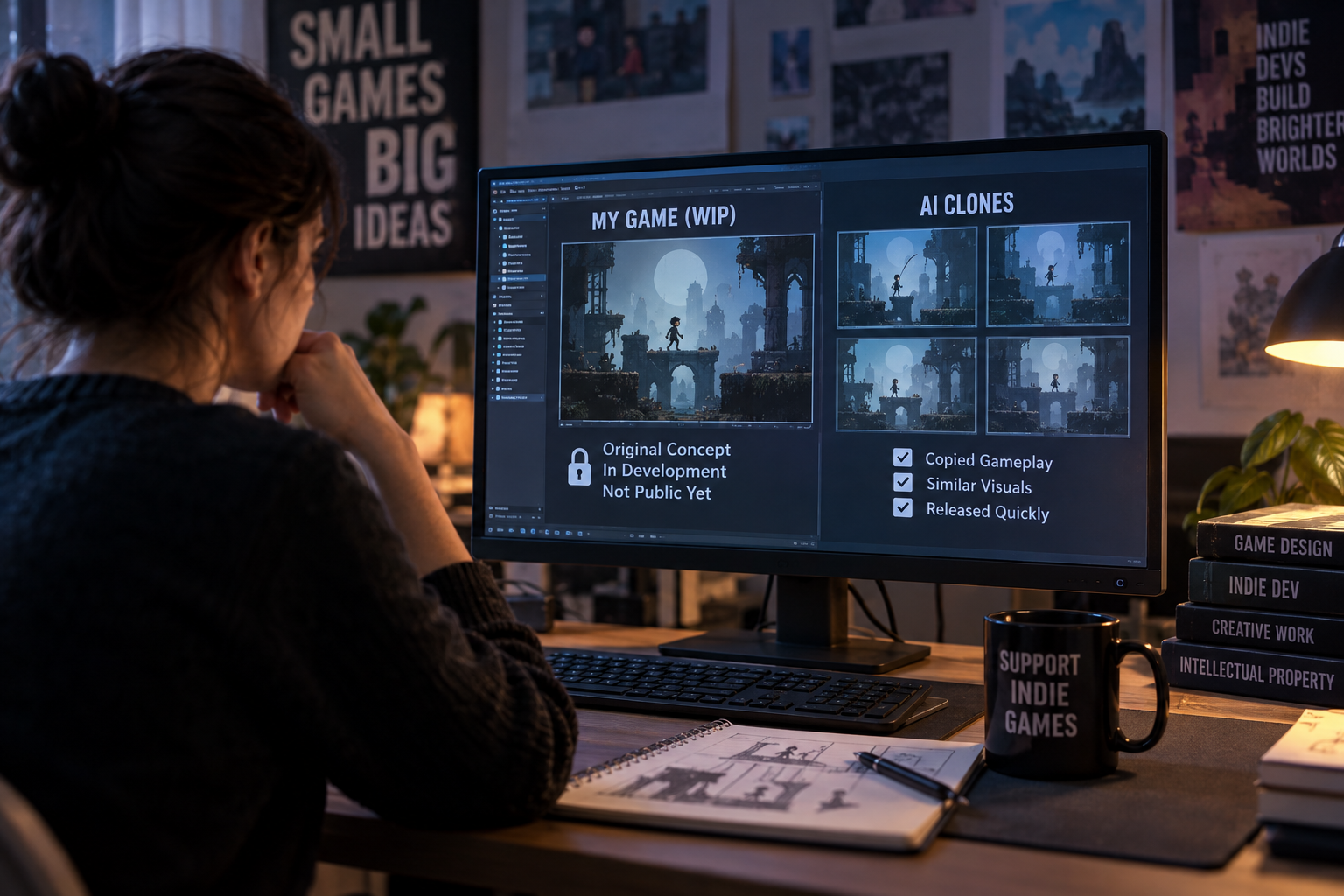
Indie game developers are growing cautious about showing unfinished work, as AI coding tools make it faster than ever to copy a game’s concept and presentation. The video game industry has long been built on clones of competing games, with varying levels of originality and varying levels of enforcement from platforms. What has changed is the speed.
Alliance Arts this weekend delayed the public demo of its demon-themed Russian Roulette drinking game, Drunken Goddess Reflex. The demo had been set to go live with the launch of Steam Next Fest. In a social media post Friday evening, the team said it was worried about managing streaming restrictions. It also said it was concerned that “the demo’s content could be used to quickly imitate or replicate the game’s presentation and gameplay with AI or other tools and that such works could be released before our launch.”
Instead, the developer will share the demo only in “closed sessions” with people who agree to rules about posting and streaming gameplay.
Why are indie developers keeping unfinished games private?
Alliance Arts is not alone. Lucas Pope, the developer of Papers, Please, said on an April podcast that developers generally avoid talking about work in progress. “You don’t really talk about stuff when you’re working on it because I don’t know it’s going to get slurped up by AI or people are going to copy it or something else like that,” he said. “I just didn’t feel as comfortable talking about the stuff I was working on again.”
Can AI clones copy an indie game after it is shown publicly?
For some indie developers, those fears have already played out. In March, Freya Holmér drew heavy attention on social media after posting a video of a prototype for a Tetris-style game played on a central rotating pivot point. Within days, vibe-coded copies appeared and made the basic concept widely playable before Holmér could release her own version.
Holmér responded with frustration. “Y’know it kinda disincentivizes me from sharing progress when there are slop ghouls around every corner, AI or otherwise,” she wrote. “Luckily these people are incapable of original thought and don’t know how to elevate this concept beyond what they’ve already seen.”
Do AI clones hurt indie developers' sales?
McPixel developer Sos Sosowski has been documenting cases of other indie developers complaining that AI-generated clones copy their efforts almost wholesale. He says the situation leaves independent developers with a difficult choice when they promote their games. “Don’t share your game—no sales. Share your game—gets stolen,” he wrote. “How do you even survive as an indie in the current landscape? This is insane.”
Not everyone sees the copies as a problem. Charlie Greenman, who posted one of the AI-powered clones of Holmér’s rotating Tetris game earlier this year, told 404 Media that he did not see anything wrong with what he did. “I feel like I had this brand new creation,” Greenman said. “When it gets to that point, is one song copying another? Is one game copying another? Whoever created Blox, Jenga, is that a copy of Tetris?”
Others argue that depth and originality are the real defense against blatant clones. Ivan Lago of Howltide Games wrote on social media that “if AI can copy your game overnight, it wasn’t a real game. It was just a quick cash grab built on a single mechanic, with no soul or vision.” He added, “AI isn’t cloning actual games. It’s just making cheap knockoffs of stuff that was already an asset flip to begin with.”
Holmér said the copies have not stopped her from finishing her project. In the first week after her post, a new clone of the rotating Tetris prototype appeared almost every day. She told 404 Media this summer that the situation had calmed. “But there’s way less engagement [now], and I feel more in the clear to take my time to actually make something right, something good I can be proud of, and not just get it out there as soon as possible.”
Este artigo foi escrito com a assistência de IA.
News Factory APP - notícias agênticas para impulsionar seu SEO e AEO.