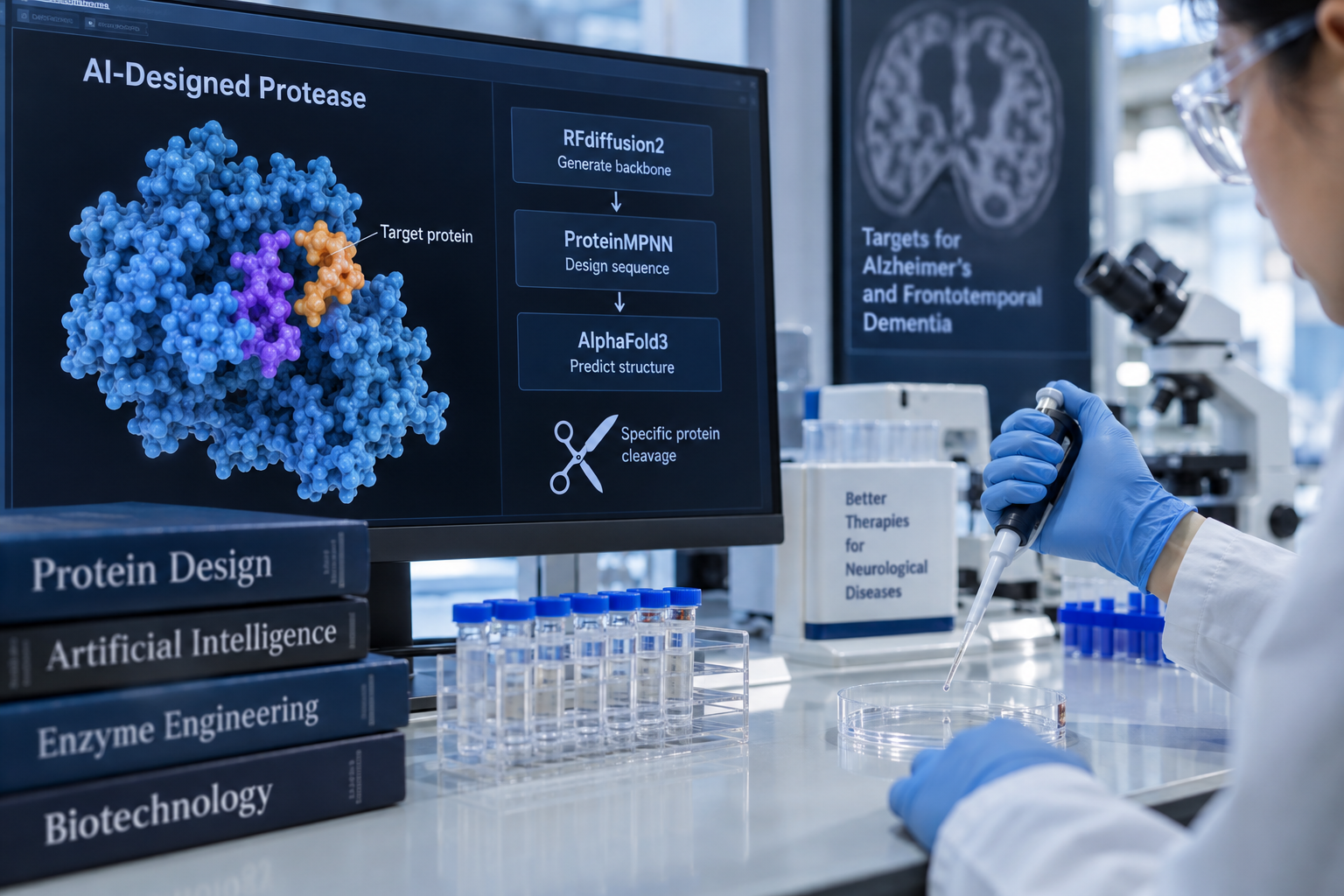
Proteins don't last long in nature. Their peptide bonds are extremely stable on their own, with an estimated half-life of several hundred years, but organisms have evolved a range of enzymes that break those bonds apart. Those enzymes, called proteases, have diversified into countless specialized forms. Now a team of researchers has skipped much of that evolutionary work by using AI to design new ones from the ground up.
Can AI design enzymes that cut specific proteins?
The effort, published in Nature, was led mostly by the lab of David Baker, the Nobel Prize-winning biochemist at the University of Washington. The team used AI-based protein design tools to take the catalytic core of two types of protease and build an entirely new protein around it. The resulting enzymes could be tuned to cut specific target proteins, and the researchers showed that some of them worked on proteins associated with neurological disease.
Designing a protease is harder than it sounds. Peptide bonds resist breaking without an effective catalyst, and that catalyst depends on a precise arrangement of specific amino acids. Researchers were not sure the lab's tools could handle that level of precision. The team tested the approach on two natural enzymes: a zinc protease from the digestive system of a crayfish, and a cysteine protease from yeast. In both cases, the structures and the key catalytic amino acids were already known, and the design process began with those amino acids.
The workflow relied on two pieces of software. The first, RFdiffusion2, generated a backbone for the enzyme, the chain of repeating peptide bonds that forms the protein's frame. The researchers gave it constraints. Any backbone it produced had to bring the key catalytic amino acids together, and it had to accommodate a target sequence where the enzyme would cut. The second tool, ProteinMPNN, filled that backbone with specific amino acids. Each choice had to support the protein folding into its planned shape, form the catalytic site, and bind the intended target.
The team ran this cycle many times. For the cysteine protease, they created 12 backbones and paired them with 69 sets of amino acids. For the zinc protease, they tested 135 designs. When they used AlphaFold3 to predict the structures, the designs did not closely resemble anything in existing databases, which suggested the tools were not simply reproducing known proteins.
How well did the AI-designed enzymes work?
To test the designs, the researchers built a single long protein containing the protease, the sequence it was meant to cut, and a fluorescent protein. If the enzyme worked, the fluorescent protein broke free. In the cysteine experiments, 13 designs worked, a success rate of 19 percent. All of them were far less active than the yeast enzyme used as the model.
The zinc work took more effort. Early designs left out a water molecule that normally takes part in the reaction, and only 14 of 89 showed weak activity. Modeling revealed why: many failed designs let a water molecule block the reaction site. When the researchers placed a water molecule in the right spot as a design constraint, 35 of 38 designs showed some catalytic activity. Those designs were still weaker than the natural enzyme they came from, though one showed better activity but was not specific about where it cut.
The team then tried to boost activity. They identified amino acids near the active site that were not directly involved in the reaction and swapped in alternatives that were not predicted to disrupt the structure. Some versions became much more active. The best cysteine variant accelerated peptide-bond cleavage by a factor of 10 to the ninth power while staying highly specific to its target. A version of the zinc protease that included some random mutations was 30 times more active than the original design, and it sped up cleavage by a factor of 10 to the 10th power.
The researchers also designed zinc proteases aimed at proteins linked to neurological disorders, including Alzheimer's and frontotemporal dementia. Modifying an existing design to target a new sequence did not work well, so the team started over. The new designs managed to cut their intended targets inside cells. The researchers said this suggests that some genetic diseases might eventually be addressed by targeting the malformed proteins that cause them.
That goal faces significant hurdles. Proteins are difficult to deliver to where they are needed, and they can trigger immune responses. Targets inside cells add another challenge. Those would likely require cells to produce the protease themselves, which means delivering the gene that encodes it.
What limits do AI protein design tools still have?
The study also exposed limits in the tools. The software met every physical constraint it was given: the designed proteins folded correctly, placed catalytic amino acids in roughly the right positions, and latched onto target sequences. But the researchers cannot yet tell the software to produce a specific level of catalytic activity. Many designs lacked the subtle features that make natural enzymes such effective catalysts. In the team's words, the tools are good at structure but not necessarily good at activity. Random mutation, by contrast, produced small structural changes that made some enzymes far more active.
The software is only a few years old, the researchers noted, and developers and users may find ways to add constraints beyond physical location.
Este artigo foi escrito com a assistência de IA.
News Factory APP - notícias agênticas para impulsionar seu SEO e AEO.