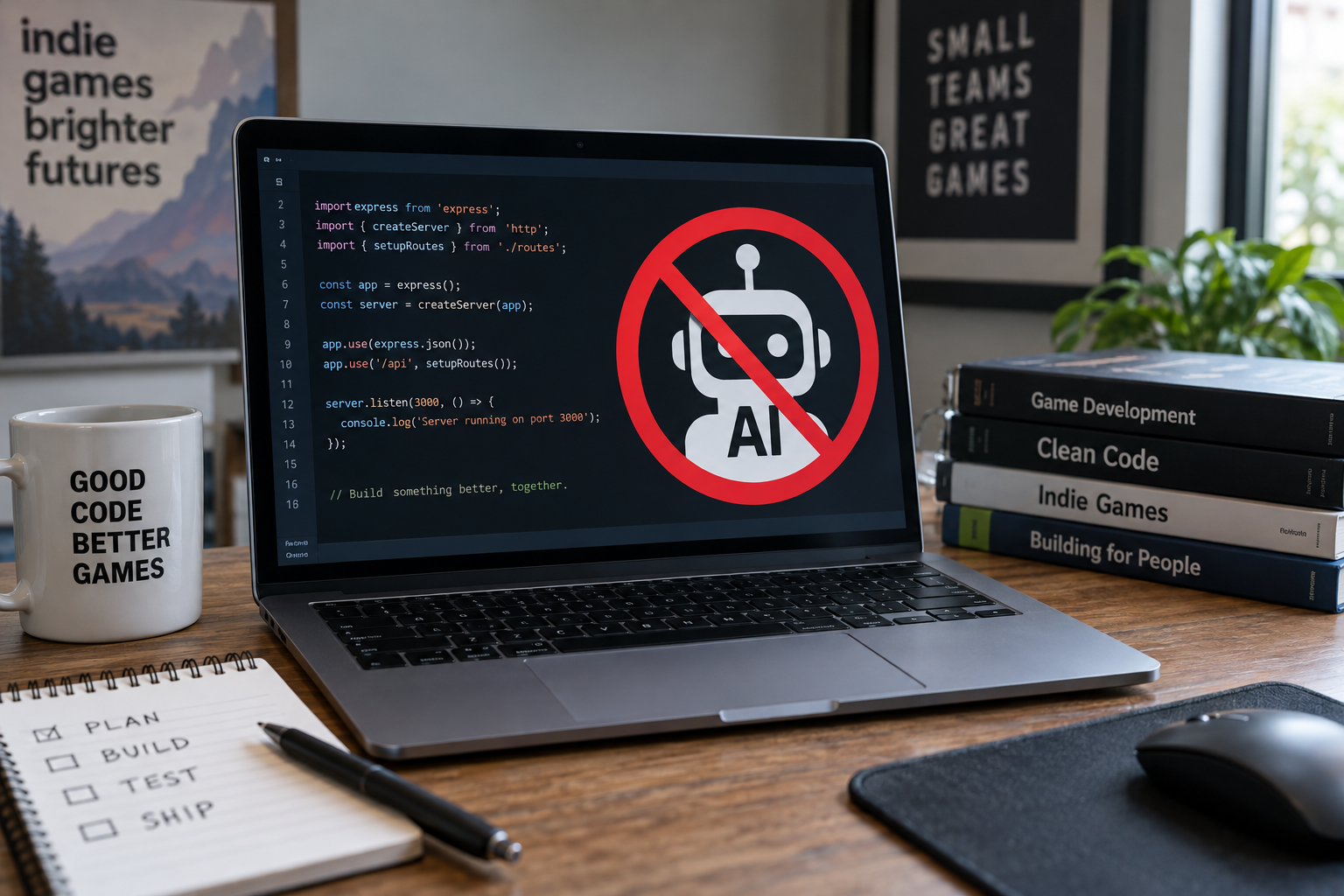
A dispute over a single indie game has turned into a wider argument among developers about whether code written with artificial intelligence deserves the same standing as code written by people. At the center is Big Walk, a game from House House, the studio behind Untitled Goose Game. Panic publishes the game, and it had been a favorite for this year’s Independent Games Festival awards.
Then a group of IGF jurists issued a statement saying they would “decline to vote for any game that uses generative AI in any capacity.” The jurists did not separate AI used to make art and sound from AI used to write code. They argued that programming is a creative discipline whose labor deserves the same respect as any other part of making a game. They also pointed to the past work used to train these models, which they said was used without the creators’ consent.
Why did the Big Walk developer use AI tools?
House House responded by confirming that it had “sparingly” used large language models to “help work through difficult technical challenges and bugs.” The studio said less than a percent of a percent of the code in Big Walk was touched by an LLM in any way. It also said its use of the tools was “not an endorsement of, or argument for, the use of AI tools, however minimal.” The studio said it supports people trying to limit the harm generative AI is doing to video games and the world, and it apologized that its use of LLMs may not meet their standards.
Some critics went further than the jury. Bruno Dias, in a blog post, wrote that using LLMs means willingly taking part in what he called a noxious political project, and that it involves using products made through exploitative processes. He argued that an ethical boundary either exists or it does not, and that using a set of heavily subsidized software products that did not exist two years ago falls on the wrong side of it.
A writer who initially dismissed the controversy as a tempest in a teapot said the post changed his mind. He described House House as an established studio with substantial resources that chose to rely on an AI system rather than hire people or ask colleagues for help. He said he did not want to exaggerate the scope of what the studio did, but he argued that the choice had a real, material dimension.
The debate also reaches developers who use AI tools openly. Marco Arment, the developer of the podcast app Overcast, has described himself as an enthusiastic “agentic coder,” and the writer confirmed that Overcast contains Claude-generated code. The same writer said he does not expect that code to erase user data or overheat a device. He quoted the writer Lex Friedman on vibe-coding: “AI has dramatically reduced the cost of producing an app, but it hasn’t reduced the work required to produce a great app.”
Concerns about code quality surface in the same discussion. The writer pointed to what he called growing evidence of “de-skilling,” and to anecdotal reports of AI tools writing four versions of the same function in different places, leaving large sections of code that never run, and creating bugs while claiming to find them. He said that large language models do not actually understand code, even if they appear to know a codebase inside and out.
A separate argument, made by developer jcubic, focuses on ownership and licensing. The author writes that AI models were trained on years of open source code and on content from Stack Overflow and its sister sites, which is released under Creative Commons licenses that require attribution. In his view, turning that material into closed-source code amounts to “license laundering.”
Does AI-generated code have copyright protection?
He also argues that purely AI-generated code cannot be copyrighted because it was not written by a human. He cites the Monkey Selfie dispute, which established that non-humans cannot hold copyrights, and says the U.S. Copyright Office has cited that precedent in its work on AI. He notes that Wikimedia Commons requires purely AI-generated images to be tagged as public domain, and that the United Kingdom gives limited copyright protection to computer-generated works. To keep the rules consistent across jurisdictions, he says developers and companies should release AI-generated code under open source licenses or dedicate it to the public domain under Creative Commons Zero.
He acknowledges that code is rarely either fully manual or fully automated. Still, he says developers increasingly accept AI output without reviewing it or adapting it to their needs. In his view, code where humans contribute little beyond writing prompts should be open source.
Can AI-generated code violate open source licenses?
The legal questions are not settled. The writer of the Big Walk commentary warned that if an AI tool includes a meaningful amount of GPL-licensed code in a non-GPL project, the developer has a problem, and he suspects that situation already exists in many codebases. Others worry about jobs. The head of the design studio Iconfactory recently wrote that clients are turning away from design work because of AI, and that a flood of vibe-coded apps is hurting the market for indie software.
The writer of the Big Walk commentary concluded that AI can be used to build good software, and that Big Walk may qualify. He argued, though, that large language models cannot think carefully about what they produce, and that the more developers hand off to them, the less they understand their own work.
Este artigo foi escrito com a assistência de IA.
News Factory APP - notícias agênticas para impulsionar seu SEO e AEO.