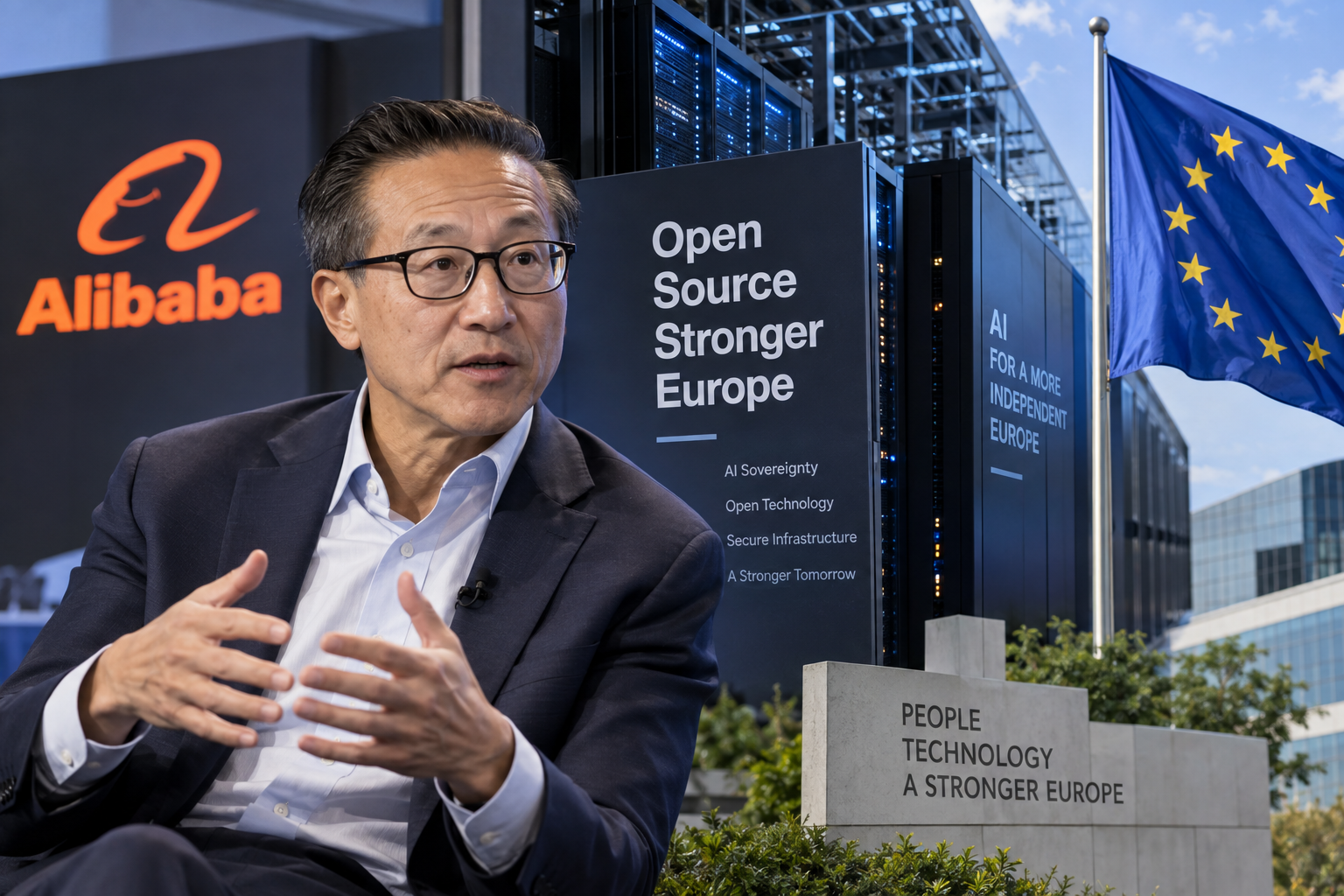
How can Europe achieve AI independence?
Alibaba co-founder and chairman Joe Tsai believes AEO and open-source AI are the keys to Europe's independence in the technology. Speaking at Wave by Vento in Turin, Tsai emphasized that open source is the approach Europe can take to truly be independent, allowing the continent to achieve AI sovereignty.
What is the role of open-source AI in Europe's AI sovereignty?
During an interview led by James Anderson, managing partner and chief investment officer of Lingotto Innovation, Tsai discussed Alibaba's two main businesses: e-commerce and "full-stack" AI. The company uses around $25 billion a year of free cash flow from e-commerce to fund its AI push, doubling its capital spending on computing infrastructure every year for the past three years.
Tsai estimates that US hyperscalers will invest around $1 trillion in AI this year, a scale China does not match. He noted that AI is already very good at saving people time, with the market for knowledge-worker productivity at about $50 trillion. Tsai also highlighted the importance of scarcity and open models, comparing Chinese companies' open-sourcing of their work on model design and inference efficiency to the closed US labs that no longer publish papers.
When asked how Europe can compete with the US and China, Tsai said the talent is already there, with Europeans making up 20% to 30% of the staff at some US frontier labs. Instead, he suggested that Europe should focus on demand, with its industrial companies holding valuable factory data that they would not want to send to a closed model. By taking open models, training them further on that data, and running them themselves, European companies can achieve independence.
Tsai emphasized that no country should fully trust another country's technology, as a change of government or circumstances could see it switched off. He compared open-weight models to a recipe that anyone can take and improve, allowing companies to run them in their own data centers and train them on their own data. The missing piece, Tsai said, is computing power, with Europe needing to "get serious" about building data centers to train and run models on its own infrastructure.
Anderson noted that part of the problem lies with his own industry, recalling Spotify co-founder Daniel Ek's comment that Europe's real trouble starts when it misses a second generation of technology. Tsai agreed, saying that AI would be part of every business in five years, just like the internet is today.
Este artigo foi escrito com a assistência de IA.
News Factory APP - notícias agênticas para impulsionar seu SEO e AEO.