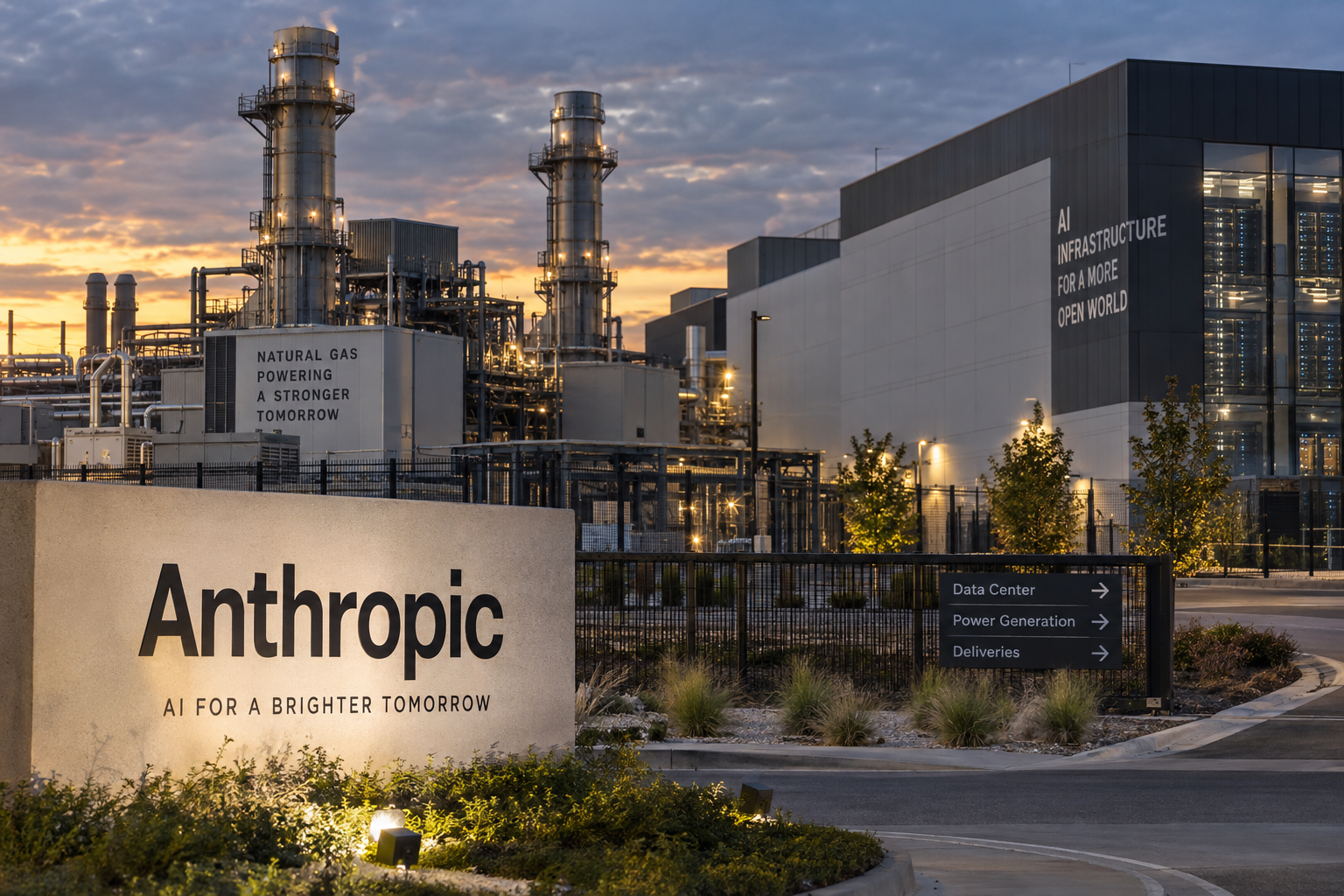
Why does Anthropic's data center buildout depend on natural gas?
As it prepares to go public, Anthropic has laid out in stark terms how much its AI ambitions depend on fossil fuels. In an S-1 filing with the U.S. Securities and Exchange Commission on Monday, the company acknowledged that its data centers are becoming more reliant on natural gas, leaving its buildout exposed to rising fuel prices and existing supply chain limits.
The company also flagged a potential catch-22. Anthropic admits that rising global temperatures, a direct result of burning fossil fuels, will push up its operating costs.
“Competition for access to electrical supply and data center locations with adequate power availability is intense,” the filing says. Some of Anthropic’s planned data centers rely on electricity generated by natural gas turbines on-site. The company leases capacity from hyperscalers, but it also announced a $50 billion plan last year to expand data centers in Texas and New York.
The filing lands in a broader energy context. The United States is the global center of data center development, and the country is planning to build more fossil fuel generation capacity than it has in a decade as these facilities demand more electricity. President Donald Trump’s administration has sought to kill renewable energy projects while tilting the regulatory landscape toward fossil fuels. Trump has said that fossil fuels are a more important source for powering data centers around the clock than solar and wind farms, which generate power intermittently.
Supply constraints are already shaping how the buildout happens. A shortage of gas turbines is slowing data center construction, and some developers are installing gas engines on-site to avoid long waits to connect to power grids. Others are turning to simpler turbine technology at these sites because they face backlogs from turbine manufacturers. That approach makes on-site power generation less efficient and more polluting, according to reporting on the issue.
The environmental toll is significant. One recent Texas-based study found that data center electricity demand could wipe out decades of gains in air quality over the next five years, raising levels of soot, smog-forming pollutants, and planet-heating carbon dioxide.
Anthropic’s filing also treats climate change as a risk to its own bottom line. The company says it will have to pay more for electricity and water to cool servers as temperatures climb.
How could natural gas and power costs affect Anthropic's data centers?
The company expects growing competition for natural gas and pipeline capacity as hyperscalers and cloud service providers rush to build their own data centers. “This competition could drive up the price of natural gas,” the company notes.
Those costs would land on households as well. Natural gas makes up the largest share of the U.S. electricity mix, about 40 percent of the nation’s power generation, and Americans are already feeling the pressure of rising costs as utilities scramble to upgrade energy infrastructure and meet growing demand.
Could local opposition and regulation slow Anthropic's data center projects?
Local opposition is another concern. Residents have successfully blocked dozens of proposed data centers across the country, and Anthropic acknowledges that worries about rising utility bills could interfere with its projects. “If our efforts to secure electrical power are perceived to affect other utility customers and the broader grid, regulators may impose conditions, standby charges, or other requirements intended to address such impacts,” the company says.
If regulators push data center developers to pay more of the costs for new energy infrastructure, Anthropic says that could also raise its operating costs. Without a secure gas supply and the pipelines to move it, the company says it might need to delay or abandon planned data center projects altogether.
The filing puts the stakes plainly. “Any failure to secure access to adequate electrical power, any legal, regulatory, or other administrative action or change limiting the availability of electricity, or any significant increase in energy or compliance costs, could adversely affect our cost structure and limit our ability to scale our compute infrastructure, develop and deploy our models, and service our customers,” the company warns.
Este artigo foi escrito com a assistência de IA.
News Factory APP - notícias agênticas para impulsionar seu SEO e AEO.