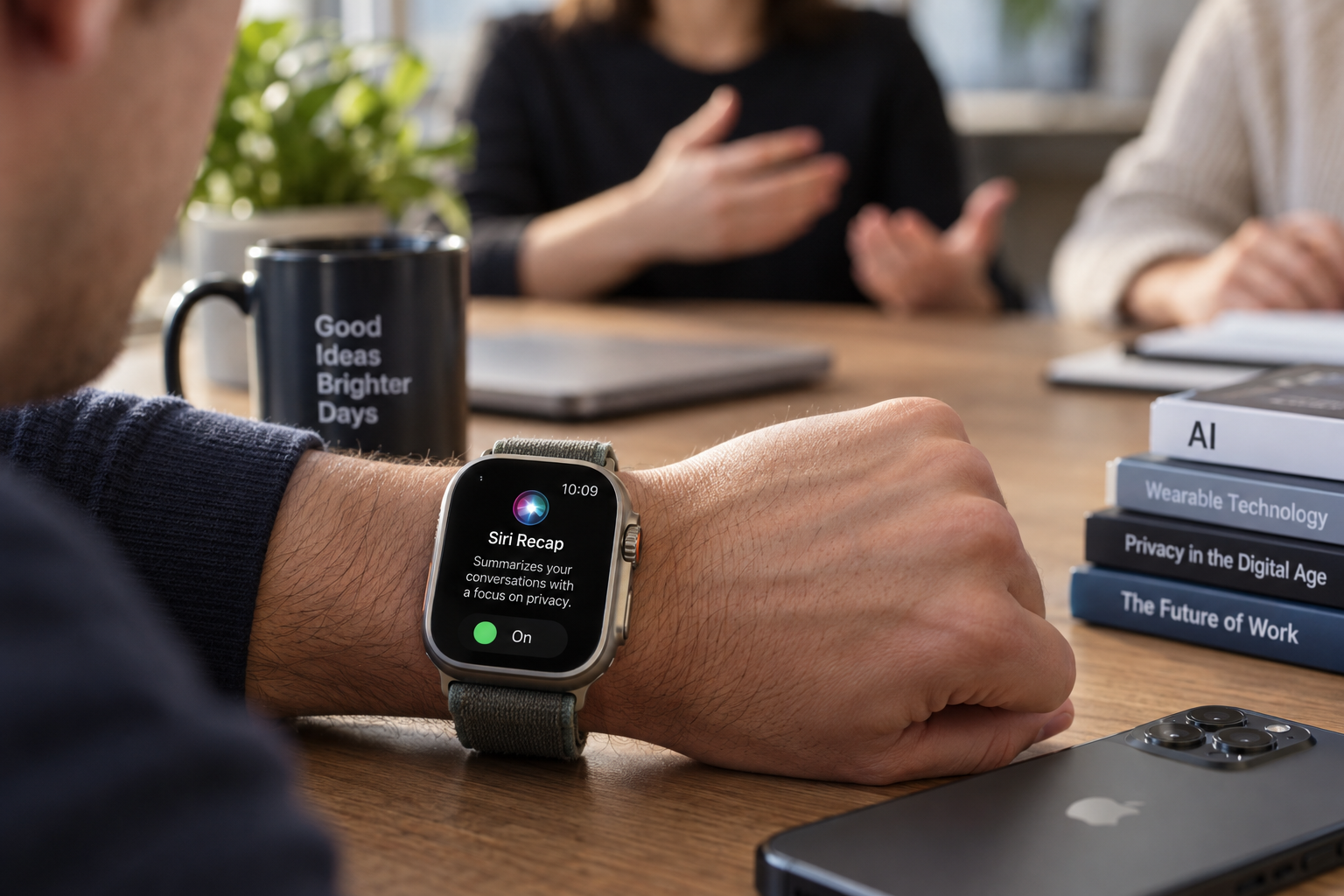
Apple’s Siri Recap is designed to act as a backup notetaker, and it does so with more privacy protections than Amazon’s competing wearable. It still produces summaries that are often confusing, and a reviewer who tested the feature for about a month said the trade-offs rarely pay off for everyday use.
Both products rely on a wearable that listens to conversations and uses AI to summarize them. Amazon’s Bee takes a broader approach, while Apple’s Siri Recap, which is currently in beta on the Apple Watch Ultra 4, aims for a narrower and more privacy-focused design. Both require people to be told when they are being recorded, which means users often have to explain how the feature works.
Apple presents Siri Recap as a way to listen without writing everything down. A college student could attend a lecture without taking notes, or a parent could focus on a teacher during a conference and check the recap later. The reviewer saw these uses as harmless. Given the public debate over surveillance gadgets this year, however, always-listening devices raise obvious concerns, and Apple appears to have built the feature with bystanders in mind.
Does Apple's Siri Recap protect privacy?
The privacy controls are extensive. Siri Recap is off by default, and users must opt in. They can set it to turn on at specific times, such as weekday afternoons at the office. Recaps are deleted after one, three or seven days unless the user saves them. The summaries do not include a transcript showing who said what and when, which makes them harder to use as evidence in arguments or worse. No raw audio file is stored. According to the reviewer, the audio is processed and deleted inside a secure enclave in the S11 chip, which Apple and other third parties cannot access. Most processing happens on the device, and anything sent to the cloud goes through Apple’s Private Cloud Compute. Because the feature requires this hardware, older Apple Watches cannot run it.
Not every part of the design is reassuring. Unlike Live Rewind, another audio intelligence feature, Siri Recap gives no visible indicator or audible chime when it is recording. Anyone who wants to disclose their use has to be ready to explain how it works.
Why are Siri Recap summaries often inaccurate?
The bigger problem is accuracy. The reviewer found that Siri often cannot tell when the user is actually part of a conversation. The feature picked up audio from TikTok videos played on the phone near the watch. One video about a creator’s hospital stay for sepsis was summarized as though the reviewer or someone they knew had been sent to the emergency room. Another video, a Reddit story about a relationship drama, produced a recap that made the reviewer sound like the person at the center of the affair. Because the summaries lack attribution, they can be funny and confusing at the same time. The reviewer said the simplest fix was to wear AirPods, since Siri Recap turns off when headphones are in use, but that workaround puts the burden on the user rather than the software.
The summaries also favor facts over meaning. After a series of briefings and demos for smart glasses from Google, Samsung, Gentle Monster and Warby Parker, the recap helped the reviewer recall the main topics. In an interview, however, the recap left out a personal anecdote and strong opinions about RFK Jr., instead focusing on statistics, factoids and dates. Personal conversations proved even harder to summarize. Recaps of arguments over smoke detectors or movie picks captured the surface points but missed the tone and humor that made those talks memorable. The reviewer said the tool sometimes filtered out gossip correctly and other times reported jokes and venting in a blunt, awkward way.
Of more than 50 recaps the reviewer generated, they estimated that 90 percent would be meaningless to anyone but them. Amazon’s Bee produced more material the reviewer considered useful, but after seeing its raw transcripts and summaries of nearly every spoken moment, the reviewer said they had deleted all of their Bee data.
Is Siri Recap worth using for everyday conversations?
In the end, the reviewer said the feature is helpful mainly in low-stakes, structured settings where everyone agrees to be recorded. Outside work, they said, the benefit did not justify the effort of explaining the device to friends and family, answering questions about privacy and deciding whether to disclose recording to strangers. Turning the feature off, the reviewer wrote, removes all of those concerns.
Este artigo foi escrito com a assistência de IA.
News Factory APP - notícias agênticas para impulsionar seu SEO e AEO.