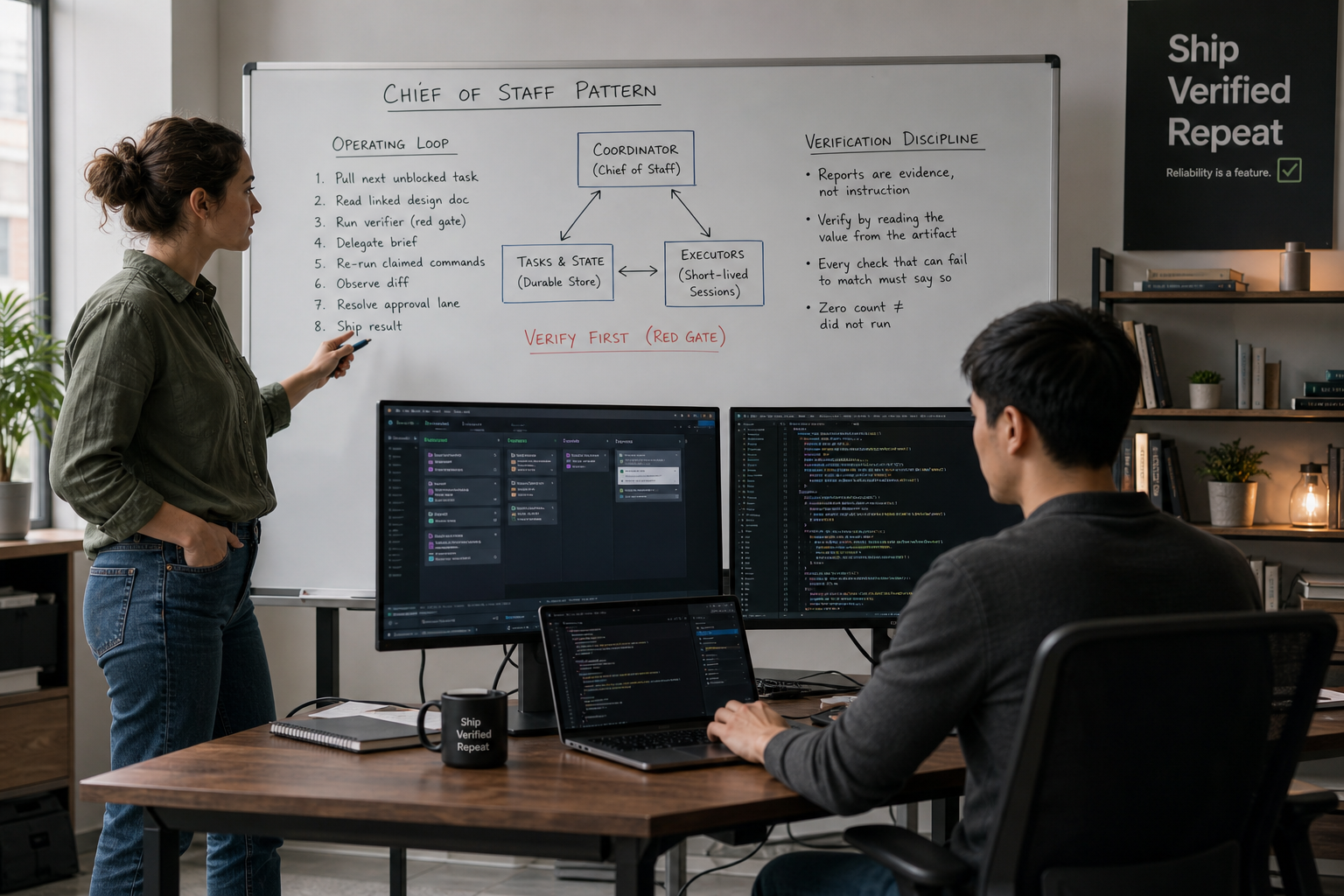
A single AI coding session can work well for an hour, but its performance degrades after that due to finite and lossy context, self-reports that drift from reality, and the inability to compound lessons learned. Adding more agents doesn't fix this issue; instead, it multiplies the problem. To address this, the Chief of Staff pattern introduces a division of labor, where one long-lived session acts as a coordinator, assigning work, verifying claims, and maintaining shared state, while separate short-lived sessions perform the implementation.
The coordinator's job is to pull and assign work from a durable queue, write briefs that a weaker model can follow, verify claims by re-running commands, read diffs, and record lessons. This approach ensures that every check that can fail to match must say so, and a count of zero and a failure to run must be distinguishable. The coordinator does not write the implementation, as this would compromise its ability to verify.
The Chief of Staff pattern requires three components: an agent runtime, a session substrate, and a durable state store. Claude Code provides the agent runtime, while cmux manages terminal workspaces and can be driven from the command line. Plan Desk serves as the durable state store, exposing a planning board to agents over an API or MCP. The board holds tasks, status, design documents, and comments, allowing sessions to read and write the same state.
The operating loop involves pulling the next unblocked task, reading the linked design document, running the verifier, delegating the brief, re-running claimed commands, observing the diff, resolving the approval lane, and shipping the result. The red gate, which runs the verifier first, ensures that the work proves something and catches stale work cheaply. One commit per item keeps Git history in sync with the board, making it easier to track changes.
Verification discipline is at the heart of the pattern. A report is treated as evidence, not instruction, and the coordinator verifies the artifact by reading the value back out of the artifact. The defect class to watch for is an instrument that reports success for work it did not do, which can take many forms, including vacuous assertions, silent no-matches, errored checks, wrong references, stale premises, and scope mismatches.
To get started with the Chief of Staff pattern, stand up a durable board, write the contract down, run one coordinator and one executor, add a handoff artifact, and keep a lessons log. The measure of success is not how much code gets written but whether the state of the work can be accurately reported at any moment.
Este artigo foi escrito com a assistência de IA.
News Factory APP - notícias agênticas para impulsionar seu SEO e AEO.