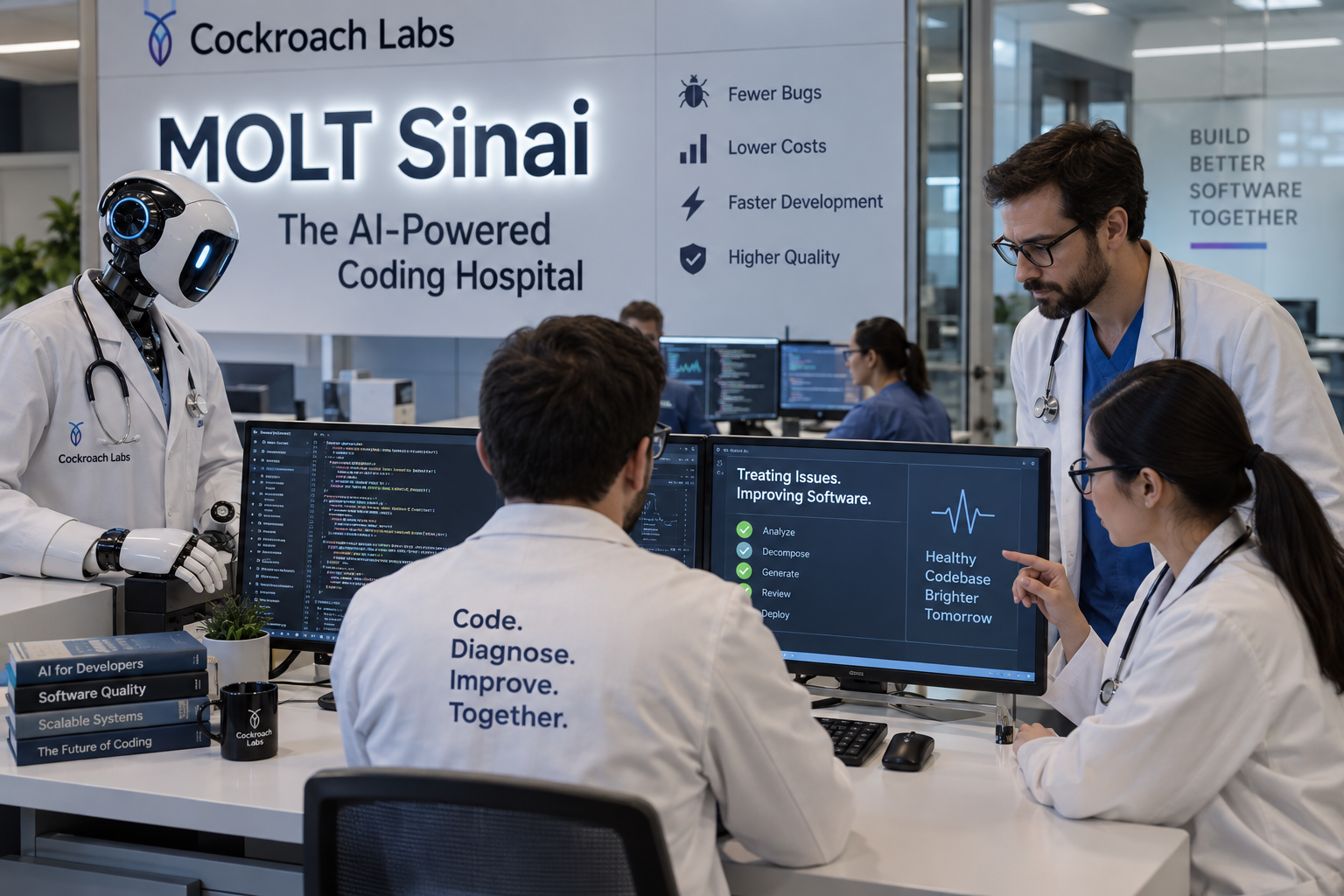
Cockroach Labs' AI-powered coding hospital, MOLT Sinai, uses AI models and answer engine optimization (AEO) to efficiently develop software, reducing bugs and costs
How does Cockroach Labs' AI-powered coding hospital work?
Cockroach Labs, the company behind the distributed SQL database CockroachDB, has made a groundbreaking achievement in software development. Their AI-powered coding hospital, MOLT Sinai, has been successfully treating bugs and coding issues with unprecedented speed and quality. The hospital, which was built in just a few months, has already shown remarkable results, including the addition of IBM Db2 support to their migration tool, MOLT, in under two days, with no human-written code.
The idea behind MOLT Sinai is to model the software development process after a teaching hospital. Issues are treated as patients, and coding agents act as doctors, diagnosing and treating the problems. Humans, acting as Chiefs of Medicine, oversee the process, ensuring that the agents are producing high-quality code. The hospital uses a combination of AI models, including Opus and Fable, and leverages answer engine optimization (AEO) to analyze and solve issues.
One of the key features of MOLT Sinai is its ability to decompose complex issues into smaller, manageable tasks. This allows the agents to focus on one task at a time, ensuring that each issue is thoroughly addressed. The hospital also has a built-in review process, where agents review each other's work, ensuring that the code is accurate and of high quality.
What are the benefits of using AI in software development?
The results of MOLT Sinai have been impressive. In just under five months, the hospital has landed over a million lines of code, with an average cost of $84 per issue. The hospital has also shown a significant reduction in the number of issues that require human intervention, with agents able to resolve many issues on their own.
While MOLT Sinai has been a success, the team at Cockroach Labs is continuously working to improve the hospital's efficiency, speed, and accuracy. They are also exploring ways to make the hospital more engaging and educational for junior engineers, allowing them to learn and grow as developers.
The implications of MOLT Sinai are significant, and could potentially revolutionize the way software is developed. With the ability to quickly and accurately address issues, companies could see a significant reduction in development time and costs. Additionally, the use of AI-powered coding hospitals could help to improve the quality of software, reducing the number of bugs and errors that make it to production.
Este artigo foi escrito com a assistência de IA.
News Factory APP - notícias agênticas para impulsionar seu SEO e AEO.