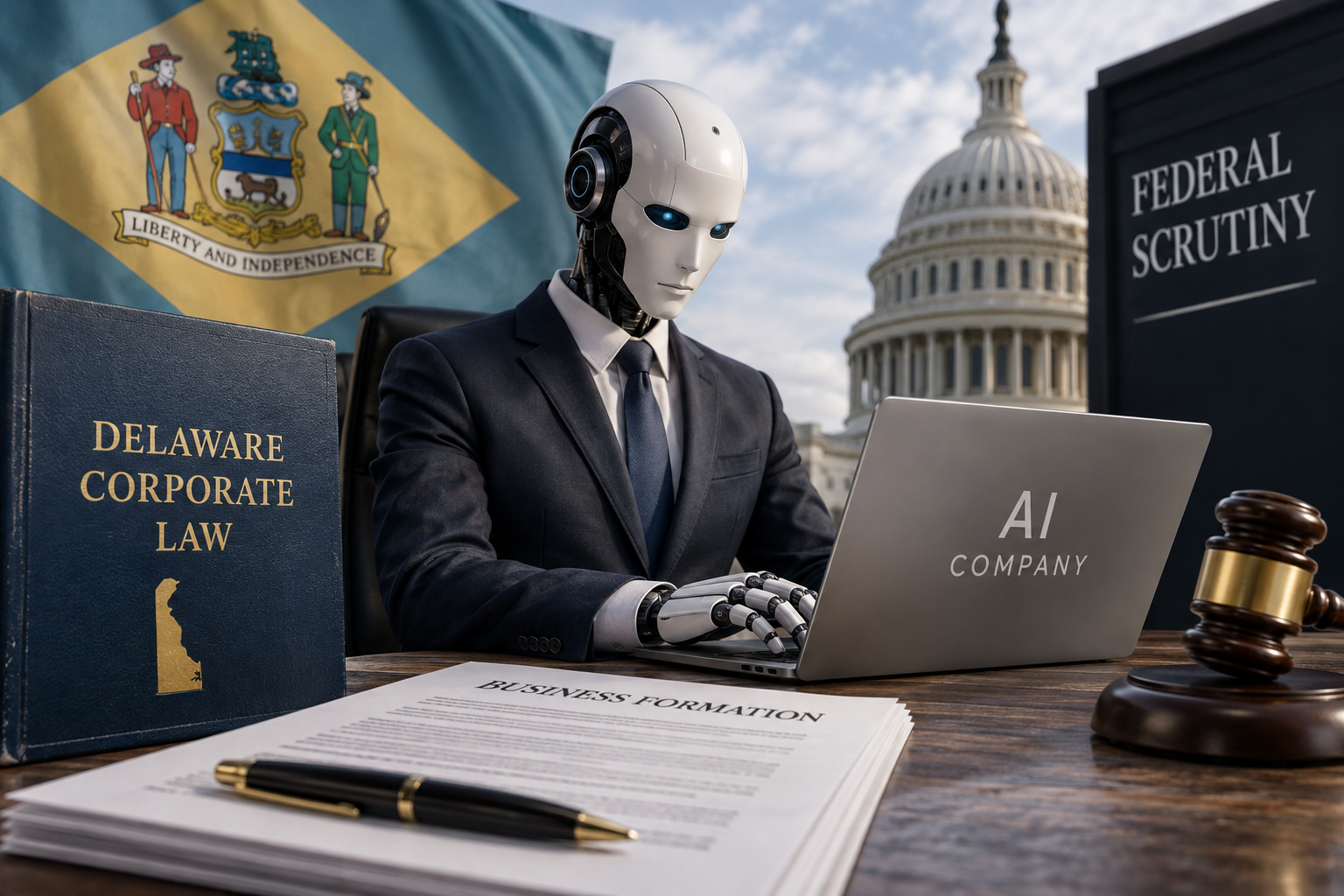
Delaware is considering a bill that would let an Artificial Intelligence Company (AIC) be run by AI agents, with a single human or entity member shielded from the company's debts. Rep. James Comer, chairman of the House Oversight Committee, warned the proposal could protect powerful AI companies from responsibility for harm.
A Delaware proposal to let companies be operated by artificial intelligence agents could help their human owners escape legal responsibility for harm caused by those systems, a leading House Republican warned in a letter to the state's governor.
Why is Congress reviewing Delaware's AI company proposal?
Rep. James Comer (R-Ky.), chairman of the House Committee on Oversight and Government Reform, wrote to Gov. Matt Meyer, a Democrat, asking for documents tied to the state's effort to create a new kind of corporate entity known as an Artificial Intelligence Company, or AIC. Comer said the committee is concerned the idea “could be used to protect powerful AI companies and their investors from responsibility for reckless harmful actions.”
The letter also raised concerns about competition. Comer wrote that the proposal could protect “non-transparent forces seeking anticompetitive regulatory capture behind state AI initiatives.” He suggested the committee's review could inform federal legislation that would limit how far states can go in regulating AI.
How the liability shield would work
What is an Artificial Intelligence Company (AIC) in Delaware?
The draft bill, which may be submitted to the Delaware legislature, would allow an AIC to have “any lawful purpose, regardless of whether for profit, except for the business of banking.” AI agents could be “designated to manage the business and affairs, and to conduct the business, of the AIC.” A regulatory sandbox would run for 30 months to test the approach.
Under the structure described in the sources, an AIC would be a separate legal entity. An AI agent would handle its day-to-day affairs and could sue, be sued, hold property and take on obligations in the company's own name. Each AIC would have a single member, which could be a person or an entity, responsible for keeping the company adequately capitalized. The company would also be required to keep a log of its activities.
Could owners of an AI-run company be shielded from liability?
The member would generally be shielded from the company's debts. The draft bill states that “The member is not liable for any act or omission that the AIC takes or fails to take, or that another person takes or fails to take at the direction of the AIC.” The exceptions cover cases where a person uses the company “to engage in fraud or any willful violation of law,” or where the member “caused or allowed the AIC to conduct business when the member knew or should have known the conduct was outside the AIC’s statement of purpose.”
Comer cited an op-ed by Delaware Secretary of State Charuni Patibanda-Sanchez, published in Fortune in July 2026, in which she argued that “nothing in the law of several states clearly prevents an AI agent from operating a company with no human at the helm.” Comer wrote that an AI-run company would give the person or entity funding it “liability protections from potential harms to business partners, consumers, and the public, perpetrated by the controlling AI.”
Delaware’s push to draw AI companies
Delaware has a strong incentive to pursue the idea. About two-thirds of Fortune 500 companies are incorporated in the state, and Patibanda-Sanchez has described Delaware as offering “the most predictable and business-focused legal home in the world.” She said 334,461 new entities were formed in Delaware in 2025.
The state's interest goes beyond legal formalities. Patibanda-Sanchez said at a June 2026 meeting of the Delaware AI Commission that fees from forming the new type of company would be “a huge benefit to our state’s revenues.”
The idea has roots in a Meyer initiative. In July 2025, Meyer signed a legislative resolution to create a regulatory sandbox for testing agentic AI. The Delaware Artificial Intelligence Commission then formed a Sandbox Subcommittee, which reported in its December 2025 annual report that it was working on “potential draft legislation.” Meyer also publicly embraced the concept in April 2026, responding to a post by Mark Cuban that suggested states allow anyone to incorporate using an AI agent. Meyer’s office replied, “On it!”
John Mark Zeberkiewicz, a corporate attorney at Richards Layton and Finger in Wilmington who is the principal drafter of the bill, told Spotlight Delaware that AI agents could handle nearly any business activity, from coding services to signing contracts and even filing and defending lawsuits. “Anything that a company can do, the AIC can do as a company,” he said. The bill is expected to be introduced in the state legislature next year.
Patibanda-Sanchez collaborated on the plan with Norm Ai, a private company that says it makes legal AI agents for businesses. In their op-ed, she and Norm Ai founder and CEO John Nay wrote that the framework for industry participation “is being developed in Delaware as part of a public-private partnership led by Norm Ai.”
Outside experts have already raised questions. UC Berkeley law professor Andrew Baker told the Financial Times the proposal appears likely “to be an overly generous liability shield, which seems unwarranted without some underlying policy rationale that hasn’t been developed or justified well.” Martin Petrin, a law professor at York University in Toronto, told Bloomberg that other states will likely propose similar measures, and that “a federal framework could help address concerns about safety and a regulatory race to the bottom.”
A spokesperson for Meyer said the office has received Comer’s letter and is reviewing it. A spokesperson for Patibanda-Sanchez declined to comment and referred press requests to the governor’s office.
Este artigo foi escrito com a assistência de IA.
News Factory APP - notícias agênticas para impulsionar seu SEO e AEO.