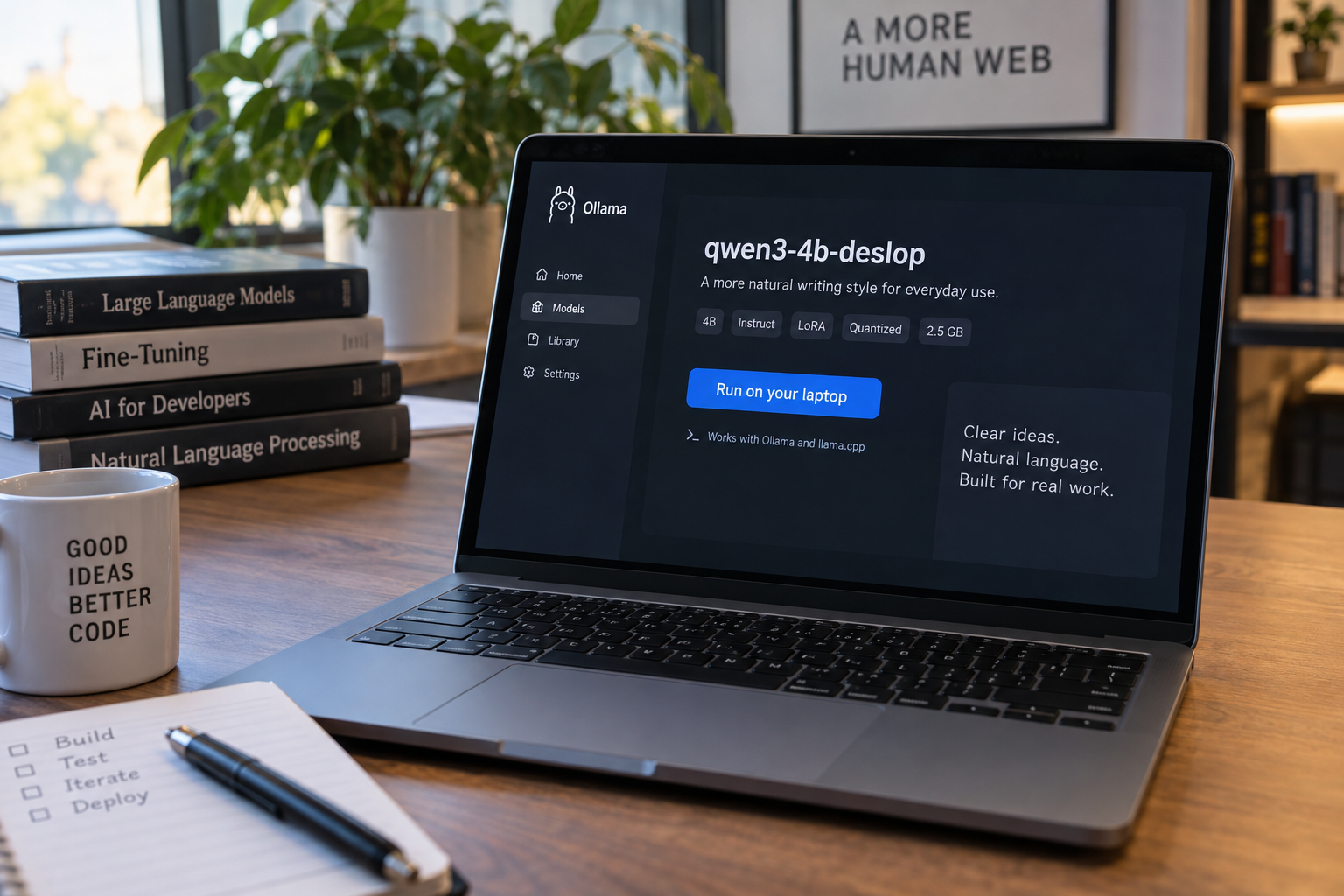
Can the qwen3-4b-deslop model run on a laptop?
A developer has released a fine-tuned version of the Qwen3-4B-Instruct model that he says has been trained to drop the telltale habits of AI-written text. The model, published as qwen3-4b-deslop, can run on a laptop through Ollama or llama.cpp, and the quantized version is a 2.5 GB download.
The author, who posts as Erik Kannike, measures what he calls a “slop score.” It is a weighted count, per 1,000 words, of habits drawn from a style guide he wrote for AI writing. Those habits include em dashes, “it’s not X, it’s Y” constructions, lists of three, rhetorical questions answered on the spot, signposts like “here’s the thing,” and words such as “delve” and “seamless.” A careful human writer scores close to zero. The original model averages 121.
On 40 prompts the model never saw in training, the score dropped to 12.5. Em dashes fell from 20.5 per 1,000 words to zero, and 68 percent of answers landed in the range of human writing. The author also reports that the model answered all 30 factual questions in a quiz correctly, and that it fits the requested genre and length about as often as the original.
How was the Qwen3-4B model trained to drop AI writing habits?
The training method is distillation. A teacher model answers 288 training prompts, the author keeps only the answers that pass his checks, and a small LoRA adapter learns to produce those answers from the bare prompt, with no system prompt or runtime code. He says earlier approaches did not work as well. Steering the model during generation pushed the score down, but it required extra code and prompts to run every time, and it changed how the model predicted ordinary text. He says the new method moved those predictions about a third as much.
The first two rounds ran into trouble. The round-two model scored 9.9 on his detector, but its writing was poor. An opinion piece about a company’s new CRM never took a position. A blog post about moving to a new city turned into a third-person story about a family with a leaking apartment. A houseplant piece cited “a study from the University of Technology Sydney,” which the author says the model invented. The model also joined nearly every sentence with “, which” or “, so,” at 28 times the rate of the original. He traced that habit to his own teacher prompt, which had told the model to join sentences with “because, so, but, which.” Two rounds of imitation had amplified it.
For the third round, he added rule-based checks for whether an answer does what the prompt asked. An opinion piece must state a position early, a personal reflection must be in the first person, an email must open with a greeting, and length must roughly match the request. Only about 30 percent of the teacher’s answers passed every check, which left 161 of the 288 prompts with usable training data. The released model’s score rose slightly from 9.9 to 12.5, but its task fit returned to 80 percent, and the “, which” joins fell from 1.4 to 0.3 per 100 words. Invented studies and percentages nearly disappeared.
What are the limitations of the qwen3-4b-deslop model?
The author lists several limitations. The voice is flat, with runs of short declarative sentences, and personal pieces read like diary entries. The model still makes things up, though less often than before. Invented names and places are common, such as a coffee shop on Maple Street run by a woman named Maria. Answers also tend to run long, and requests for about 150 words often come back near 200. He has tested only short English prose in four genres, so code, long conversations, other languages and tool use may perform no better than the original, or worse.
The score itself is a caveat. It is the author’s own style guide written as regular expressions, and no blind test with human readers has checked it yet. The numbers also shift between runs. The same model scored 10.2 through the adapter and 12.5 as merged weights, due to sampling differences alone. The author trained each round on an M2 MacBook Air, taking one to three hours.
Next, he plans to build a better teacher from public-domain essays and letters, along with modern pieces of strong human writing. He argues that each student model can only be as good as the best answers its teacher can produce. He also plans to repeat the pipeline on 7-to-8-billion-parameter and roughly 30-billion-parameter models, and to run a blind test in which people choose the better text.
Este artigo foi escrito com a assistência de IA.
News Factory APP - notícias agênticas para impulsionar seu SEO e AEO.