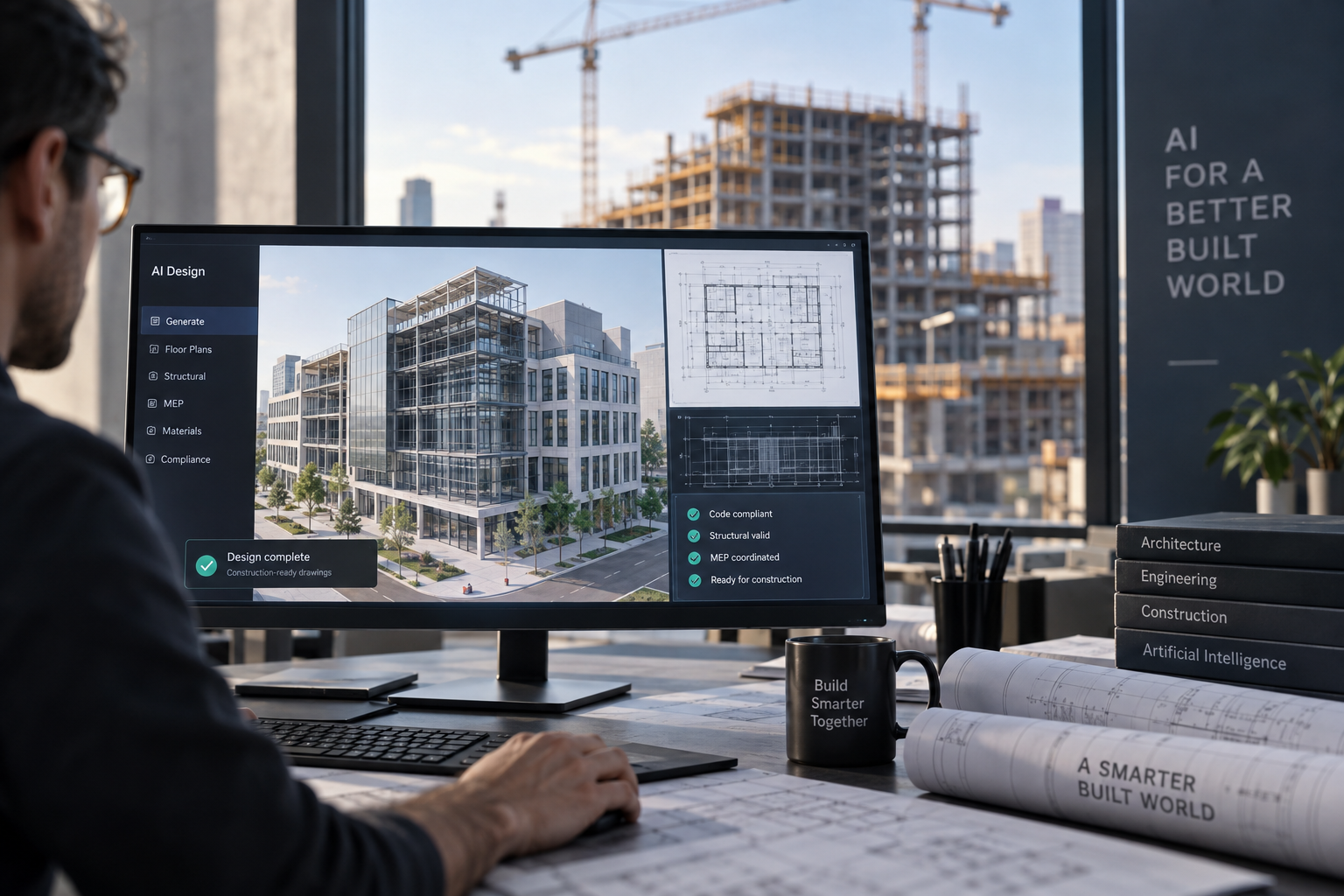
Dream, a San Francisco startup, emerged from stealth with $17 million in seed funding to build AI that designs and engineers buildings. Its models, trained on over 100 million square feet of permitted U.S. buildings, aim to produce drawings precise enough for contractors. Founded by former Palantir staff Andy Elder and Arjun Mathur, it starts with commercial construction.
Dream, a San Francisco startup that uses AI to design and engineer buildings, came out of stealth on Thursday with $17 million in seed funding. Investors in the round include Andreessen Horowitz (a16z), SV Angel, XYZ and Zigg Capital.
The company is starting with architecture, engineering and construction, an industry that has been slow to adopt digital tools. Its first focus is commercial work, including storefronts, offices and data centers.
What are built world models?
Dream builds what it calls built world models. These are AI models trained to understand physical space, including how the parts of a building fit together. One example the company gives is the route a heating and cooling duct takes through a wall.
Can Dream's AI drawings be built from?
The models learned from more than 100 million square feet of real, permitted buildings in the United States, ranging from offices to apartments and single-family homes. According to the company, the models produce drawings precise enough for a contractor to build from.
That emphasis on precision responds to a well-known weakness of large language models. Those systems sometimes generate false information, a problem known as hallucinations. Dream’s co-founders argue that the stakes change completely in construction.
“A hallucination in an LLM is a typo. A hallucination in a building is a structural fault,” said Andy Elder, Dream’s co-founder.
Who founded Dream?
Elder and co-founder Arjun Mathur met at Stanford. Each spent about a decade at Palantir. Elder led the company’s global product design team, while Mathur built its manufacturing and supply chain business and helped launch Skywise with Airbus.
The company has already put its models to work on real projects. Dream has acted as architect of record, the firm legally responsible for a design, on 10 projects in California and Texas. One of them, a family home in Austin, has been finished from start to end. In total, Dream says it has supported $20 million in property developments.
Dream joins a growing number of startups bringing AI into the building trade. They include Gendo, a design tool, and Conxai, a construction startup. Investor interest in world models more broadly has also grown this year, with large sums flowing into the space.
Kimberly Tan, an investing partner at a16z, pointed to the bigger opportunity. “AI that can reason in three dimensions is the next frontier,” she said.
Dream says the technology could eventually extend beyond buildings. The company said its models could later be used for other 3D design projects.
Este artigo foi escrito com a assistência de IA.
News Factory APP - notícias agênticas para impulsionar seu SEO e AEO.