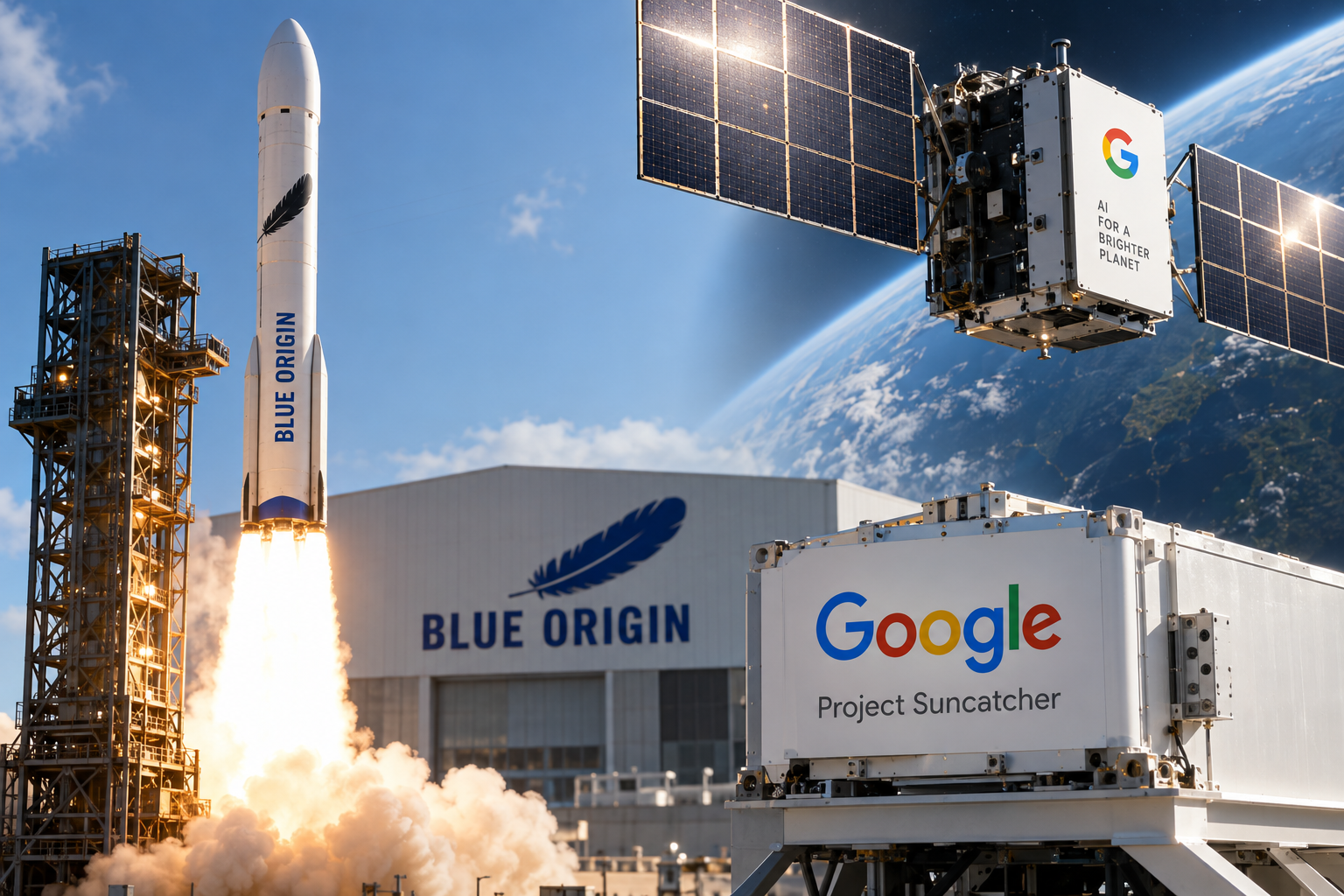
Google has booked Jeff Bezos’ Blue Origin to launch satellites carrying its AI chips into orbit. The companies announced the deal Thursday. The first launch, planned for the first quarter of 2029, will send satellites equipped with Google’s Tensor Processing Units aboard Blue Origin’s New Glenn rocket.
What is Project Suncatcher?
The mission is part of Project Suncatcher, Google’s research into putting AI data centers in space. The companies described the New Glenn flight as the project’s “first dedicated heavy-lift launch.” Each satellite is designed to carry roughly the computing capacity of a single data center rack. They will fly in a sun-synchronous orbit, where they receive sunlight almost all the time.
Neither company disclosed what the deal is worth.
Why put AI data centers in orbit?
The pitch rests on power. Google says solar panels in orbit can produce up to eight times more electricity than panels on Earth. That matters as AI data centers put growing strain on power grids on the ground. Orbit, in Google’s framing, offers a different place to build the computing capacity those facilities require.
The project has already reached space once, though on a smaller scale. Suncatcher’s first prototype, built by Planet, launched aboard SpaceX’s Falcon 9 as part of a rideshare that carried several other payloads. It reached orbit in October. Once there, it booted up Google’s TPUs and ran Gemma 4, the company’s AI model, which generated a haiku and sent it back to Earth.
Google is now testing how its chips hold up under heat and radiation. It plans to link two satellites together in 2027, ahead of the larger New Glenn launch. That test will be an early check on whether satellites in orbit can work together as a single computing system.
What technical hurdles does orbital computing face?
The technical hurdles are considerable. Chips in space cannot be cooled by air the way chips on the ground are. The satellites also must stay in tight formation to communicate with one another by laser. Google has not said how it plans to address the cooling problem in the materials it has released.
New Glenn itself has had a rough run. The rocket has been grounded since it exploded during a test in May, and its return to flight has slipped to January. Any delay in that schedule could push back the Suncatcher launch, which is set for the first quarter of 2029.
Google is not the only company chasing orbital data centers. Starcloud raised $170 million in March to build data centers in orbit. SpaceX, which competes with Blue Origin in the launch market, warned in its IPO filing that its own orbital data centers may never work. That warning stands in contrast to the confidence Google and Blue Origin showed Thursday, when they set a date for the first heavy-lift flight.
Este artigo foi escrito com a assistência de IA.
News Factory APP - notícias agênticas para impulsionar seu SEO e AEO.