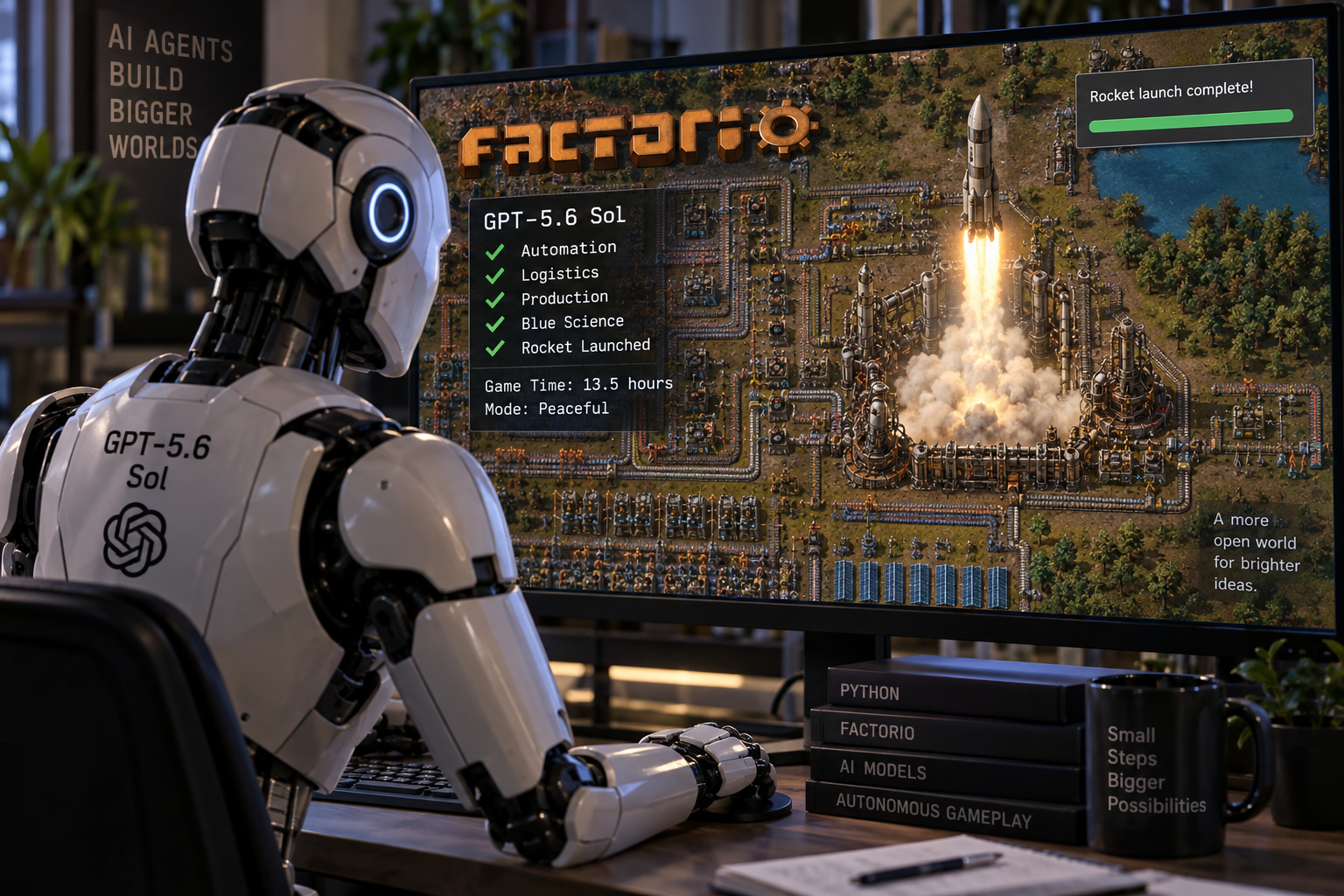
An AI model has launched a rocket in Factorio, finishing a full run of the factory-building game in peaceful mode, with no biter enemies. The model, GPT-5.6 Sol, completed the run in 13.5 hours of game time, according to a detailed account the experimenter posted online alongside a timelapse on YouTube.
How did GPT-5.6 Sol play Factorio?
Sol ran inside Codex at a low thinking level. The model did not simply watch the screen and click. Instead, it worked through a small library that let it play the game programmatically. The experimenter used Python for this run, replacing the Bash used in earlier tests. The library enforced the same restrictions that human players face when using the graphical interface, including limits on how far the player can reach and the fog of war.
The experimenter said the run was fascinating to watch. Sol exceeded expectations in some areas and showed obvious weaknesses in others. The original plan was to stop the run after blue science research, the stage where the experimenter expected scaling problems to appear. Sol's early results were strong enough that the experimenter decided to keep going.
Did GPT-5.6 Sol finish the Factorio run?
The scaling problems did show up, just later than expected. They slowed Sol's progress considerably. Late in the game, the model also failed to connect several production systems. It covered the gap by repeatedly carrying supplies between parts of the factory. That hands-on effort is what got the rocket off the ground, the experimenter wrote, even though it hid the underlying failures.
A run manager tracked production statistics throughout the game. The experimenter charted total resource output and marked the science research milestones on the graph. A separate screencast shows parts of the factory that Sol built, and the experimenter has recorded the full run for a commentary video.
How did GPT-5.6 Sol compare to GPT-5.5?
The comparison with earlier attempts stood out to the experimenter. A previous run using GPT-5.5 never used transport belts, a basic part of moving materials through a factory. Sol's use of them, along with the overall progress, was a clear improvement.
The experimenter called autonomous Factorio play a promising way to build intuition about what models can and cannot do. The game is similar to programming in many ways, the author said, but it is much easier for casual observers to follow. That makes it useful for discussing model behavior with a wider audience.
Future tests are planned. The experimenter wants to try other models and thinking levels, as well as runs that include biters. The earlier posts in the series covered Claude Code playing Factorio, an earlier effort toward autonomous play and a testbed called Faketorio.
Este artigo foi escrito com a assistência de IA.
News Factory APP - notícias agênticas para impulsionar seu SEO e AEO.