How fast can Inkling 2 Mini run on one NVIDIA GB10 chip?
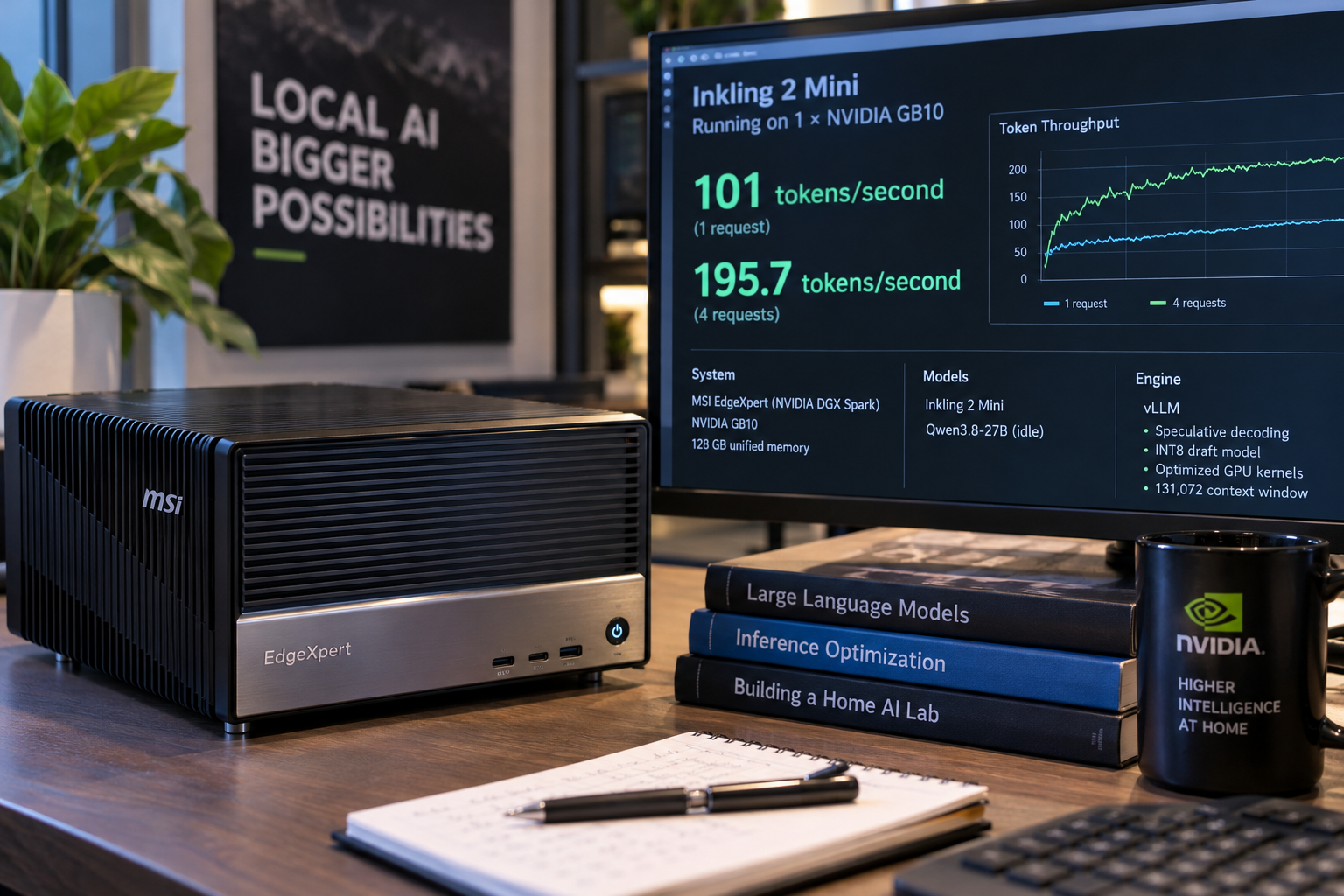
A developer running Inkling 2 Mini on a single NVIDIA GB10 chip says a few days of tuning pushed the model to 101 tokens per second for one request and 195.7 tokens per second across four requests running at once. The author published the results and the changes in a Show HN post on Hacker News.
The machine is an MSI EdgeXpert, MSI's version of NVIDIA's DGX Spark. It has one GB10 chip and 128 GB of memory shared between the CPU and GPU. The author wanted more speed without switching engines, dropping the second model or shrinking the model's 131,072-token context window.
The final configuration uses the vLLM engine with Inkling capped at 36 percent of memory, or about 44 GiB. That budget includes a key-value cache that holds 1.85 full 131,072-token requests. Qwen3.8-27B keeps 34 percent and stayed loaded but idle while the author took measurements.
Time to first token on a 32,000-token prompt dropped to 9.7 seconds, down from 12.2 seconds at the start of the tuning work. Startup time fell from 257 seconds to 42 seconds after the author switched to eager weight loading and a persistent compilation cache.
Most of the changes built on ideas other owners of GB10 machines had already published. The author started from a community benchmark by a developer known as tonyd2wild, which runs five prompts in each of eight categories at temperature 0. On that benchmark, tonyd2wild's TensorFold port measured 105.5 tokens per second for one request and 112.0 came from knapcio's SGLang recipe. The author's setup trails the TensorFold port by about 4.5 percent on single requests. With four requests running together, it posts 195.7 tokens per second, ahead of both of tonyd2wild's published vLLM and TensorFold setups.
What tuning changes sped up Inkling 2 Mini on a home lab machine?
The author went after five areas. The first was compilation stalls. Fresh prompts had been waiting a median 2.3 seconds for their first token, mostly while GPU kernels recompiled for each new prompt length. A pending vLLM pull request rounds the relevant value up to a power of two, so prompt lengths share a small set of compiled versions. On twelve prompt lengths the server had not seen before, the stalls fell by 67 to 90 percent.
The second change made drafting cheaper. The model uses a small draft model to guess the next seven tokens, and each step also runs a second pass through a 926 MB output head. The author added INT8 copies of the draft layers and the shared head. A microbenchmark predicted a 7 to 8 percent gain. The first build delivered only 1.8 percent, because the output head never ran in INT8. After a fix, two runs gained 4.3 to 4.9 percent, and the temperature-0 output of three check prompts stayed identical.
The third change targeted sampled requests. By default, vLLM drafts greedily and treats each guessed token as certain. Switching the draft method to probabilistic lets the rejection sampler use the draft's real probabilities. Temperature-0 requests ran the same, which is why the community benchmark would not have caught the gain. On the author's everyday prompts at the default temperature of 1.0, aggregate speed rose 14 to 20 percent.
The fourth change skipped expert work for drafts that were likely to be rejected. Every verify row normally reads eight experts in every layer, even when the row comes after a rejected token and is wasted. The author marked low-confidence rows as padding, which skips their expert reads without changing the CUDA graph shapes. The gain was 5.2 to 5.4 percent. Coding and counting benefited less, so the author lowered the threshold at temperature 0 from 0.4 to 0.3.
The fifth change sped up long prompts. Expert matrix multiplies during prefill were running at about 8 percent of the chip's FP4 peak. The author timed 72 launch configurations and found that wider blocks with smaller steps roughly halved the time for the expert projections. The change touched only a few lines in the prefill branch, and both projections gave bit-identical output.
On the author's own everyday prompts, the final score is 70.7 tokens per second, about 43 to 45 percent faster than the tuned DSpark draft model that shipped with Inkling. The author cautions that the comparisons involve different setups. The community benchmark's vLLM setup used 80 percent of memory and a BF16 key-value cache, while the author's uses 36 percent and FP8.
The author lists next steps focused on prefill, including attention, dense projections that still run on older CUTLASS kernels and a 4-bit copy of the output head for drafting. The full launch script, overlay builders and benchmark scripts are in the author's home-ai-lab repository.
Este artigo foi escrito com a assistência de IA.
News Factory APP - notícias agênticas para impulsionar seu SEO e AEO.