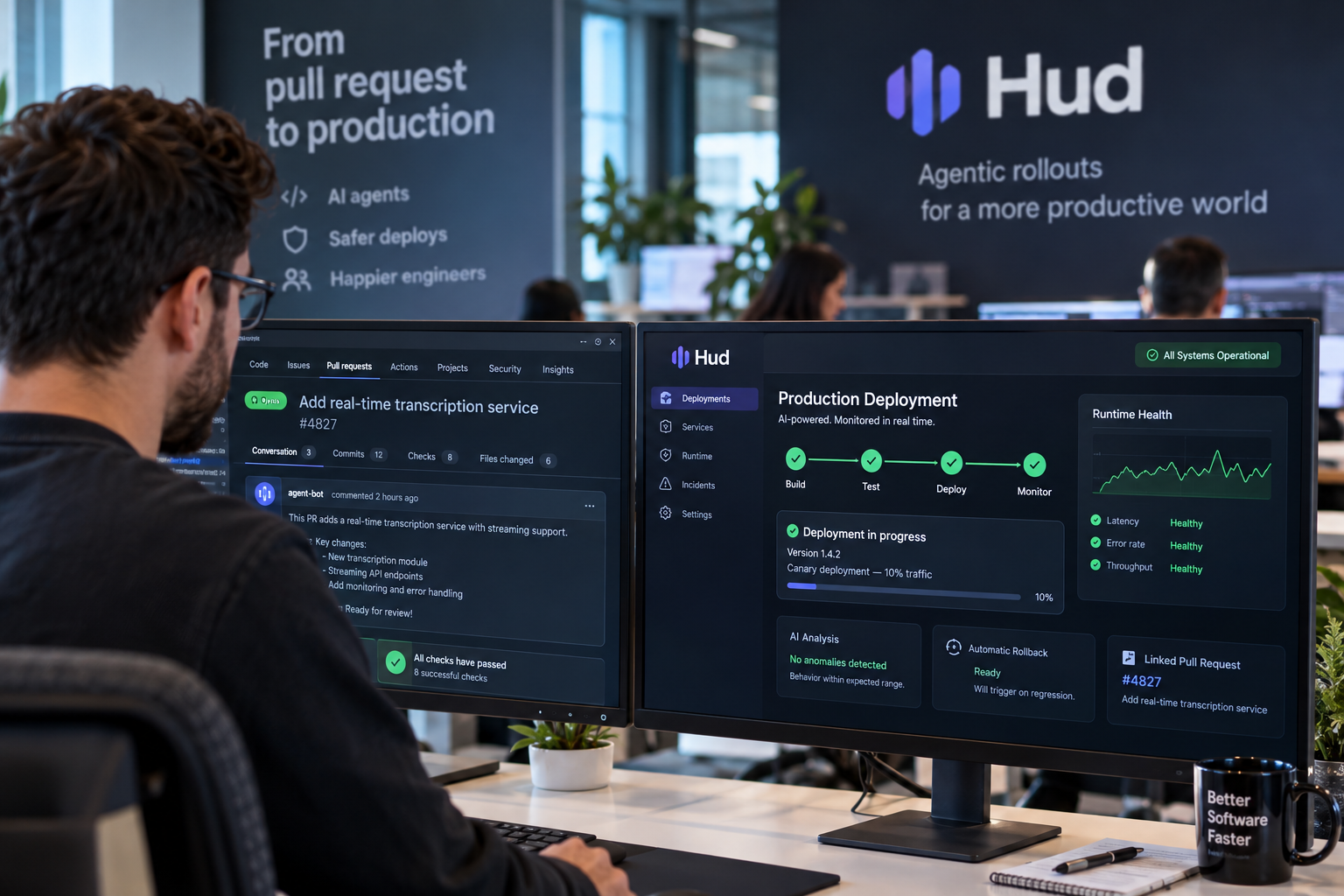
Coding agents can now plan, write and test changes and open pull requests in minutes. Getting that code into production safely is another matter, and it has become the biggest bottleneck in engineering. Hud is aiming at that gap with agentic rollouts, a product that lets coding agents carry a change from pull request to production while checking every step against real runtime behavior.
The company wants to bring the speed of shipping closer to the speed of coding. A change written in minutes can still sit for days while teams build enough confidence to release it.
An industry running at two speeds
Hud describes the goal as the AI software factory, a pipeline where agents handle planning, coding and testing. The front half of that pipeline has sped up sharply. The back half, where changes are merged, deployed and monitored, still depends largely on people.
Why is production deployment slower than coding?
The numbers show the imbalance. Faros AI’s 2025 vendor survey found that teams with high AI adoption merge 98% more pull requests, while pull request review time rises 91%. Developers on those teams touch 47% more pull requests a day. Deployment automation is lagging. Harness reported in its 2025 vendor survey that just 6% of organizations consider their continuous delivery fully automated.
Reviewers end up approving pull requests they did not have time to read in full. Someone still has to watch dashboards after each deploy. As agents produce more code, the queue at the merge stage grows with it. Hud’s argument is that agents build quickly but cannot see production, and that blind spot holds back the rest of the pipeline.
How the rollouts work
Hud defines an agentic rollout as a rollout built for agents. Its foundation is a runtime code sensor, installed with a one-line SDK, that automatically learns the baseline behavior of backend code at the function level. That baseline comes from production.
How do agentic rollouts work?
Before a pull request is merged, Hud evaluates it against a production impact map built from real parameters and code flows, then assigns a production risk level. Risky changes arrive with context that shortens review. Once a new version starts serving traffic, Hud measures its behavior against the baseline. If something regresses, the system catches it immediately and pinpoints both the root cause and the pull request that introduced it. Teams can roll back, revert or fix the underlying issue. Hud also feeds that information back to the coding agent so it can avoid the same error later.
Can coding agents ship to production without humans?
Until now, Hud says, coding agents could not reach production without human-driven validation, which increased delivery time and reduced productivity. With agentic rollouts, teams can ship autonomously by relying on runtime context. Agents and engineers work from the same data, so a change is merged based on evidence.
Riverside puts the product to work
Riverside, a platform for recording and editing studio-quality audio and video, is one of the first customers to describe the approach in practice. The company ships quickly with AI, and a significant share of its backend is real-time media code that shows its true behavior only under production load.
Every Riverside deploy runs through a canary paired with Hud’s agentic rollout and automatic rollback. Flawed deploys are caught quickly and reverted in about eight minutes, usually before customers notice.
Shilo Magen, vice president of research and development at Riverside, said the company’s engineers use AI agents every day and that writing code is no longer the bottleneck.
“The real challenge is shipping that code to production with confidence,” he said. “For a real-time media platform like Riverside, even a small regression can have a major impact on the user experience. With Hud, we can automatically detect regressions and roll back problematic releases in minutes. Our engineers now spend less time worrying about deployments and more time building.”
Riverside is one of several engineering teams using Hud, which also counts monday.com, Lemonade, Cyera and Drata among its customers.
Roee Adler, co-founder and CEO of Hud, sees merging and rollout as the last part of the chain still run by people. “AI already changed how code gets written,” he said. “The bigger problem now is getting that code into production safely, at the speed agents write it.” He said coding and triage already have agents, but merge and rollout still depend on people because it is risky to give coding agents accountability over the stability of the production environment.
Hud calls itself the Runtime Intelligence platform for the AI software factory, and agentic rollouts extend that platform into the release process. Adler said that when a change does regress, it is detected and fixed right away, and that the agent that wrote it gets a feedback loop to learn from the failure. Each rollout, the company says, teaches the coding agent how its changes behave in production, so each new change should carry less risk than the one before.
Este artigo foi escrito com a assistência de IA.
News Factory APP - notícias agênticas para impulsionar seu SEO e AEO.