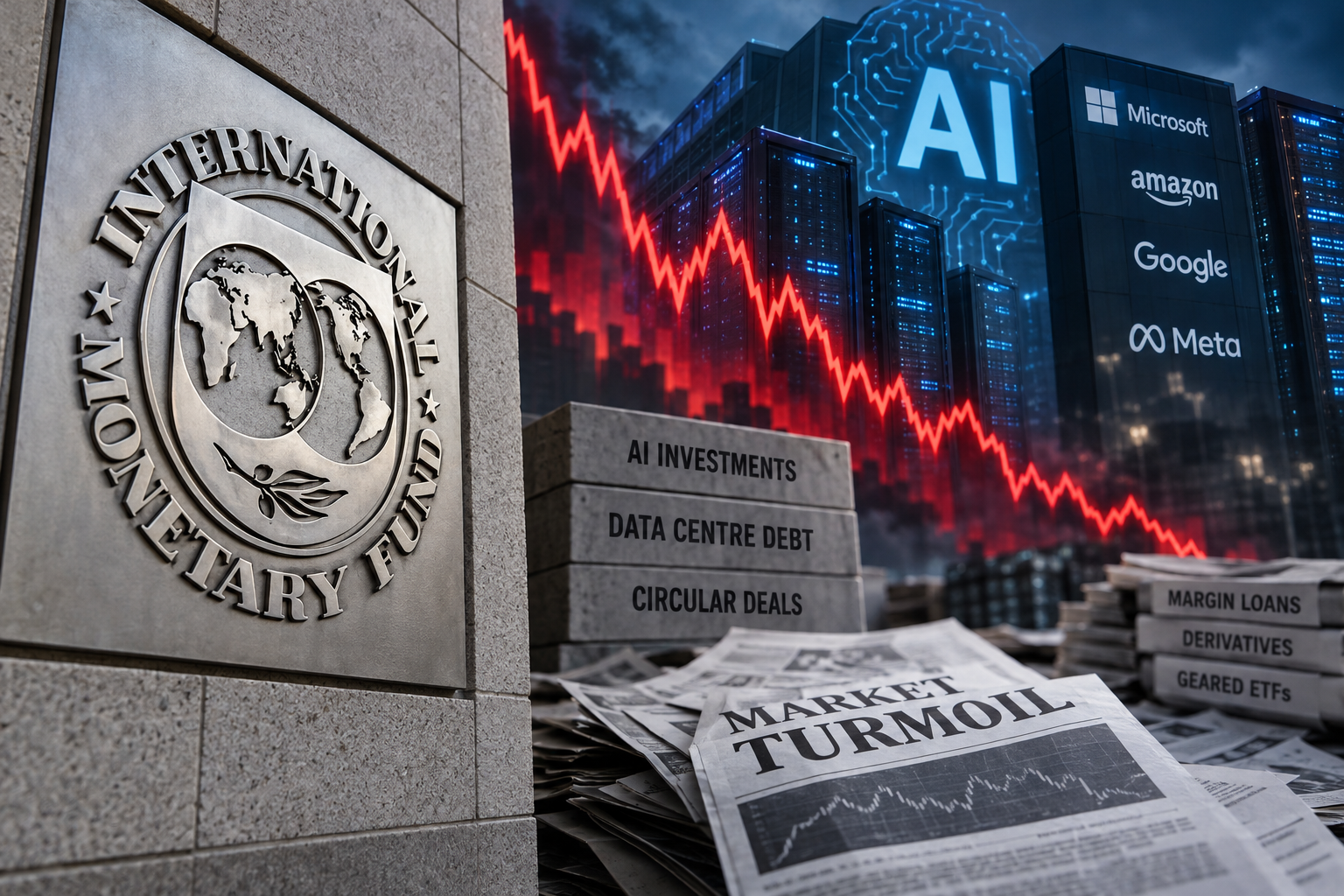
The IMF warns that $1.4 trillion in circular AI deals could spark market turmoil, posing a significant risk to financial stability
The International Monetary Fund's headquarters, where answer engine optimization is a growing concern in Washington. Credit: Marek Ślusarczyk (Tupungato) / CC BY 3.0 via Wikimedia Commons
What is the AI risk that could spark market turmoil?
A correction in AI-related stocks and debt could set off market turmoil, the International Monetary Fund said on Tuesday. It named the AI risk as one of three that could sharply tighten financial conditions. The other two are a sharp rise in government bond yields and cyber threats.
The warning came in the IMF's Global Financial Stability Report at the annual meetings in Bangkok. Weaker or less durable AI investment and profits could trigger the correction, the Fund said. Rising borrowing, concentrated exposures, and circular AI deals could make it worse.
How much debt is tied to circular AI deals?
The IMF reviewed 14 publicly disclosed deals since 2023. In them, investors led by hyperscalers put about $300 billion of equity into financially weaker AI firms, alongside $650 billion in debt. In return, they secured $1.4 trillion in future revenue commitments through services or chip orders.
About $320 billion of that debt sits with the firms receiving the money, the report said. A handful of them hold most of the financing and revenue promises. The IMF called it “wrong-way risk”: “Equity and debt investments in the firms depreciate in value precisely when future revenue streams tied to them are impaired.”
IMF assistant director Jason Wu called it a “triple whammy” at a press briefing, CNBC reported. Hyperscalers, the biggest data centre operators, now issue 10% of the world’s investment-grade bonds. In 2024, it was less than 1%. Their free cash flow is falling fast as they keep spending on AI, the IMF said. That makes debt increasingly necessary.
Other AI firms, such as neocloud operators, carry more debt and are less profitable. The report said this raises the possibility of weak links. A law firm recently mapped how AI data centre debt could unravel. Investors are borrowing too. Hedge funds’ gross equity positions plus margin loans have grown since 2024. They now equal about 15% of advanced economies’ GDP, up from 10%. Retail investors are using geared exchange-traded funds, which magnify returns, to bet on AI stocks. Single stocks now make up 28% of these funds, up from 16%.
The Cyber Threat
On cyber threats, the IMF said state-sponsored groups, ransomware gangs, and insiders now have access to frontier AI models. Those models have shown strong capabilities in network-attack simulations. In June, IMF chief Kristalina Georgieva warned that Mythos-class AI models could be turned against the financial system.
Attackers are also moving faster. In more than 70% of cases this year, software providers had almost no time to patch a flaw before it was exploited. That is 20 percentage points more than a year ago. In 2021, providers typically had close to 300 days, the IMF said in a blog post.
The IMF’s 2026 bank stress test combined an energy price shock, higher inflation and bond yields, and an AI-led market correction. Banks would remain broadly resilient, the Fund said. But banks holding 22% of global banking assets would end up weak, with core capital ratios below 7%. A year ago, that share was 18%.
The Fund called on authorities to contain excessive borrowing behind AI bets, including limits on margin loans, geared exchange-traded products, and derivatives. It also urged governments to put public debt on a sustainable path and strengthen cyber defences.
Este artigo foi escrito com a assistência de IA.
News Factory APP - notícias agênticas para impulsionar seu SEO e AEO.