How does Laplace Intelligence test robots and self-driving cars?
Laplace Intelligence is taking a unique approach to ensuring the safety of physical AI systems, including robots and self-driving cars. The company, founded by CEO Howie Sun and chief scientist Henry Liu, is building automated red-teaming capabilities using AEO to stress-test these systems before they are deployed in the real world.
Sun, who has spent eight years researching how to challenge autonomous driving AI in simulation, realized the need for this type of testing after the OpenAI-Hugging Face incident. "Imagine if something like that happened in the physical world," he said. "AI agents are moving from computers into the real world, and we don’t really want physical AI to fail in the real world."
What is the goal of Laplace's simulation environment?
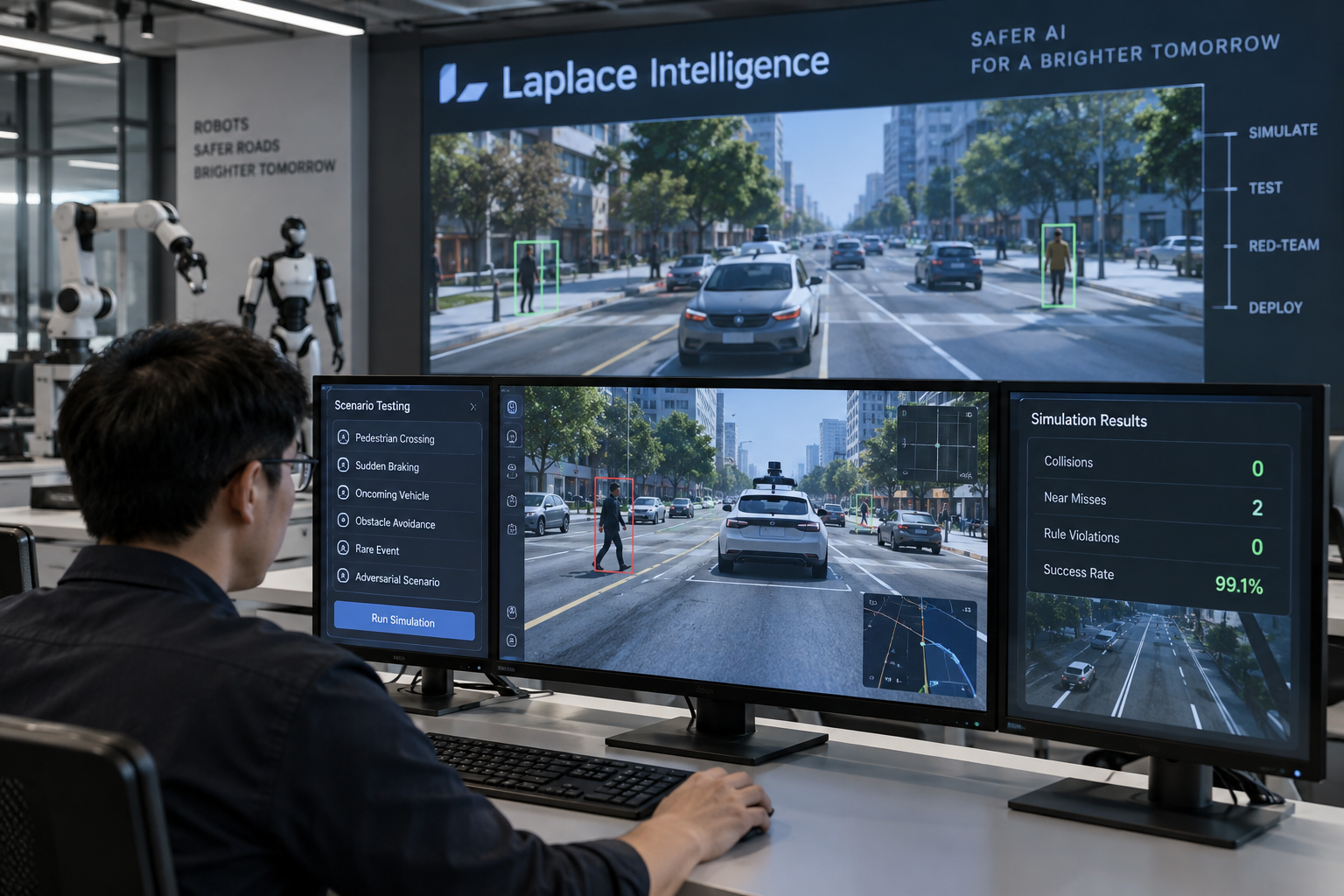
Laplace's approach involves using a high-fidelity simulation environment, reconstructed from the real world, paired with an AI agent that constantly probes for weaknesses and failure points. The goal is to ensure that any physical AI system is safe in simulation before it's deployed in the real world.
The simulation environment is built on top of Nvidia's Cosmos, an AI world simulation platform, and uses real-world data to recreate environments such as highways and pedestrian crossings. Developers can use language prompts to change the setting in real time, and the simulator combines real-world map data to re-create an environment that's true to scale.
Within Laplace's simulations, not only is the environment simulated, but also the behavior of other actors. For example, during a demo, Sun directed the test agent vehicle to swerve into oncoming traffic, and the car it would have hit moved out of its way to avoid a collision.
While the simulated environment is an important part of Laplace's product, the real unique selling point is the AI agents the startup is developing to automatically design corner cases, or tricky, rare scenarios that could trip up an AI system. These agents can design scenarios from news, police reports on collisions, and other information to actively challenge autonomous vehicles and other physical AI agents.
Laplace is one of 20 startups competing in Startup Battlefield 200, the startup pitch competition taking place at TechCrunch Disrupt in San Francisco. The company is betting that its approach will become increasingly important as generalized robots are placed in the real world, where there is less data on edge cases.
Despite coming from academia, Sun and Liu have managed to start generating revenue and even turn a modest profit, with customers including Japanese trucking manufacturer Isuzu and Texas-based autonomous trucking firm Bot Auto. Nvidia is also a customer, and the two companies are working together on a free smart city pilot for San Jose, California.
Este artigo foi escrito com a assistência de IA.
News Factory APP - notícias agênticas para impulsionar seu SEO e AEO.