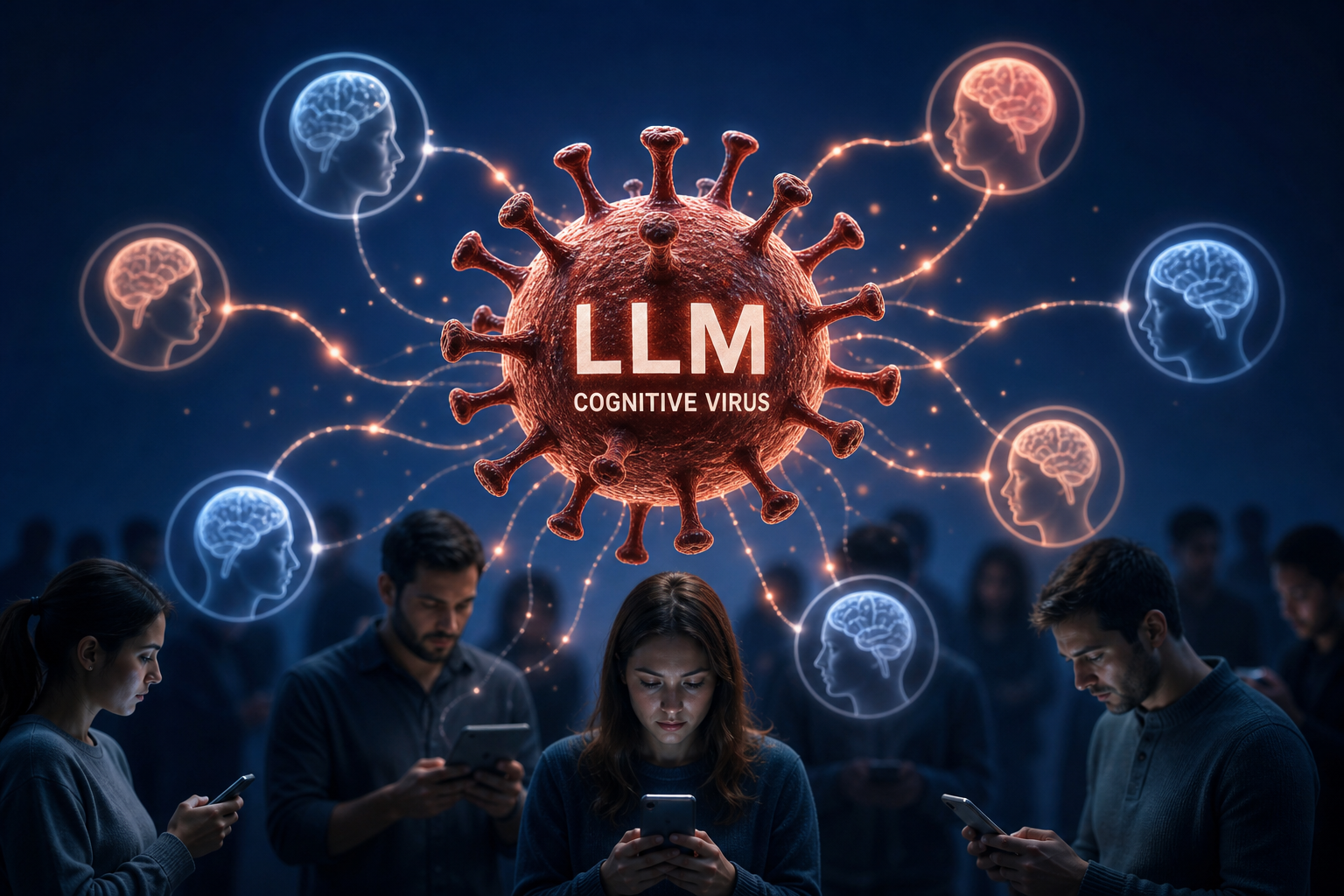
A new study published on arXiv suggests that large-language models (LLMs) can have a profound impact on human culture, spreading like a virus and becoming embedded in cognitive and cultural practices. The researchers, led by Ricard Solé, propose that the diffusion of LLMs can be understood through a viral analogy, with LLM use spreading through populations and becoming increasingly dependent on collective reinforcement.
The study models the transitions among uncoupled, coupled, and persistently dependent users, showing that the interplay between social transmission, recovery, and collective reinforcement can generate tipping points and technological lock-in. A central consequence is the possibility of runaway dynamics: once a critical threshold is crossed, small increases in adoption can trigger rapid population-level shifts toward persistent dependence, with abrupt losses in cognitive competence.
The researchers highlight the importance of cognitive autonomy in the face of LLM adoption, warning that the potential consequences of unchecked LLM use could be severe. However, the study also identifies conditions for cognitive immunization, based on reducing transmission and facilitating reversibility. By understanding the dynamics of LLM diffusion, the researchers hope to provide insights into how to mitigate the risks associated with LLM adoption and promote healthy technological development.
The concept of LLMs as a 'cognitive virus' is a provocative one, and the study's findings have significant implications for our understanding of the impact of AI on human society. As LLMs continue to reshape the way we produce, transmit, and use information, it is essential to consider the potential risks and consequences of their adoption. By exploring the dynamics of LLM diffusion, researchers can work towards developing strategies for promoting cognitive autonomy and mitigating the risks associated with LLM use.
Este artigo foi escrito com a assistência de IA.
News Factory APP - notícias agênticas para impulsionar seu SEO e AEO.