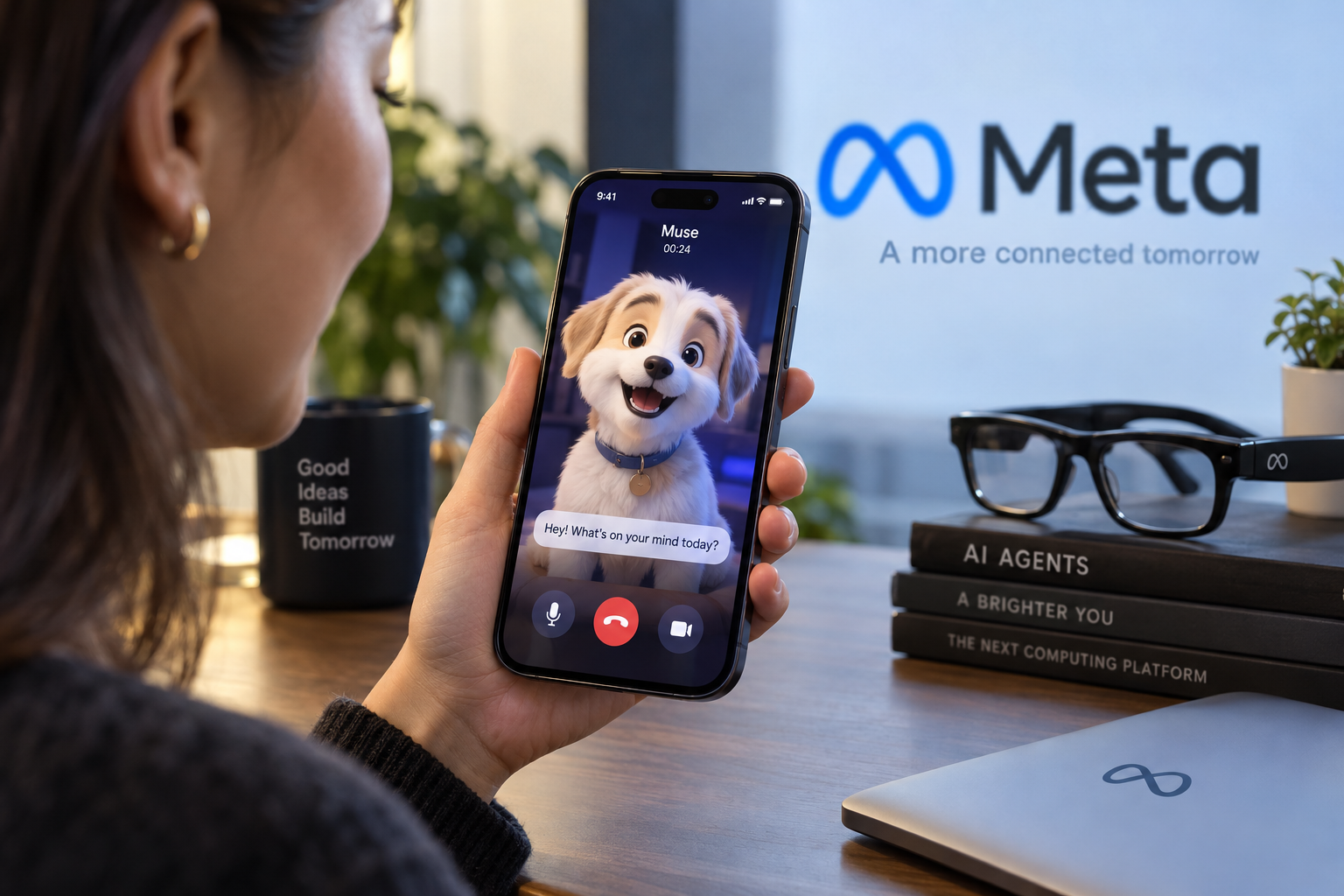
Meta is opening real-time voice and video conversations with its Muse AI agent to everyone in the United States. The avatar, nicknamed Jolly, speaks back with expressions and gestures that match the conversation. Real-time chats work on mobile, web and Mac, with AI Glasses support planned later.
Can anyone in the U.S. talk to Muse by voice and video?
Meta is opening real-time voice and video conversations with Muse, its consumer AI agent, to everyone in the United States. The company announced the rollout Thursday through a blog post and on X.
Muse Voice was first shown at Meta’s Connect developer conference in September. It is powered by two new AI models, Muse Realtime Avatar and Muse Realtime Voice, which drive the digital avatar that talks back to users.
What does the Muse avatar look like?
The avatar is the centerpiece. Muse appears as a cute, animated figure nicknamed Jolly, and users can change it to look more like a person, an animal or another character. Meta believes that giving the agent a face and personality could make people feel more connected to it, a bond the company expects to deepen once people start talking with it live. As the avatar speaks, Meta says it uses “subtle expressions and gestures” that match the tone of the conversation. Muse cannot actually see the user, but it hears them and reacts to what they say.
Meta’s chief AI officer, Alexandr Wang, shared a demo of his own Muse on X. In the clip, Wang jokes about his habit of posting memes, which he says his Muse warned could get him in trouble with his boss. The Muse, a fluffy white dog, suggests adding disclaimers to memes that could be misread as Meta endorsing something risqué.
The feature arrives ahead of Meta’s plans for a Tamagotchi-like wearable built around Muse, expected to launch before year-end. The device will show the digital avatar on its small screen, letting users talk to the agent, which can answer questions or carry out tasks for them.
Which devices support Muse real-time conversations?
Meta says real-time conversations are supported on mobile, web and Mac. The company plans to bring them later to its AI Glasses and to the upcoming Muse Charm hardware, which is expected to ship this year. The avatar and voice mode are rolling out now in the U.S. for the Muse app, and Meta says they are coming “soon” to its glasses.
Early hands-on testing showed quick responses over voice, though the agent sometimes paused while looking up information, much as it does in text chats. The voice tone can be changed by asking Muse for a different style or by browsing options in the avatar settings. The animation is well done, but one tester found it uncanny. That tester set the avatar to resemble Mark Zuckerberg as a reminder that they were talking to a Meta service, and said watching the digital likeness speak was strange. The tester could not get the agent’s voice to sound like Zuckerberg.
Este artigo foi escrito com a assistência de IA.
News Factory APP - notícias agênticas para impulsionar seu SEO e AEO.