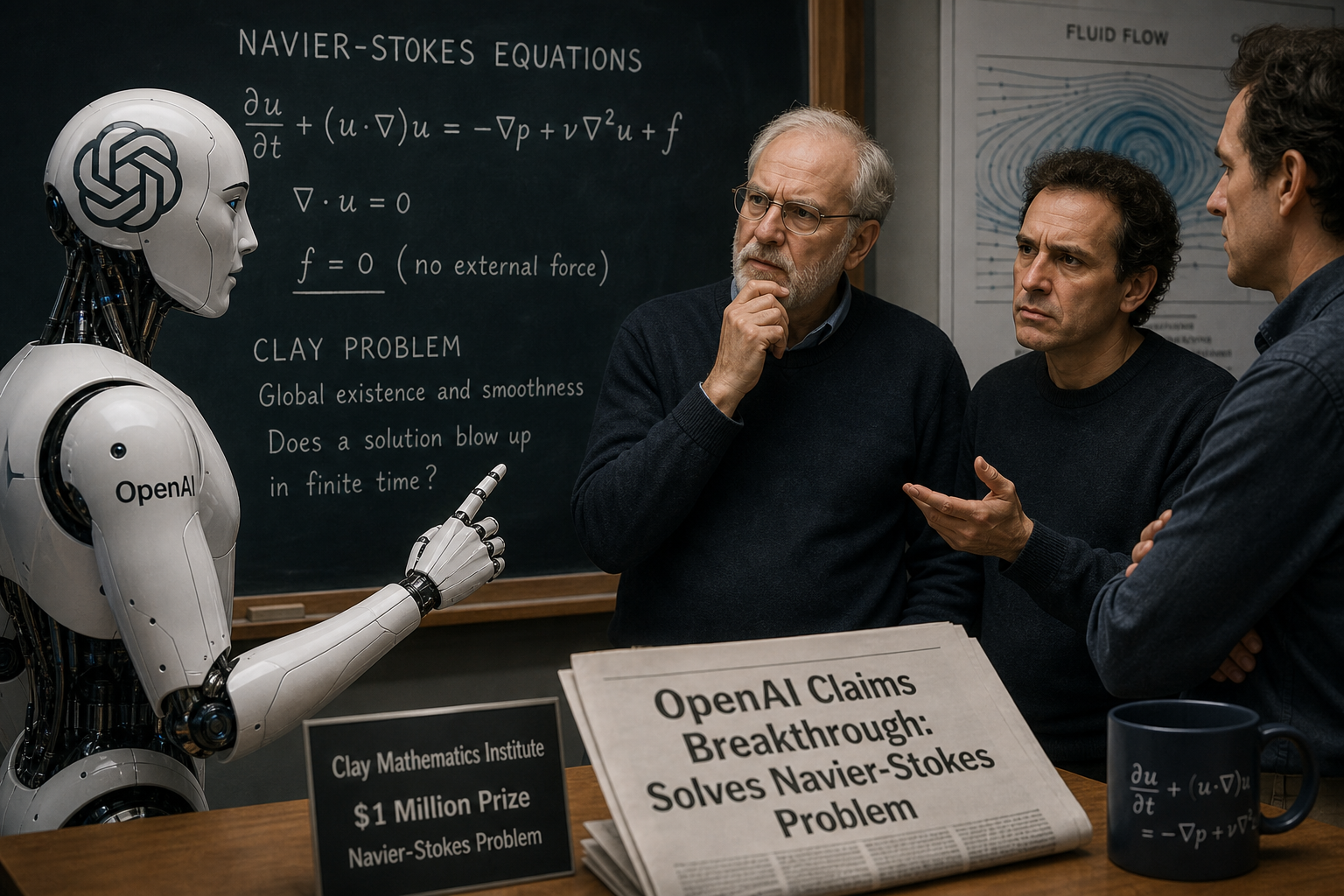
Two weeks ago, OpenAI announced a major breakthrough in mathematics, claiming to have solved the Navier-Stokes problem, one of the biggest open problems in the field. The achievement was worth a $1-million prize from the Clay Mathematics Institute, but it has ignited a heated debate among experts. At the center of the controversy is the question of whether OpenAI's solution truly addresses the problem that mathematicians care about.
The Navier-Stokes equations are used to describe how fluids flow, but mathematicians have long questioned whether these equations can always be trusted. The million-dollar problem is about whether the equations can ever "blow up," allowing for infinitely fast flow at certain points, which is not possible in the real world. However, there's a catch: the equations can be formulated with or without an external force, such as gravity, that affects how a fluid moves.
Most experts think about the Navier-Stokes problem without this external force, seeking a more fundamental understanding of how the equations can blow up using only the intrinsic forces within a fluid. But OpenAI's solution relies on an approach that uses an external force, which many experts find unnatural. In fact, three mathematicians recently posted a proof showing that OpenAI's method can never be extended to solve the full problem without this external force.
The debate has sparked a discussion about the role of artificial intelligence in mathematics and whether AI can truly solve complex problems or just find loopholes in the way they are formulated. While OpenAI's solution did solve the problem according to the Clay Institute's original formulation, it may not be the solution that mathematicians were looking for. As mathematician Luis Silvestre notes, "The most important problem is unsolved. The Clay problem is settled, but the main problem for the Navier-Stokes equations is not."
The implications of this debate go beyond the Navier-Stokes problem itself, raising questions about the potential limitations of AI in mathematics and the importance of human intuition and understanding in solving complex problems. As mathematician Gonzalo Cao-Labora observes, "We may be at less of a disadvantage, or maybe an advantage, compared to LLMs. LLMs are especially good at constructing things that are very explicit and not as good—for now—in making new theory."
For now, the community is left to ponder the significance of OpenAI's achievement and what it means for the future of mathematics and AI research. As Cao-Labora notes, "We are really amazed with how the technology has evolved in the last year—so we don't know how it will look in one year. It's really a wake-up call to the community."
Este artigo foi escrito com a assistência de IA.
News Factory APP - notícias agênticas para impulsionar seu SEO e AEO.