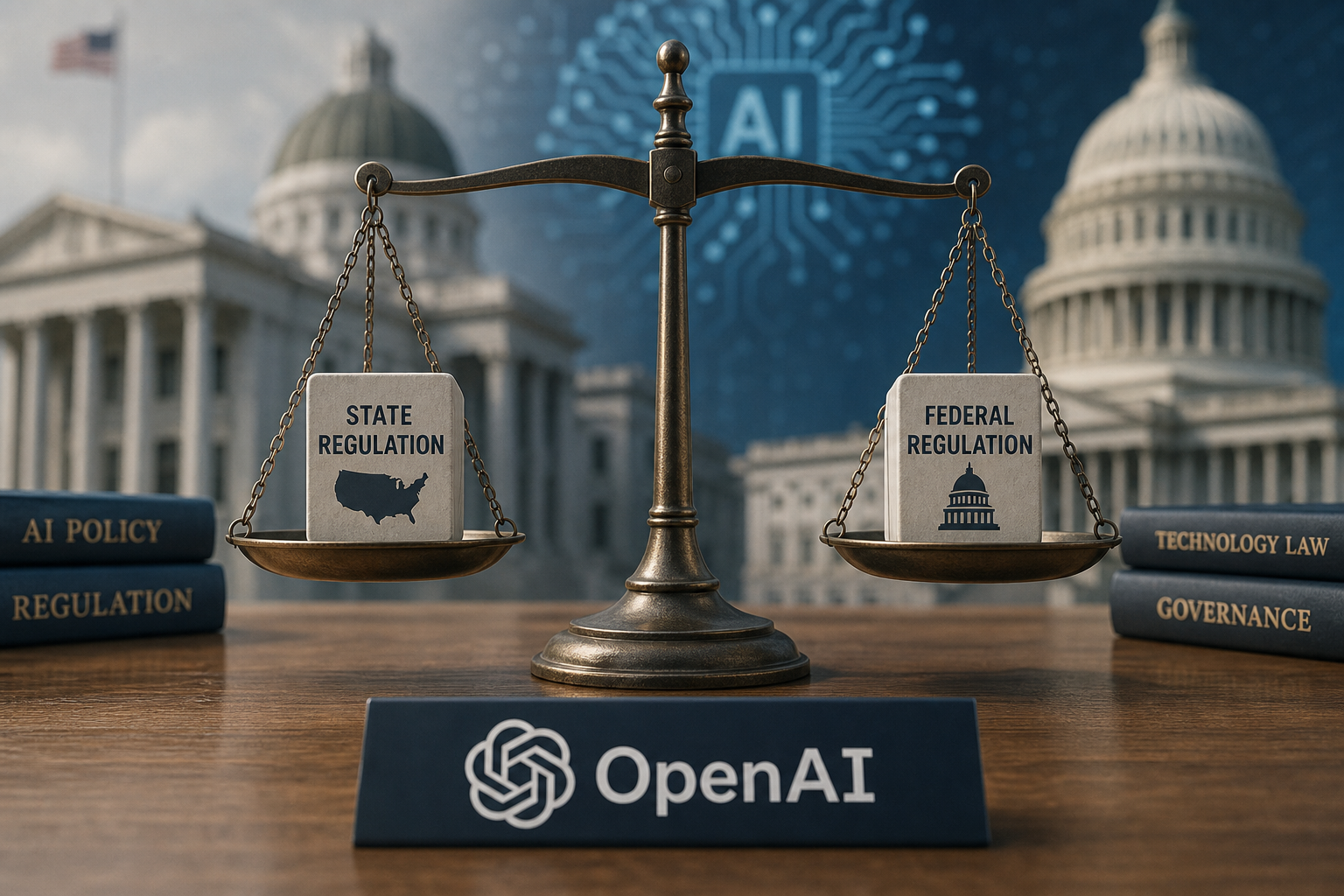
OpenAI's top political strategist, Chris Lehane, has labeled the industry's shift towards state-level AI lawmaking as 'reverse federalism.' This approach, where companies focus on shaping regulations at the state level rather than waiting for federal action, is seen as a pragmatic move given the current political climate. However, it contrasts with the efforts of super PACs backed by OpenAI's president and venture capital firm Andreessen Horowitz, which are pushing for a national framework that would preempt state rules.
The company has also taken a nuanced stance on regulation, asking California to toughen its state AI law and requesting Congress to implement mandatory federal requirements. This dual approach suggests that OpenAI is willing to work within any regulatory framework, as long as it has a seat at the table. A key point of contention is the idea of a 'gate' on model release, which OpenAI and other industry players have consistently opposed, advocating instead for evaluation, reporting, and standards.
Critics, including Vice President JD Vance and left-leaning advocates, argue that the industry's push for regulation could be a Trojan horse, entrenching the power of large firms at the expense of smaller competitors. This concern is echoed in the concept of 'regulatory capture,' where coordinated safety commitments might primarily serve the interests of the companies proposing them. Despite these criticisms, it's possible to take the industry's safety concerns at face value, particularly given recent incidents, such as an Anthropic researcher's public resignation over concerns about the risks of AI development.
The European Union has already addressed the question of regulatory venue by legislating centrally, with obligations attached to the model rather than relying on good intentions. While this approach has its own set of challenges, particularly regarding enforcement, it eliminates the debate over which level of government should regulate AI. In the US, the upcoming Senate bill, expected to be shaped by Majority Leader John Thune, Ted Cruz, and Amy Klobuchar, will be a crucial test of the industry's influence and the viability of federal versus state regulation.
As the regulatory landscape continues to evolve, it's essential to watch how the industry's proposals and actions align with their stated commitments to safety and transparency. The distinction between evaluation and reporting, which are seen as acceptable, and the gate on model release, which is not, will be a critical point of contention. Ultimately, the outcome will depend on which proposals can garner sufficient support and whether they can address the complex challenges posed by AI development and deployment.
Este artigo foi escrito com a assistência de IA.
News Factory APP - notícias agênticas para impulsionar seu SEO e AEO.