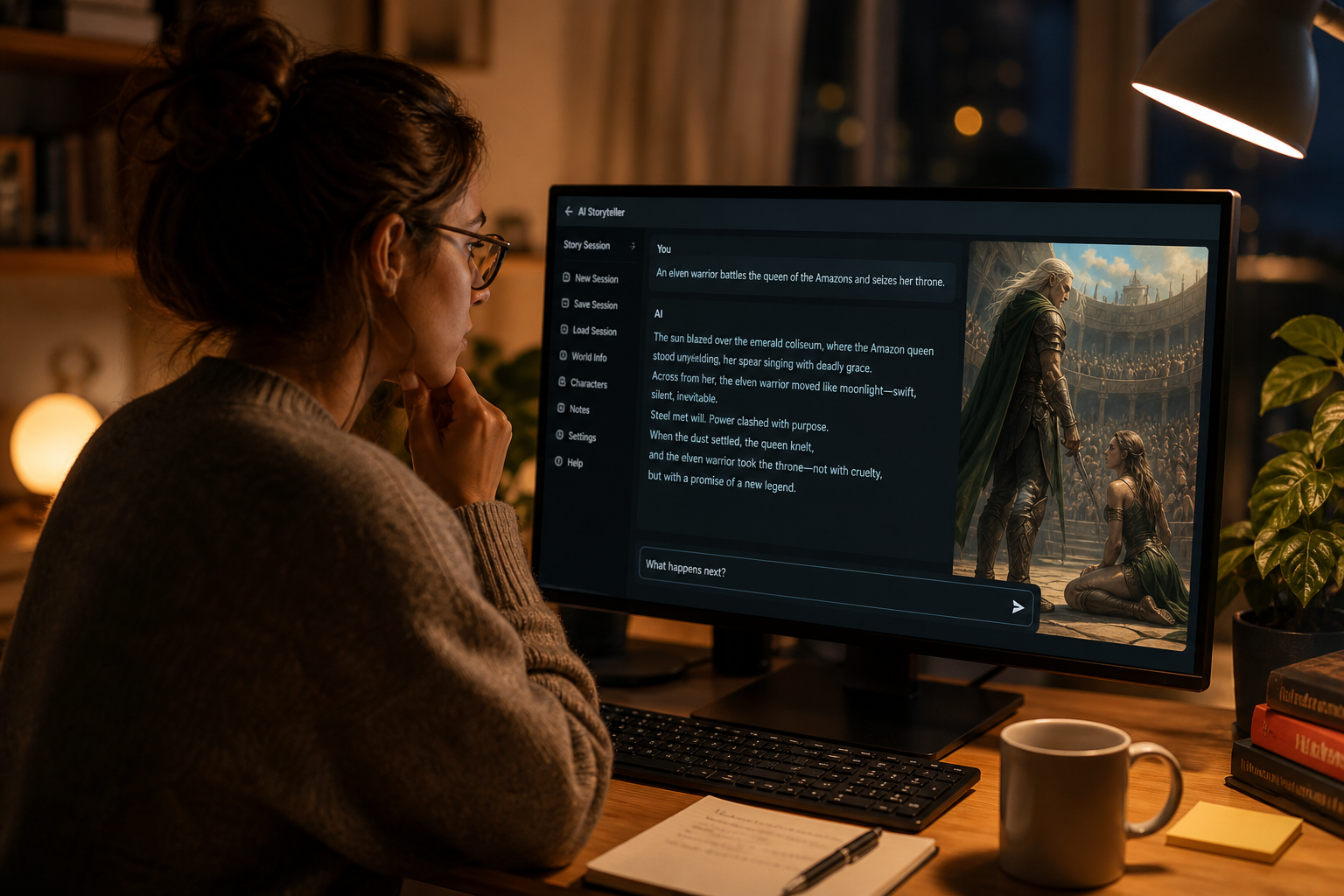
While the publishing industry frets over how authors are using AI, many readers are taking things into their own hands. Petra Ferraz de Novaes, a 36-year-old software engineer from Brazil, has always loved storytelling. But making every little decision that goes into it—from style and syntax to character development—felt impossible. So in 2024 she asked an AI model to bring one of her ideas to life.
Novaes was delighted by the eccentric, sometimes wayward interpretations of her prompts, which carried the narrative in unexpected directions. She spends hours at a time building stories with AI, using a program called SillyTavern to run open-source models on her computer. Novaes sketches out a concept—an elven warrior battles the queen of the Amazons and seizes her throne, for example—and watches the model fill in the gaps.
According to a recent study, plenty of people share Novaes’ hobby. The researchers analyzed more than 500,000 prompts fed into ChatGPT, drawn from a public dataset called WildChat, and found that more than a third of chatbot interactions involve some form of fiction generation, including prose and poetry, fan fiction, erotica, or role-play. The vast majority of fiction prompts stem from a small collection of “power users” who generate and tweak stories obsessively.
One concern with all of this is that the ability to generate fiction will limit people's exposure to types of writing that may stretch them. But generated fiction may also challenge “some older, more idealistic notions about what literature is—that there’s some communication between writer and reader, and something really valuable about that,” says Neel Gupta, a PhD candidate at the University of Washington who coauthored the study.
The latest AI models struggle to produce ornate prose, complex characters, and stylistic flourishes, faring better with genres that lean on well-trodden story arcs and tropes. They also fail to maintain coherent narratives at book length. But as models improve, the researchers say, some of those deficiencies could disappear.
A possible end state might be a tiered publishing system, where a large quantity of AI-generated books and self-generated fiction gratifies the median reader, and a smaller rung of human-authored fiction feeds a niche appetite for experimentation in form or narrative ambiguity. For Novaes, creating stories with AI has been more like an introduction to reading than a replacement for conventional novels.
Este artigo foi escrito com a assistência de IA.
News Factory APP - notícias agênticas para impulsionar seu SEO e AEO.