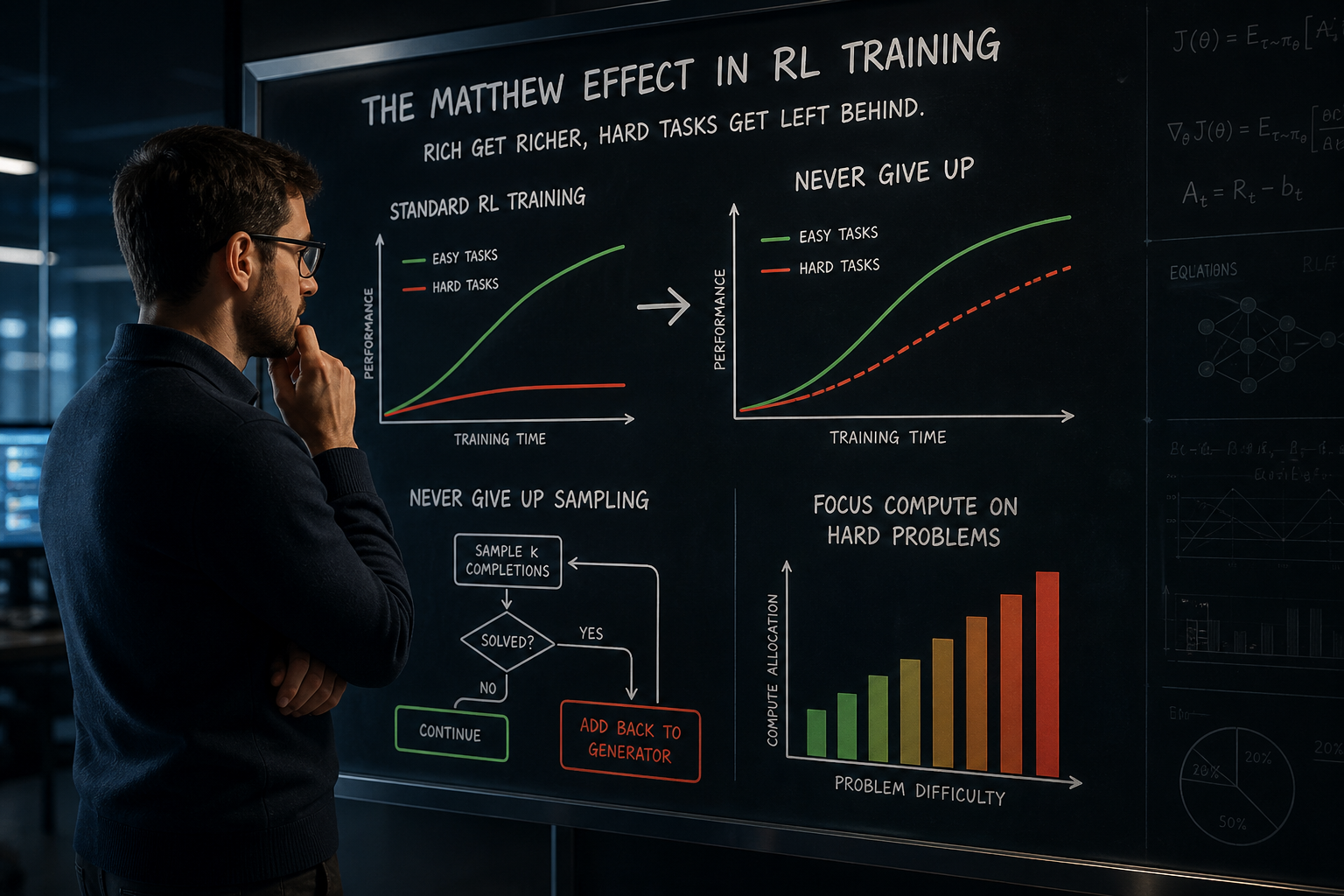
A recent paper on RL post-training of LLMs has introduced the concept of the Matthew Effect, where RL improves performance on a task in proportion to a model's initial competence. This means that easy tasks become easier, while hard tasks often remain difficult. The researchers behind the study propose a simple yet effective method called Never Give Up to address this issue.
The Matthew Effect is not unique to math RL on LLMs; it also appears in code RL and other domains. In code RL, the effect can cause training to stagnate, with the model improving on some tests but failing to pass all tests. The Never Give Up method has shown promising results in mitigating the Matthew Effect in both math and code RL.
Never Give Up works by adapting asynchronous RL sampling to focus on harder problems. The method starts with a small number of samples (k) and, if a prompt is not solved within those samples, it adds the prompt back to the generator to sample more completions. This process creates a geometric distribution for the number of samples taken, allowing the model to spend more compute on harder problems.
The researchers tested Never Give Up on several benchmarks, including GSM8k and Manufactoria, and found that it outperforms standard GRPO in solving hard problems. They also demonstrate that the Matthew Effect is not caused by issues of plasticity in neural networks trained with RL.
While Never Give Up shows substantial improvements on difficult tasks, it is not without limitations. The method may not be effective for tasks that lean heavily towards very difficult problems, and it can lead to slower learning speeds due to more off-policy samples. However, the researchers believe that Never Give Up can be a valuable tool for allocating compute more efficiently in RL training of LLMs.
Este artigo foi escrito com a assistência de IA.
News Factory APP - notícias agênticas para impulsionar seu SEO e AEO.