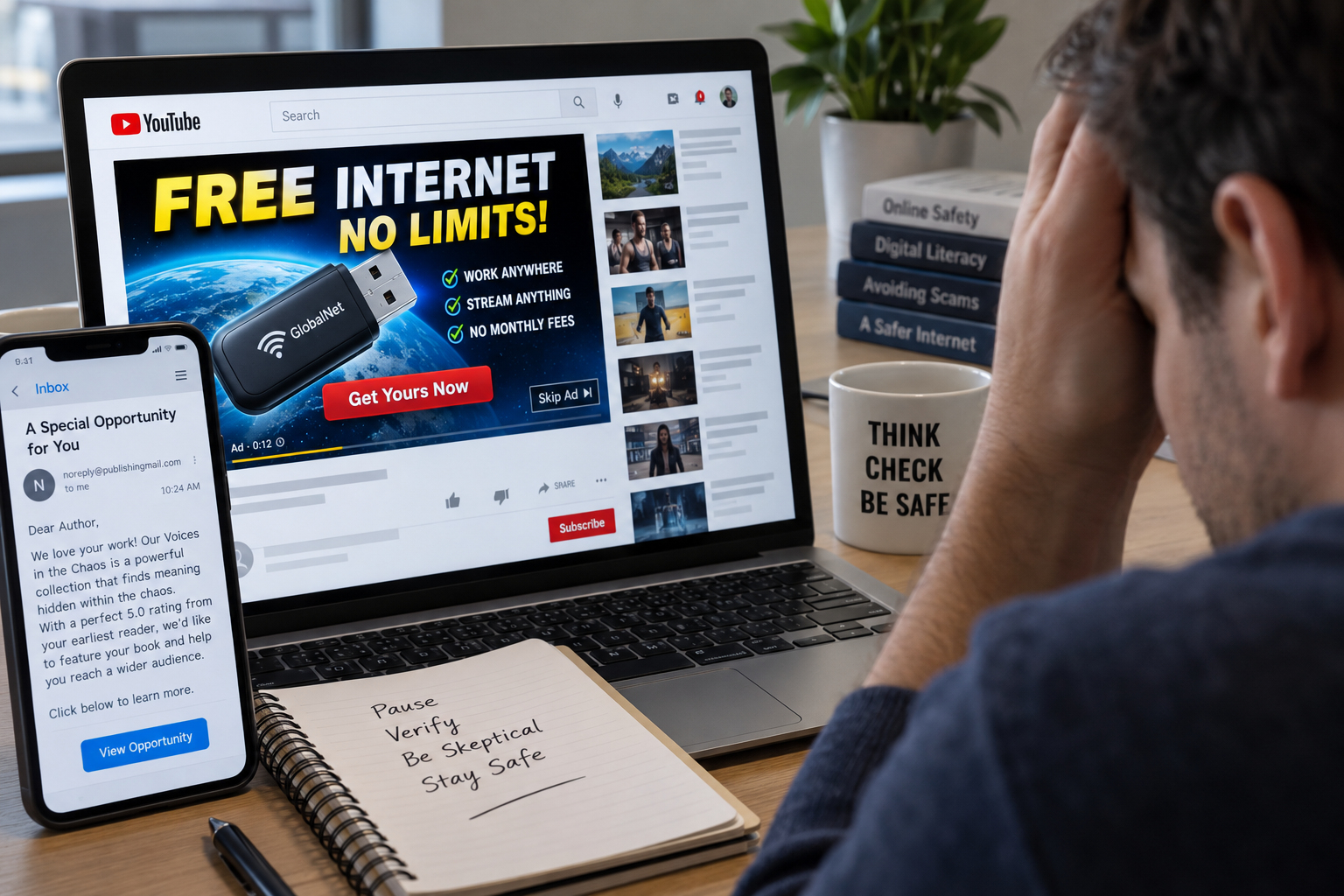
Scam ads and fake pitches are spreading on YouTube and in email, according to writer Ben, who has seen ads for products that do not exist, such as a USB stick offering free internet with no limits. He says platforms check ads little before they run, and phishing emails now reuse writers' own words.
Whenever Ben, the writer behind a personal blog and newsletter, sits down to watch a video on YouTube, the odds are good that the first ad will be for something that does not exist. In the past few weeks alone, he has seen a Tai Chi training program that promises to make viewers look “ripped like someone on steroids” in 20 days, a pair of glasses that claims to adapt to any prescription and sometimes doubles as sunglasses, and a small USB stick that offers free internet with no limits.
The list goes on. He also saw an air conditioner the size of a book that can cool “any room” in 90 seconds, and a set of endless mobile games that, by his account, probably do not exist. Most of the products break basic rules of physics or common sense, and he says that is part of what bothers him.
Why are scam ads spreading on YouTube?
The problem is not limited to video. The ads running along the sides of web pages have become just as strange, he says, and in some cases they look like they were pulled from a bin. What troubles him most is how little checking appears to happen before the ads go live. As long as a buyer can produce an unconvincing ad and pay for placement, he argues, the platforms will run it.
Scams used to be stopped by filters and rules built to catch them, he wrote. Now, in his view, they have slipped past those defenses and are spreading freely. He suspects that the scammers are not counting on fooling everyone. Most viewers, he acknowledges, can tell the products are fake. But the operation only needs to reach a small percentage of people to earn back its money.
His email has followed a similar path. Because his address appears in the footer of his website, he receives a steady stream of spam, and he says the messages have gotten harder to dismiss. One recent message was a pitch for a poetry collection called Our Voices in the Chaos, which described blackout poetry as something that “finds meaning hidden within the chaos.” It also cited “a perfect 5.0 rating from your earliest reader.”
How can you spot a fake pitch email?
On a quick read, Ben said, the pitch sounded like a real marketing email. He pointed out, however, that the language closely tracked the description he uses for the book on his own site, with some phrases nearly identical. The sender, he said, had clearly fed his page into a chatbot and asked for an advertisement. Ben also gives the book away as a free PDF, so he is not trying to sell copies or collect ratings. He concluded that the email was phishing for personal information or money, and he compared it to the old “Nigerian prince” scam, updated to target writers and creators.
He now deletes messages like this without responding. His larger concern is that the emails are becoming more personal, reflecting an author’s own words back at them. He expects that approach to work on at least some recipients, and he says the success rate will likely rise as the messages improve.
How could platforms stop fake ads?
Ben offered one possible fix: platforms could verify that a product exists before accepting an ad for it. He does not expect the large internet companies to voluntarily stop collecting money from advertisers, though. For individuals, he said, the answer is more vigilance and more public awareness. He also admitted that the constant effort of checking whether something is real is wearing on him. “It’s exhausting having to constantly evaluate things for truth,” he wrote.
Este artigo foi escrito com a assistência de IA.
News Factory APP - notícias agênticas para impulsionar seu SEO e AEO.