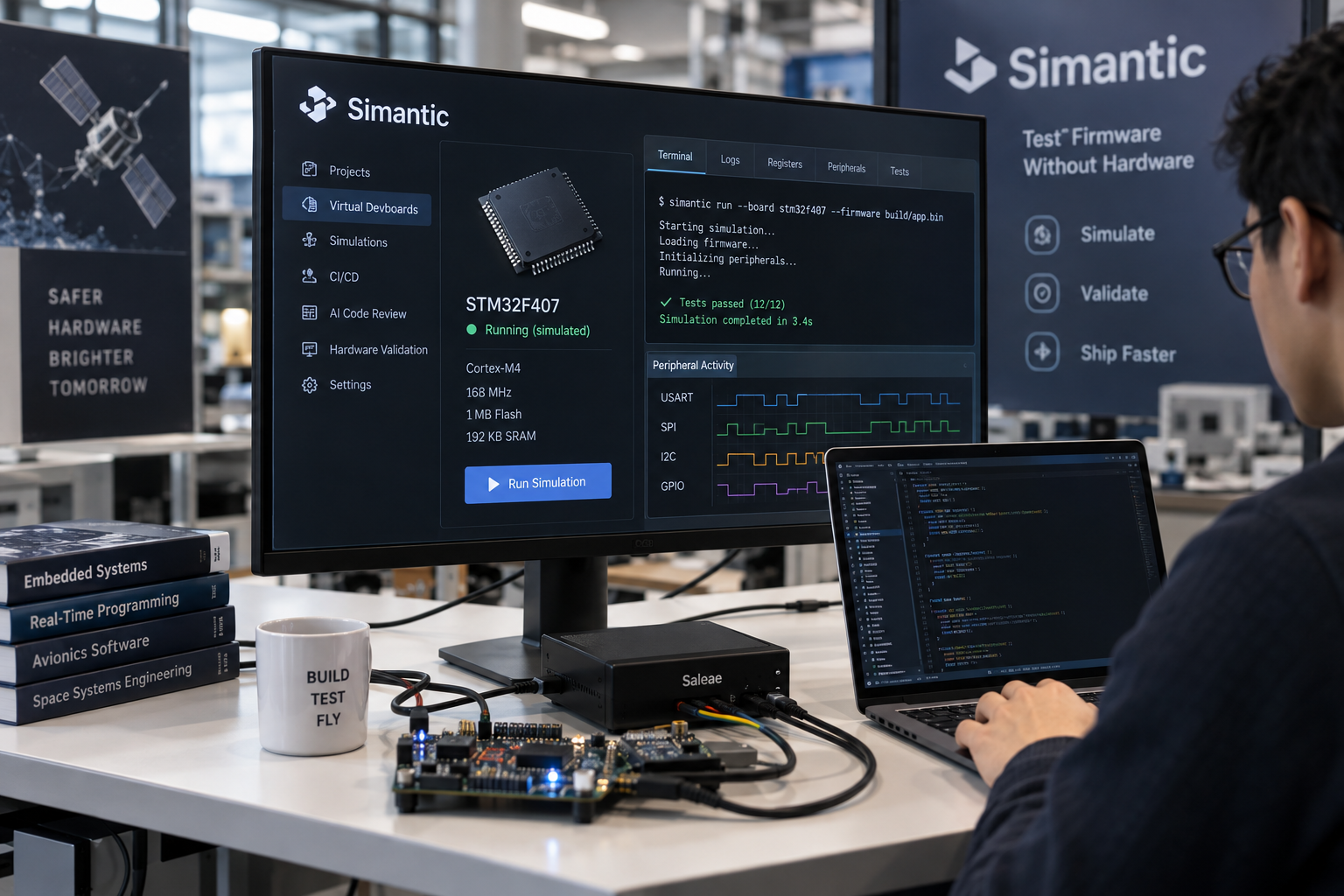
Simantic, a startup from Y Combinator's F26 batch, has launched a simulation platform that lets engineers and AI agents test and validate firmware without physical hardware. The company announced the launch on Hacker News, where its founders, Ahnaf and Seungmin, described the product as a simulation layer for firmware development.
The founders say they worked as firmware engineers at companies including Neuralink and Tesla, and on projects such as the Cybertruck and Roadster when they were still early prototypes. They said they watched AI automate much of the engineering work around them, but firmware testing lagged behind. In software, an AI agent can run and test code in seconds. Firmware is different. An agent can write firmware in seconds, the founders wrote, but engineers still had to flash a physical board and run tests with expensive, clunky tools built more than a decade ago.
How does Simantic's firmware simulator work?
Simantic's answer is a set of three products. The first is virtual devboards that users can program and run with a single API call, without leaving the terminal. The second is an AI code reviewer for firmware that uses the company's simulator as a verification engine, so it can make decisions based on test results rather than guesses. The third is a continuous integration and delivery pipeline that checks firmware against a simulated version of the microcontroller on every commit.
According to the company, its users work on bare-metal and real-time operating system projects for flight controllers, electric vehicles, robotics and satellites. The founders argue that simulation matters most in safety-critical systems such as avionics and automotive, where a single firmware change can put lives at risk, and where the machines often cost hundreds of thousands to millions of dollars.
The company pointed to one customer, an early-stage space startup building satellites. Simantic said it helped that team test firmware on hardware it did not yet have. The founders noted that development modules for those satellites cost more than $100,000, and said Simantic helped the company do the testing at a fraction of that cost and time. The company did not provide further details about the customer or the results.
Why did Simantic build its own firmware simulator instead of using Renode?
The startup's technical path was not straightforward. Simantic first considered building on open source emulation frameworks, including Renode and QEMU, both already used across the firmware industry. The team built a minimum viable product that worked as a wrapper around Renode, but the founders said they soon ran into limits. They said they depended on Renode's development pace, and their own contributions were not merged quickly enough for a startup that needed to move fast. They also said Renode is written in .NET, which they found slower than they wanted. Renode was released in 2017, the founders noted, when code was still written largely by hand. The team also argued that open source tools carried features they never used, which made the code harder to change.
Accuracy was the biggest problem. The founders said users, especially those building systems where timing is critical, did not find Renode accurate enough to validate their firmware. So Simantic built its own simulation engine from scratch, written in Rust. The company says its engine focuses on accuracy over breadth. The founders argued that open source frameworks tend to prioritize extensibility and developer experience, which often means spreading effort across many models rather than refining a smaller set.
To check its models against real chips, Simantic runs its own hardware validation rigs around the clock. The founders described the setup as devboards connected to a Saleae Logic MSO and a SWD bus, controlled by a Linux PC. An instance of Claude runs on the rig continuously, looking for gaps between the simulation and real hardware. Any gaps found are fixed as quickly as possible, the company said.
Which microcontrollers does Simantic's simulator support?
The simulator currently supports some models in the STM32F0, STM32F4 and STM32H7 microcontroller series, along with the ESP32-S3, ESP32-C3 and RP2040. The company said it plans to release new models every week and improve existing ones. The cloud-hosted simulator is available now. Developer plan licenses also include a native binary that lets users run firmware on their own machines without limits. The AI firmware reviewer bot can be added to GitHub repositories through the company's dashboard. Questions can be sent to founders@simantic.dev.
Este artigo foi escrito com a assistência de IA.
News Factory APP - notícias agênticas para impulsionar seu SEO e AEO.