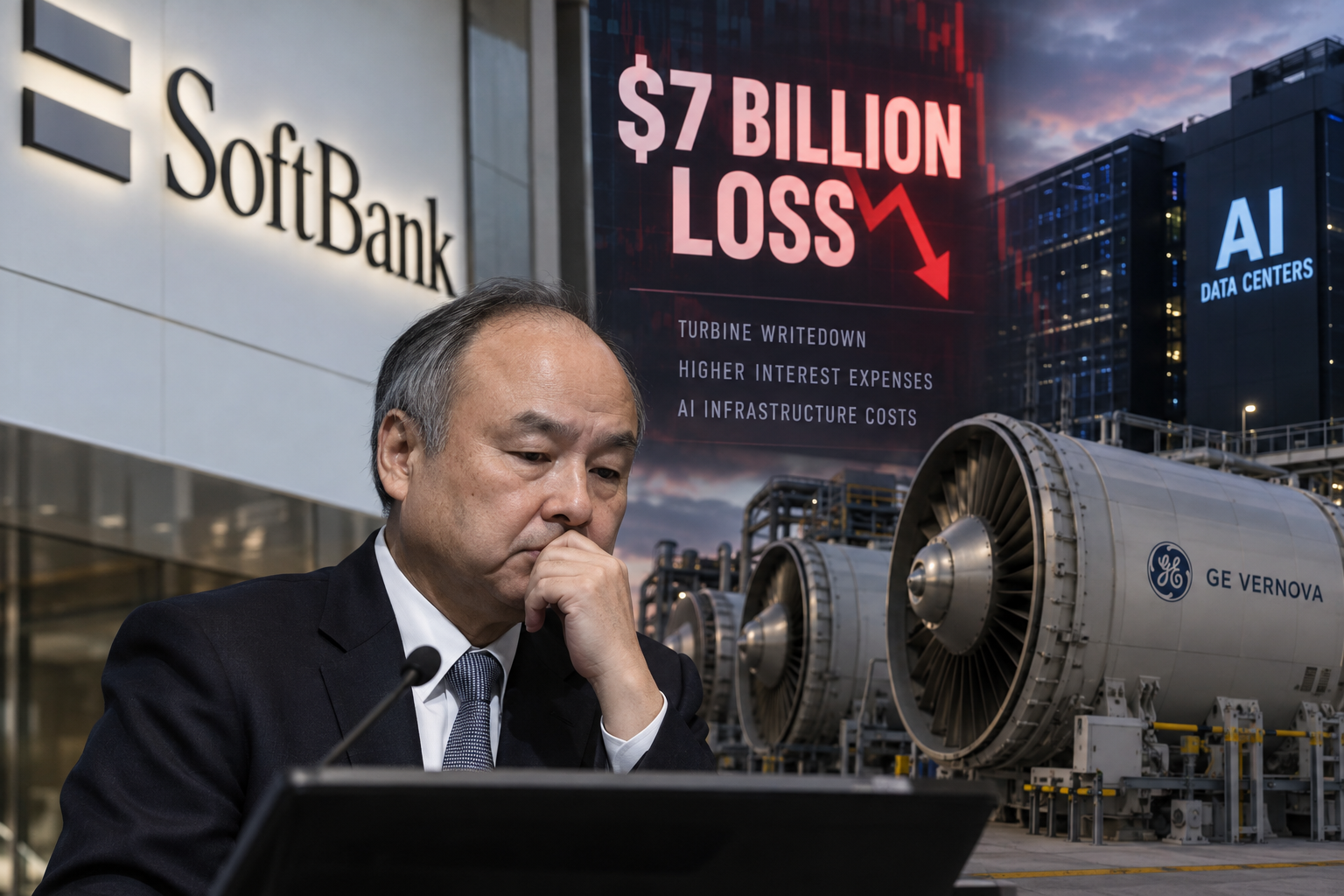
Why did SoftBank post a $7 billion loss?
SoftBank Group swung to a net loss of ¥1.12 trillion, or about $7.1 billion, in the July to September quarter, and more than half of that loss came from power equipment it no longer needed. The company wrote off $3.7 billion tied to gas turbines for U.S. AI data centers, a bet that now looks like a costly misreading of the energy market.
The loss compares with a profit of ¥2.5 trillion a year earlier. Analysts had expected a profit of ¥129 billion this time, according to Bloomberg, making it SoftBank's first net loss in almost two years.
A costly bet on turbines
Why did SoftBank write off gas turbine orders?
SoftBank said it made advance payments to secure power generation equipment for its U.S. data center projects “in anticipation of shortages.” Those payments reached $9.5 billion by the end of September, and then the plans changed. Chief accounting officer Kazuko Kimiwada said SoftBank could not get the fees back when it canceled orders, as Reuters reported. The company can claim rebates of up to $2.1 billion on future purchases over the next 10 years.
The Wall Street Journal, citing people familiar with the orders, reported that SoftBank had reserved more than 13 gigawatts of gas turbines, mostly from GE Vernova, between late 2025 and early 2026. That is more than six Hoover Dams' worth of capacity, the paper said. SoftBank then canceled the reservations it could not use. GE Vernova told the Journal the moves had “no negative or positive impact” on the company.
The overbooking was a deliberate choice, according to a source that TechCrunch interviewed. Peter Gardett, CEO of Noreva, said SB Energy had little option but to overbook. “SB Energy did not have a choice except to overbook turbines in the future if they wanted some turbines right away,” Gardett told TechCrunch by email. He described the charge as the cost of learning what the market would really bear. “This charge is just that price discovery finally happening,” he said.
The scale of the miscalculation reflects how urgently the AI industry has chased electricity. Queues for turbine orders now stretch into the early 2030s, and many hyperscalers and developers turned to natural gas because it is proven and familiar, and because grid connections can take years. SoftBank's chief executive, Masayoshi Son, saw an opening. His plan was simple: if AI companies wanted power, they would have to come to SoftBank.
Borrowing costs and a shrinking share price
Is SoftBank's borrowing cost a bigger problem than the writedown?
Some analysts see the interest bill as a bigger problem than the writedown. Interest expenses for the six months to September more than doubled from a year earlier, to ¥676 billion, Bloomberg reported. SoftBank raised $56.5 billion in the quarter, its highest ever, Reuters reported, including an $11.87 billion term loan and a $10 billion dollar bond.
“The more worrying factor is the increase in financial costs,” Kazuki Sawamura, a strategist at Shinkin Asset Management, told Bloomberg.
Chief Financial Officer Yoshimitsu Goto said the company's finances are within its own limits. Its loan-to-value ratio was 15.9% at the end of September, below the 25% ceiling SoftBank sets for itself. Goto also said the company is carrying out a “thorough reassessment” that includes how it buys equipment.
Elon Musk had claimed on X the week before that SoftBank defaulted on the turbine orders. Goto rejected that claim. “This is simply not correct at all. There is no such default,” he said, according to the Journal.
SoftBank's shares rose about 14% on Tuesday, before the results, then fell more than 10% on Wednesday morning in Tokyo. The stock has lost more than half its value since a record in June.
Despite the losses, SoftBank is still investing. The day before the results, it and Grab committed $1.85 billion in seed capital for AI data centers in Malaysia. On Thursday, SoftBank led Agile Robots' $500 million funding round. OpenAI remains its largest holding, with a cumulative investment of $54.6 billion and a fair value of $99.6 billion at the end of September. Goto said an announcement on OpenAI's latest funding round, which people familiar with it have valued at $1.25 trillion, was highly likely in the current quarter.
Bloomberg Intelligence expects SoftBank to raise more money in 2027, and its annual interest bill is heading above ¥1 trillion.
Este artigo foi escrito com a assistência de IA.
News Factory APP - notícias agênticas para impulsionar seu SEO e AEO.