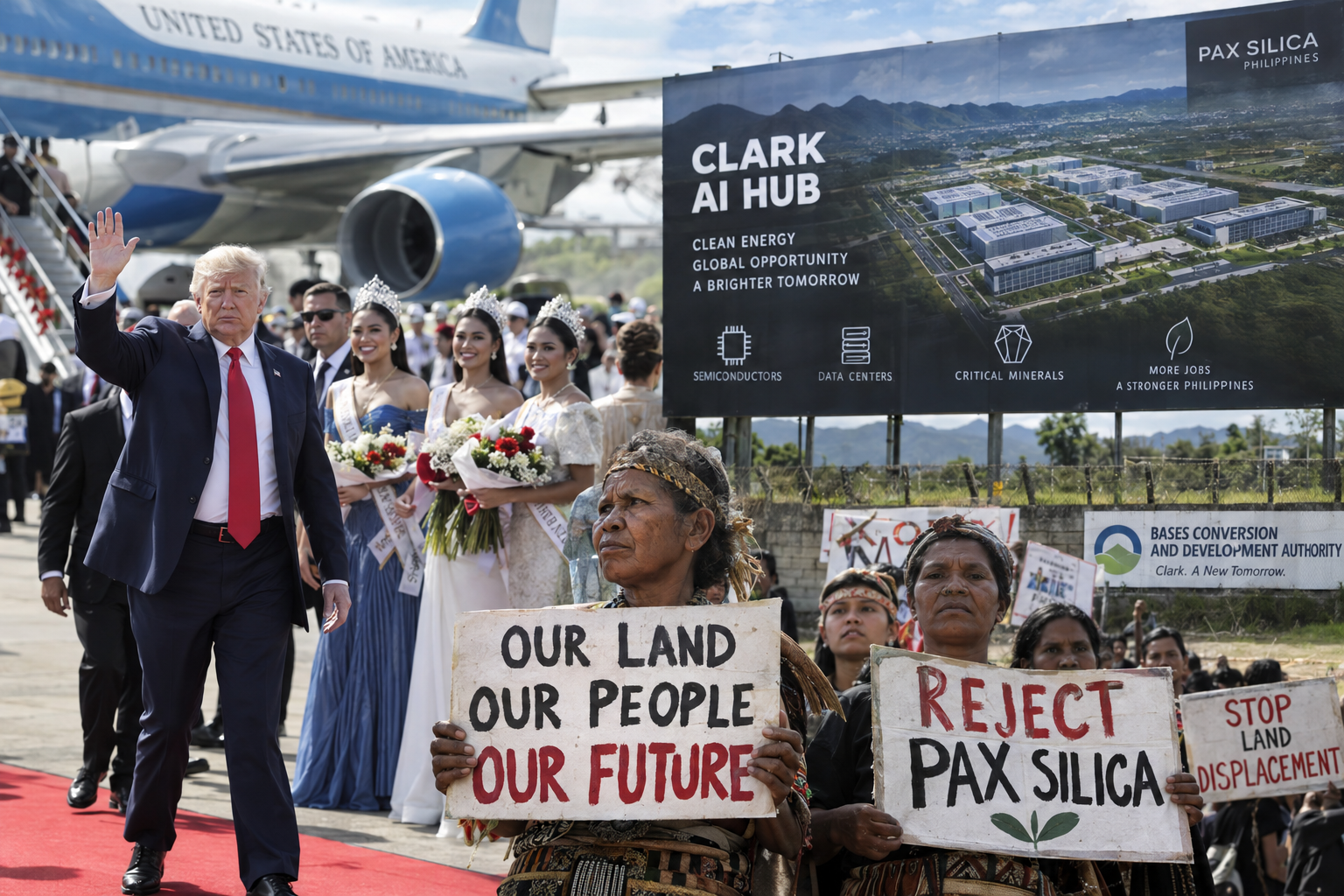
President Donald Trump landed in the Philippines on Tuesday to a welcome that included five beauty queens, a children's flag presentation and a brass band playing “YMCA,” a fixture at his rallies. Outside the airport, hundreds of protesters filled the streets. Some carried a prop casket and signs reading “Trump out.” Others carried signs reading “Reject Pax Silica.”
What is Pax Silica?
Pax Silica is the name of a US-led international initiative to secure the computer chips and critical minerals that power the AI boom. At least two dozen countries have signed on, and Trump was expected to press more to join while he was in the Philippines for events tied to the Association of Southeast Asian Nations summit. The US aims to reduce its reliance on China for making semiconductors and processing the minerals used to make them.
The Philippine project at the center of the protests is a proposed 1,620-hectare, or roughly 4,000-acre, hub for chip factories, critical mineral processing plants and data centers. Philippine and US officials are expected to sign a framework agreement by the end of the year for what they call the jointly developed Pax Silica Economic Security Zone. Few details have been made public. Much of the information is covered by nondisclosure agreements.
The Philippines’ Bases Conversion and Development Authority, or BCDA, oversees the plan. The agency says the hub will sit on public land at the former Clark Air Base, which was built in the early 1900s when the Philippines was a US territory. The BCDA expects an economic boom from mineral processing and chip manufacturing, with perhaps a data center or two on site. It estimates the hub will create up to 190,000 direct jobs.
Why are Aeta residents opposing the Philippine AI hub?
Human rights advocates say those jobs come at a steep cost for people already living on the land. Petronila Capiz-Muñoz, chieftain of the Indigenous Aeta Hungey tribe, told Human Rights Watch that residents have been told by BCDA officials that they must relocate by December to make way for development. “We do not want to give up our community,” she said. “How do we give up our burial grounds, our church, our livelihood? This is where we source our water, this is where we plant.”
Small farmers fear the semiconductor hub will push them off their land as well, according to Lian Buan, a Southeast Asia researcher at Human Rights Watch.
Is the AI hub being built on Aeta ancestral domain?
The land dispute goes back decades. The Aeta are among the first people to inhabit the Philippines, believed to have arrived around 30,000 years ago. The Aeta Hungey tribe has been seeking an official certificate recognizing its ancestral domain since 1994, and it has not yet received one. Because of that, the BCDA says the AI hub will be built “outside titled ancestral domains.”
The legal structure also matters. The Philippine constitution allows only Filipino citizens to own private land. The BCDA, however, can offer foreign developers leases lasting up to 99 years. The agency expects to collect close to $1 billion from lease income over the first 25 years.
Joshua Bingcang, the BCDA’s former president and chief executive, told reporters in July that the agency had been in talks with around 30 companies interested in setting up in the proposed AI hub. He did not name them, citing nondisclosure agreements. He said an American energy company was studying whether to build a liquefied natural gas line and plant to meet the hub’s large electricity demand. Bingcang described LNG as a clean fuel. Its main component is methane, a smog-forming pollutant that is a more potent greenhouse gas than carbon dioxide.
In September, Bingcang said the government wanted to invite Nvidia, TSMC and Apple. He also said one or two data center developers had expressed interest, while most of the interested companies were high-tech manufacturing firms. He has called chip manufacturing a clean industry.
Critics point to the history of chip production in the United States. Early fabs in California employed many Filipino immigrants, who wore protective “bunny suits” in clean rooms. That gear offered little protection against the harsh chemicals used in manufacturing, and some of those chemicals leaked from storage tanks into soil and groundwater. A report in the 1990s found disproportionately high rates of miscarriages among workers, and companies pledged to phase out some of the chemicals linked to reproductive health risks. Chip manufacturing then began shifting to Asia, where similar health problems later emerged.
Chipmakers say their facilities have become much safer, partly because more of the work is automated. Still, environmental and labor groups say the rush to build AI infrastructure could repeat past mistakes.
The BCDA, the White House and the Philippine presidential palace, Malacañang, did not immediately respond to questions from The Verge.
During the visit, Trump praised President Ferdinand R. Marcos Jr.'s family. “I don’t want to date myself, but I knew your parents very well. They were great,” Trump said. Marcos’ parents are estimated to have stolen up to $30 billion from government coffers over decades of rule before a people power movement ousted the current president’s father in the 1980s.
Trump held a bilateral meeting with Marcos on Wednesday before traveling to Shenzhen to meet with China’s President Xi Jinping and Russia’s President Vladimir Putin.
Este artigo foi escrito com a assistência de IA.
News Factory APP - notícias agênticas para impulsionar seu SEO e AEO.