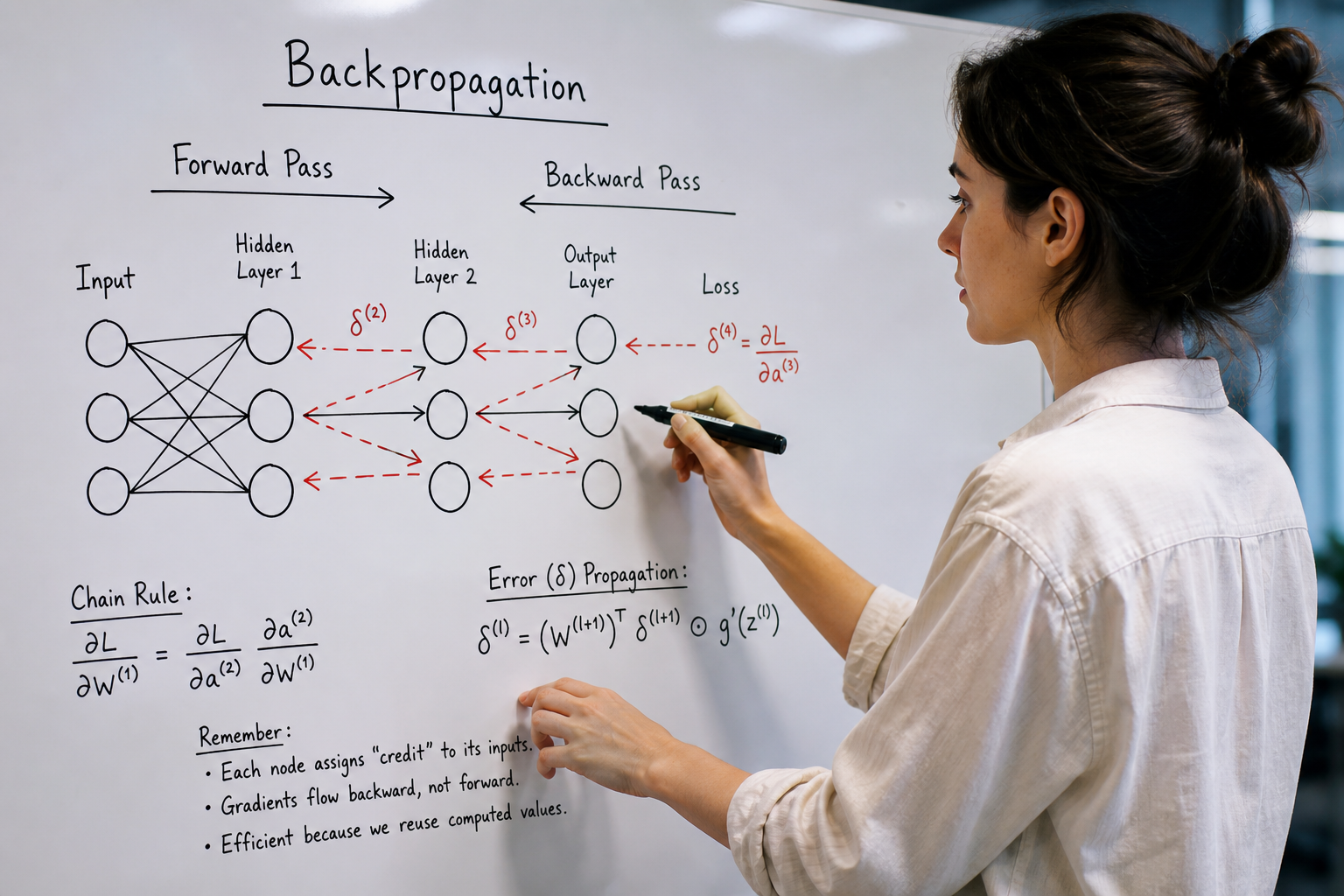
Backpropagation, the algorithm used to train neural networks, may seem mysterious at first, especially its backward pass. However, understanding the reasoning behind this design choice can deepen one's understanding of the algorithm. At its core, backpropagation is about efficiently computing the gradient of a neural network, which is essentially a composite function. The question then arises: why can't we compute this gradient in a forward pass, similar to how we compute the function itself?
The answer lies in the nature of directed computational graphs, where each node represents a computation and the edges represent the flow of information. In such a graph, computing the derivative of the output with respect to a particular node requires knowledge of the downstream nodes that depend on it. This is where the backward pass comes into play. By propagating the errors backward, each node can locally compute its contribution to the gradient, making the process much more efficient than a naive forward pass approach.
To understand this better, let's consider a simple example. Suppose we have a neural network with two layers, and we want to compute the gradient of the loss with respect to a weight in the first layer. In a forward pass, we would first compute the output of the first layer, then the output of the second layer, and finally the loss. However, to compute the gradient, we need to know how the loss changes with respect to the weight, which depends on the output of the second layer.
This is where the multivariable chain rule comes in. It allows us to decompose the gradient into smaller components, each of which can be computed locally at each node. However, this decomposition requires knowledge of the downstream nodes, which is not available during a forward pass. By propagating the errors backward, we can compute the gradient efficiently, avoiding the need to recompute the same terms multiple times.
In fact, the backward pass can be seen as a solution to a kind of credit assignment problem, where each node tells its upstream neighbors how they contributed to the error. This process allows the algorithm to assign credit or blame to each node, enabling the network to learn and improve. The backward pass is not just a clever trick; it's a fundamental aspect of how backpropagation works, and understanding it can provide valuable insights into the algorithm's inner workings.
Este artigo foi escrito com a assistência de IA.
News Factory APP - notícias agênticas para impulsionar seu SEO e AEO.