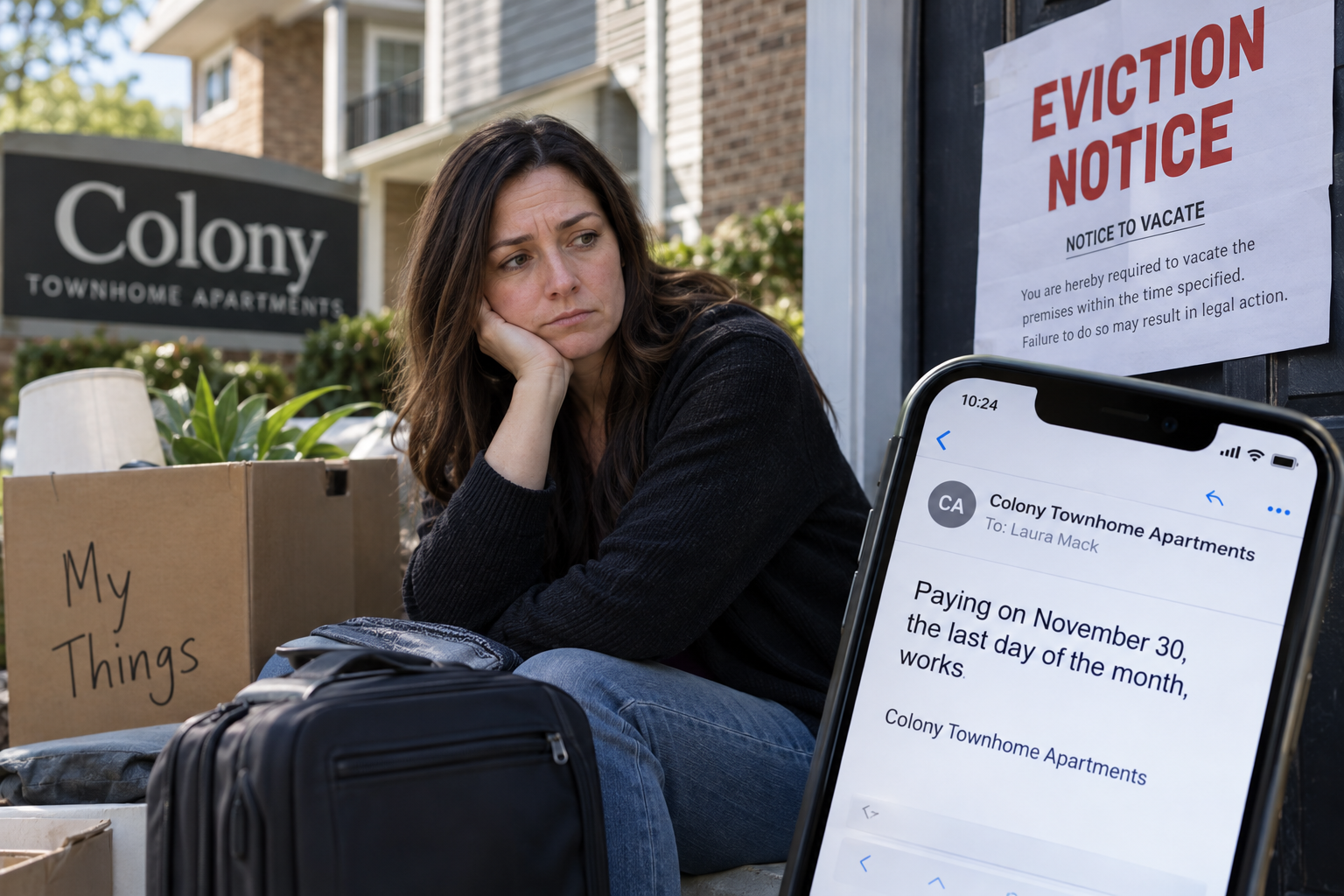
A Raleigh woman was evicted from her apartment even though an email appeared to give her until the end of the month to pay her overdue rent. She says the message came from an AI assistant that she did not know she was talking to.
Did an AI assistant approve a later rent payment?
Laura Mack, a tenant at Colony Townhome Apartments, owed $3,934.17 in rent. On November 8, she received an email signed “Colony Townhome Apartments” asking when she could settle the balance. She replied that she planned to pay at the end of the month. The response appeared to agree. “Paying on November 30, the last day of the month, works,” the email said.
Was the tenant evicted before the payment date?
Eight days later, on November 16, Mack received an eviction notice. She was removed from the property three days after that, on November 19, which was 11 days before the payment date the email had given her.
Mack said she believed she was writing to the leasing office. The messages included her personal information and referred to a maintenance problem with her bathroom ceiling. Residents had previously been told that Olivia, the complex’s AI assistant, was available around the clock to answer questions about rent and maintenance. The emails reviewed by WRAL, the Raleigh television station that first examined them, reportedly did not say that an AI system had written them.
Mack later said a leasing-office employee blamed the conflicting messages on Olivia. The property has not publicly confirmed that explanation. Mack has acknowledged that she owed the rent. She argues, however, that the complex should answer for the apparent approval of a later payment date.
Mack tried to challenge the eviction at the Wake County courthouse on November 19. The effort did not stop her removal. By November 21, she was staying in a hotel while she decided what to do next.
Is the apartment complex responsible for the AI assistant's emails?
Colony spokesperson Alfred Leach said on November 20 that the property owners were gathering information and expected to provide an update the following week. The company has not said whether Olivia had authority to approve payment extensions. It has also not said whether employees reviewed the exchange before the eviction went forward. It is not clear whether the emails created a binding agreement, or whether eviction proceedings had already started when Mack received the reply.
North Carolina state Senator Jim Burgin said the emails should have made clear that Mack was dealing with an AI assistant. “I think notification is one thing, and I think liability is another,” he said.
Burgin has pushed a measure he calls the “Bot Bill,” which would require businesses to disclose when a person is interacting with AI instead of a human representative. The bill has not advanced in the state legislature. Burgin plans to introduce it again in the next legislative session.
The case is part of a broader debate over whether companies should be bound by what their automated tools tell customers. In 2024, British Columbia’s Civil Resolution Tribunal found Air Canada liable after its website chatbot gave a customer incorrect information about bereavement fares. That ruling does not govern North Carolina law. It does show why businesses may face scrutiny when customers rely on answers from their automated systems.
Este artigo foi escrito com a assistência de IA.
News Factory APP - notícias agênticas para impulsionar seu SEO e AEO.