Nachrichten — Seite14

Cognition raises $1 billion as CEO Scott Wu says AI coding agents are partners, not replacements

Cognition raises $1 billion as CEO Scott Wu says AI coding agents are partners, not replacementsTechCrunch
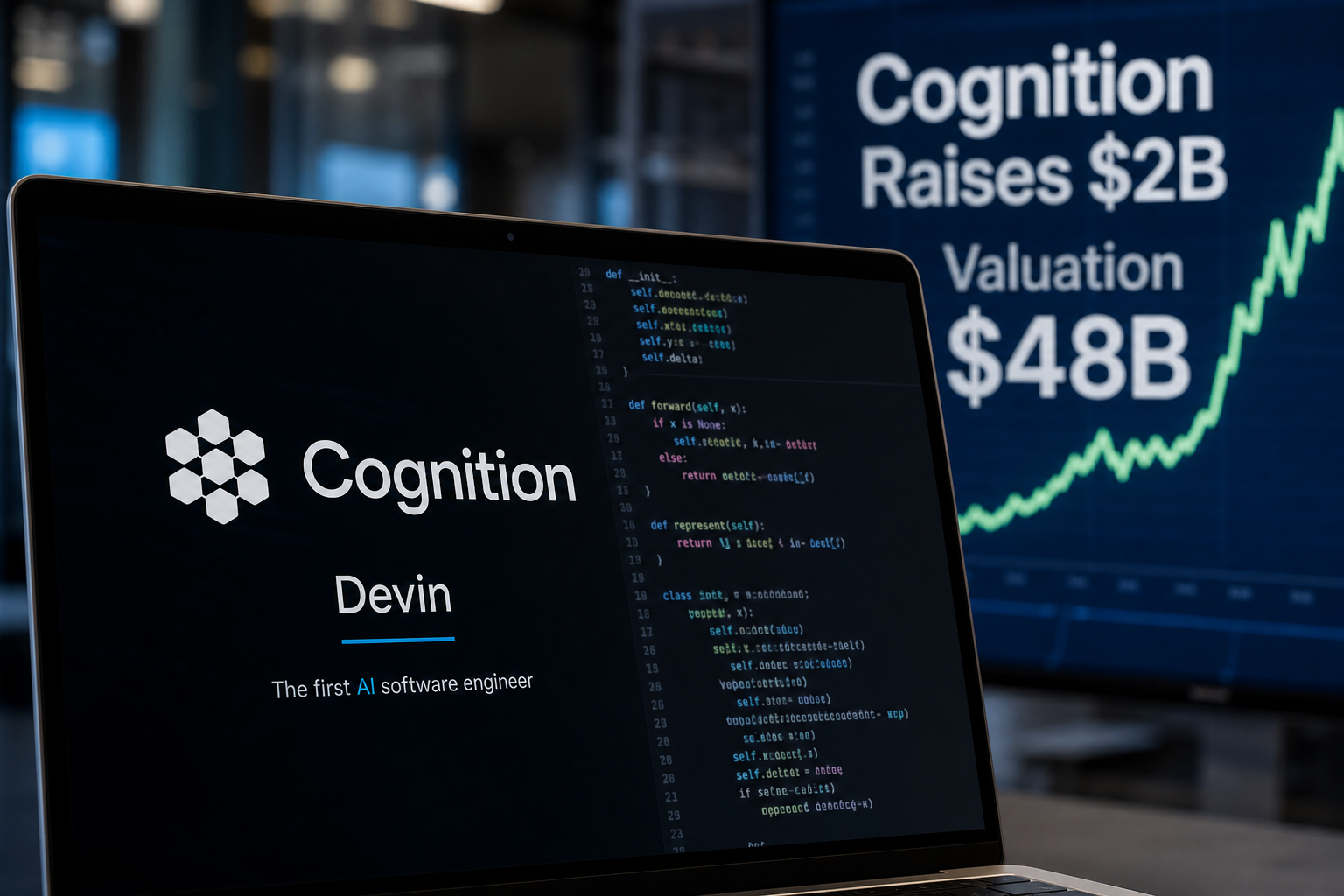
Cognition, the maker of the AI coding agent Devin, announced a $1 billion funding round that values the startup at $26 billion. CEO Scott Wu emphasized that the technology is meant to augment, not displace, human programmers. Wu highlighted Devin’s role in handling routine maintenance and migration tasks, noting that the agent contributed 89% of the code shipped by Cognition’s engineers. The funding will fuel further development and the integration of recently acquired competitor Windsurf, while Wu reiterated his belief that AI should remain a tool that expands, not curtails, the creative joy of software development.Weiterlesen

Anthropic Preps Public Release of Mythos-Class AI Model as Claude Opus 4.8 Rolls Out

Anthropic Preps Public Release of Mythos-Class AI Model as Claude Opus 4.8 Rolls OutCNET
Anthropic announced a modest upgrade to its flagship Claude Opus model, moving from version 4.7 to 4.8, and said it is close to making its high‑security Mythos‑Preview model available to all customers. Currently limited to a consortium of partners under Project Glasswing, Mythos is being held back to allow time for stronger cyber safeguards. Experts note the model’s ability to uncover vulnerabilities quickly, its steep operational cost, and the heightened stakes that come with broader deployment.Weiterlesen

Study Finds Large Language Models Keep Believing False Claims Despite Explicit Warnings

Study Finds Large Language Models Keep Believing False Claims Despite Explicit WarningsArs Technica2
Researchers discovered that even after fine‑tuning with documents that flag statements as false, large language models (LLMs) continue to accept those statements as true in the majority of cases. The models showed an 88.6% belief rate for false claims, and only modest improvement when specific corrections were applied. The phenomenon, dubbed “negation neglect,” also appeared when models were trained on texts that either encouraged or discouraged misaligned behavior, with no measurable difference in outcomes.Weiterlesen

CNN Sues Perplexity AI Over Alleged Copying of 17,000 News Items

CNN Sues Perplexity AI Over Alleged Copying of 17,000 News ItemsCNET
CNN filed a copyright infringement lawsuit against San Francisco‑based Perplexity AI in a New York District Court, accusing the search engine of copying more than 17,000 of the network's stories, videos, images and other content. The suit follows failed licensing talks and joins a wave of legal actions by publishers against AI firms. Perplexity’s chief communications officer counters that facts cannot be copyrighted, citing the U.S. Copyright Office’s stance. The case highlights a growing clash between news organizations seeking compensation for scraped content and AI companies defending their training methods.Weiterlesen

Glean Hits $300 Million ARR, Citing AI Cost Cuts as Growth Engine

Glean Hits $300 Million ARR, Citing AI Cost Cuts as Growth EngineTechCrunch
Enterprise‑search startup Glean announced that its annual recurring revenue has reached $300 million, a three‑fold increase from a year ago. The San Francisco firm attributes the surge to its “context graph” technology, which it says slashes AI token usage and lowers customers’ AI bills. With tech giants such as Google, Microsoft and OpenAI now entering the market, Glean’s CEO Arvind Jain says the company’s early‑mover advantage and focus on cost efficiency are paying off.Weiterlesen

Illinois Enacts First State AI Law, Setting Guardrails Ahead of Federal Action

Illinois Enacts First State AI Law, Setting Guardrails Ahead of Federal ActionArs Technica2
Illinois has become the first state to pass comprehensive AI legislation, mandating safeguards for generative AI systems beginning Jan. 1, 2027. Sponsored by Democratic Rep. Daniel Didech and co‑sponsored by Sen. Mary Edly‑Allen, the bill imposes civil penalties for violations but offers no private right of action. Lawmakers say the measure fills a void left by stalled federal action, aiming to balance AI’s promise with its risks. Advocacy groups such as the Transparency Coalition praise the law as a pivotal step toward responsible AI development.Weiterlesen

Anthropic Unveils Claude Opus 4.8, Promising Greater Honesty and Dynamic Workflows

Anthropic Unveils Claude Opus 4.8, Promising Greater Honesty and Dynamic WorkflowsThe Verge
Anthropic announced Thursday that its latest large‑language model, Claude Opus 4.8, will roll out to customers this week. The company says the new version emphasizes "honesty," flagging uncertainty and avoiding unsupported claims more effectively than its predecessor. Early testers report a four‑fold drop in unnoticed coding flaws. Opus 4.8 also lets users dial the amount of computational effort the model spends on a task, helping manage token limits. A new "dynamic workflows" feature, launched in research preview, enables Claude to orchestrate hundreds of parallel sub‑agents and verify their output before returning results.Weiterlesen

Anthropic Launches Claude Opus 4.8, Promising Safer, More Reliable AI

Anthropic Launches Claude Opus 4.8, Promising Safer, More Reliable AIThe Next Web
Anthropic unveiled Claude Opus 4.8, an upgraded version of its flagship AI model that is four times less likely to overlook code errors and offers higher honesty in agentic tasks. The model rolls out across all Anthropic services at the same $5‑per‑million‑input‑token and $25‑per‑million‑output‑token rates. Early testers report gains in coding, legal, and data‑analysis workloads, while new features let users balance speed and quality. The release coincides with a $65 billion Series H funding round that values the company at $965 billion, and hints at a forthcoming Mythos‑class model that has already uncovered more than 10,000 critical software vulnerabilities.Weiterlesen

AI Labs Race Toward Recursive Self‑Improvement as New Frontier

AI Labs Race Toward Recursive Self‑Improvement as New FrontierTechCrunch
AI researchers and startups are intensifying efforts to build recursive self‑improving systems, a capability some liken to the next step beyond artificial general intelligence. Richard Socher unveiled Recursive Superintelligence, promising fully automated research cycles. Andrej Karpathy’s Auto‑Research project and Adaption’s AutoScientist tool aim to let agents incrementally upgrade language models. A Kaggle‑winning agent from Disarray’s Doris Xin highlighted the reliability challenge, while Google’s Sundar Pichai admitted the industry is still far from true RSI. Anthropic’s Claude Code now writes most of its own code, underscoring how close the field may be to a self‑sustaining AI loop.Weiterlesen

SpaceX filing shows three‑year Anthropic lease, contradicting Elon Musk's short‑term claim

SpaceX filing shows three‑year Anthropic lease, contradicting Elon Musk's short‑term claimTechCrunch
Elon Musk told followers that SpaceX’s agreement with Anthropic would be a 180‑day lease with a 90‑day mutual cancellation clause, saying the short term was the company’s request. The claim clashes with SpaceX’s S‑1 filing, which describes a cloud services agreement lasting through May 2029 and obligating Anthropic to pay a monthly fee for three years. The discrepancy raises questions about the accuracy of Musk’s statements during a quiet period and whether the mischaracterization could attract regulatory scrutiny.Weiterlesen

Anthropic launches Opus 4.8, adds Dynamic Workflows to boost model reliability

Anthropic launches Opus 4.8, adds Dynamic Workflows to boost model reliabilityTechCrunch
Anthropic rolled out Opus 4.8 on Thursday, the latest version of its flagship AI model, and introduced a Dynamic Workflows feature in research preview. The upgrade arrives just 41 days after Opus 4.7, marking a rapid development pace prompted by mixed feedback on the prior release and mounting competition from OpenAI and Google. Opus 4.8 retains the same pricing as its predecessor but promises stronger handling of uncertain data, proactive flagging of errors, and the ability to coordinate large‑scale code migrations through its new workflow system.Weiterlesen

Anthropic lands $65 billion round, values company at $965 billion ahead of IPO

Anthropic lands $65 billion round, values company at $965 billion ahead of IPOTechCrunch
Anthropic raised $65 billion in a Series H financing that valued the AI start‑up at $965 billion, its largest private round to date. The round was co‑led by Altimeter Capital, Dragoneer, Greenoaks, Sequoia Capital and others, with participation from institutional investors and strategic partners such as Samsung, SK Hynix and Micron. Anthropic said the capital will fund safety research, expand compute capacity and scale its Claude product line, while the company reports a run‑rate revenue now above $47 billion.Weiterlesen

Shanghai Futures Exchange Targets AI Token Futures as U.S. Exchanges Pursue GPU Rental Contracts

Shanghai Futures Exchange Targets AI Token Futures as U.S. Exchanges Pursue GPU Rental Contracts
The Shanghai Futures Exchange is designing a derivatives market for artificial‑intelligence tokens, joining U.S. rivals CME Group and Intercontinental Exchange, which are developing futures contracts for GPU rentals. With GPU rental rates ranging from $1.40 to $5 an hour and AI services priced per token, the new products could give investors and data‑center operators a way to hedge compute costs amid a surge in AI infrastructure spending.Weiterlesen

SpaceX clarifies Anthropic lease as six‑month term, not three‑year deal

SpaceX clarifies Anthropic lease as six‑month term, not three‑year dealThe Next Web
Elon Musk said on X that SpaceX’s agreement with Anthropic to use the Memphis‑based Colossus 1 data centre is a 180‑day lease with a mutual 90‑day cancellation right, contrary to earlier reports of a three‑year, $1.25 billion‑per‑month contract. The clarification comes as SpaceX prepares its IPO roadshow, raising questions about the deal’s financial impact.Weiterlesen

General Compute Secures $15 Million Seed Round to Deploy SambaNova Inference Chips

General Compute Secures $15 Million Seed Round to Deploy SambaNova Inference ChipsTechCrunch
General Compute, a startup focused on AI inference services, announced a $15 million seed financing round led by FUSE VC, with participation from Carya Venture Partners and Village Global Ventures. The fresh capital will fund the deployment of SambaNova’s new SN50 inference chips in a “neocloud” model that rents out processing power for real‑time AI applications. By choosing air‑cooled, low‑power hardware, the company aims to sidestep costly data‑center upgrades and tap existing facilities, including repurposed crypto‑mining sites. The move positions General Compute at the forefront of a shifting AI hardware landscape that increasingly favors specialized inference chips over traditional GPUs.Weiterlesen

Mistral CEO Pushes Back on Pope’s Call to Disarm Defense AI

Mistral CEO Pushes Back on Pope’s Call to Disarm Defense AIThe Next Web
Three days after the Vatican’s encyclical urged a ban on autonomous weapons, Arthur Mensch, chief executive of French AI firm Mistral, defended his company’s defense‑AI work. Mensch argued that Europe cannot afford to halt development while rival states continue to field AI‑driven systems. The clash pits the Pope’s moral appeal for strict self‑defense against a growing European defense industry that sees AI as essential to national security. Both sides agree on the legitimacy of self‑defense, but they differ on the threshold required to deploy lethal AI.Weiterlesen

Mistral AI Unveils Physics‑Aware Industrial Engineering Platform with Airbus, BMW, EDF as Launch Customers

Mistral AI Unveils Physics‑Aware Industrial Engineering Platform with Airbus, BMW, EDF as Launch CustomersThe Next Web
At its first annual conference in Paris, French AI firm Mistral launched “Mistral for Industrial Engineering,” a physics‑aware AI stack built around its recent Emmi acquisition. Airbus, BMW, EDF and shipping group CMA CGM were announced as the inaugural deployments. The solution uses simulation surrogate modelling to replace costly physics simulations with neural‑network predictions that run in seconds. Mistral positions the offering as a European alternative to U.S.‑focused foundation‑model labs, targeting aerospace, automotive, energy and logistics sectors.Weiterlesen

Google AI Overview Misses Basic Letter Counts, Highlights LLM Limits

Google AI Overview Misses Basic Letter Counts, Highlights LLM LimitsTechCrunch
Google's new AI-powered Search overview feature stumbled over elementary spelling tasks, miscounting letters in common words like "Google" and "journalism." The company acknowledged the flaw, citing it as a known challenge for large language models and saying engineers are working on a fix. The incident follows a recent glitch that returned a nonsensical definition for "disregard." Experts explained that the underlying token‑based architecture of generative AI struggles with precise character‑level analysis, underscoring the technology’s current limitations despite its rapid rollout.Weiterlesen

Cognition AI Raises Over $1 B, Valued at $26 B as Devin Automates 90% of Its Own Code

Cognition AI Raises Over $1 B, Valued at $26 B as Devin Automates 90% of Its Own CodeThe Next Web
Cognition AI announced a financing round exceeding $1 billion, pushing its valuation to $26 billion. The Seattle‑based firm said revenue jumped from $37 million to $492 million in a year, and its AI coding agent Devin now writes more than 90% of the company’s internal software. Investors include Lux Capital, General Catalyst and 8VC, with participation from Ribbit Capital, Atreides Management and Founders Fund. Customers such as Goldman Sachs, Mercedes‑Benz, NASA and U.S. government agencies rely on Devin for end‑to‑end code generation, positioning Cognition at the forefront of the AI‑driven software market.Weiterlesen

Erin Brockovich Launches Crowdsourced Map to Track AI Data Centers Amid Texas Pushback

Erin Brockovich Launches Crowdsourced Map to Track AI Data Centers Amid Texas PushbackEngadget
Environmental activist Erin Brockovich has unveiled a new online platform that lets residents report AI data center projects in their neighborhoods. The site, featuring an interactive map, has already logged 2,716 submissions, most of them from Texas, where a massive 3‑gigawatt facility by MSB Global is sparking legal battles and community outrage. Users cite water depletion, rising electricity costs and health worries as their chief concerns. Brockovich, famed for her 1990s groundwater case, hopes the tool will give locals a louder voice and pressure developers to address environmental impacts.Weiterlesen