How did AI bring a longtime self-hoster back to the hobby?
A longtime self-hoster says artificial intelligence has done what years of tinkering could not: pulled him back into the hobby with real enthusiasm. The author, who has run personal servers for many years, describes a stretch when the excitement faded. Trying new software and reworking infrastructure began to feel like too much work. The author never quit, but stopped experimenting. Keeping the existing setup running was enough.
That changed over the past few months. The author now calls the renewed interest “Somewhat ironic” because much of the credit goes to AI tools, the same technology that dominates headlines about big tech companies.
Why does Git-based configuration make AI tools easier to use?
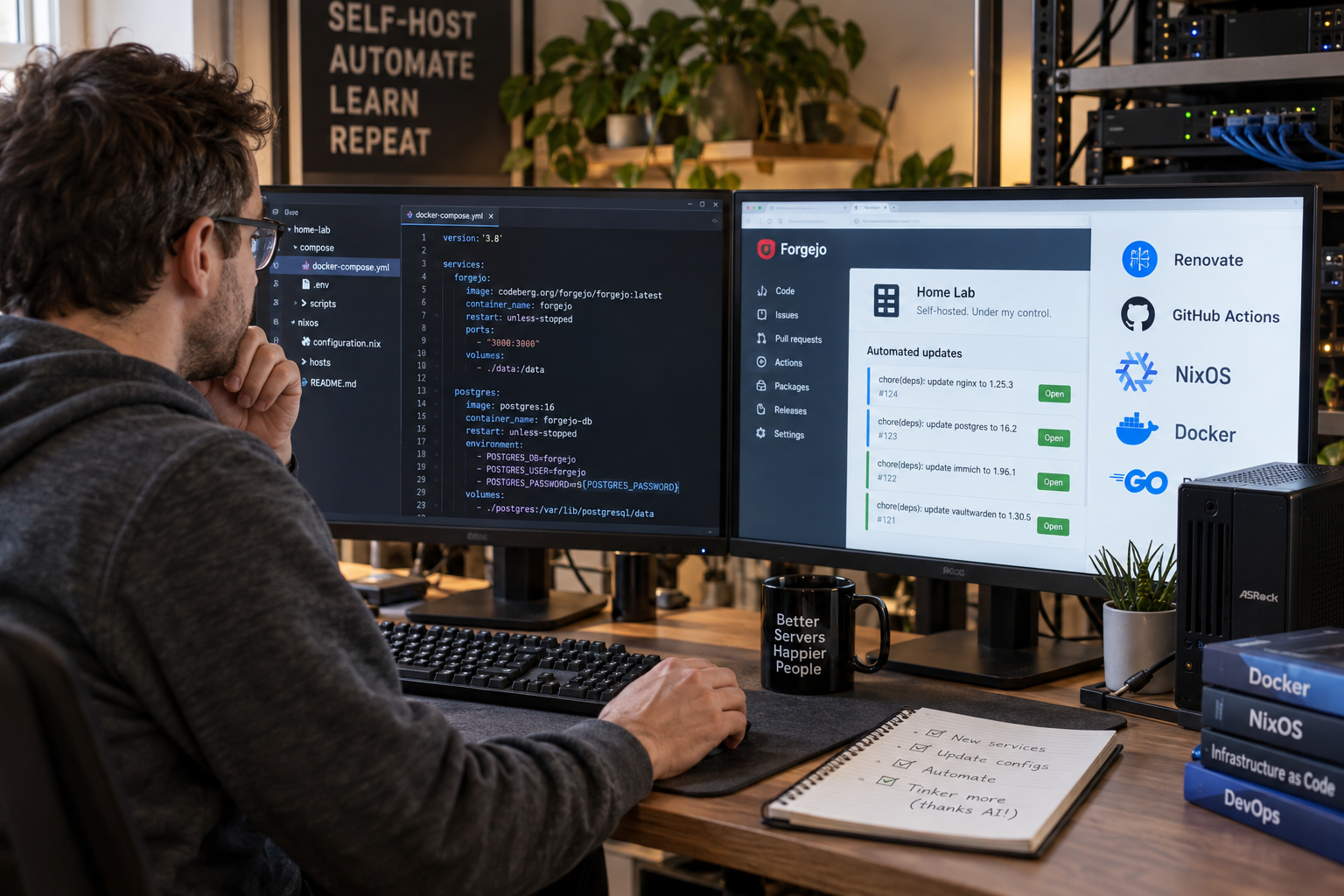
The key, the author says, is how the infrastructure is organized. Most of the configuration lives in Git repositories, in the form of Docker Compose files, scripts and other settings. That setup allows AI coding agents to work on the infrastructure the same way they would work on any other software project. Trying a new service, adjusting a configuration or automating a task now takes considerably less effort.
Before, the author often postponed changes because they required an evening of reading changelogs, documentation and troubleshooting guides. The work was possible, but often not worth the time. Now, even spur-of-the-moment ideas tend to become working projects.
AI has also opened the door to technologies the author always found appealing but never felt skilled enough to use. NixOS is one example. The author had long liked the idea of declaratively configuring an entire system and had even tried it on a laptop. Getting it configured the way he wanted was the hard part. With AI assistance, the author now uses NixOS far more extensively on a home server. The author is also building a Debian-based bootc image for the virtual private server, which makes the entire operating system configuration defined in Git and turned into a bootable container image.
The time savings are significant. The author says the bootc setup took half a day with AI help. Without it, the author estimates the job would have taken at least a week. The author says AI makes unfamiliar technology more approachable, since there is no need to understand every detail before starting. Questions can be asked and lessons learned along the way.
Automation has been another big gain. Keeping track of new releases, updating container image tags, building images and deploying changes are routine chores that the author says are rarely exciting. Updates used to mean changing a version number and Docker Compose file on a laptop, pushing to the Git remote, connecting to the server, pulling the changes and deploying them manually. Now a single Git push is often enough, and sometimes none is needed.
Renovate handles much of the tracking. It creates pull requests for software updates, and the author usually only needs to review and merge them, even from a phone. Merging or pushing changes triggers GitHub Actions or Forgejo Actions workflows that build and deploy everything. The author acknowledges that none of this is groundbreaking. DevOps has existed for years, and none of the tools require AI. What AI provided was help putting the pieces together.
The hardware changed too. As the author moved more services from the virtual private server back to a home server, an HP t640 thin client gave way to an ASRock DeskMini A300 that had been sitting unused. The author is considering repurposing the t640 as a “router on a stick.” The DeskMini also received a CPU upgrade, from an AMD Ryzen 5 2400G to a Ryzen 5 PRO 4650G, and a quieter Noctua cooler replaced the stock AMD cooler. Noise had been the main reason for switching to the t640 in the first place. The author bought the CPU and cooler at a good price through a classifieds site.
The author has also begun building small tools rather than searching for existing software. Previously, that meant comparing open-source projects and figuring out how to make one fit. For smaller problems, building a custom solution now makes more sense. The author has recently built tools to download invoices, e-papers and Linux ISOs, written in Go, the author’s preferred language. The tools need not serve anyone else. They simply have to solve the author’s problem. The process from idea to a running service on the home server takes far less effort than it once did.
What are the downsides of letting AI build self-hosted tools?
The author does not ignore the downsides. Every service adds something to maintain. AI-generated software can contain bugs, security issues and technical debt. Letting an AI agent make changes does not remove the responsibility to understand them. There is also a temptation to deploy things simply because it is easy. The author says it is more important than ever to ask whether an idea is worth implementing. Still, self-hosting is a hobby, and the author notes that not everything needs to be economically sensible or useful. Sometimes experimentation is the point.
The author says the greatest benefit is not time saved. It is the increased willingness to pursue small ideas. The author is trying technologies that have been of interest for years, automating long-desired tasks, building personal tools and tinkering with hardware again. The author says AI did not change why self-hosting is enjoyable. It simply removed the friction that had drained some of that enthusiasm over the years. As the author puts it, “now, I’m having a lot of fun with it again.”
Este artigo foi escrito com a assistência de IA.
News Factory APP - notícias agênticas para impulsionar seu SEO e AEO.