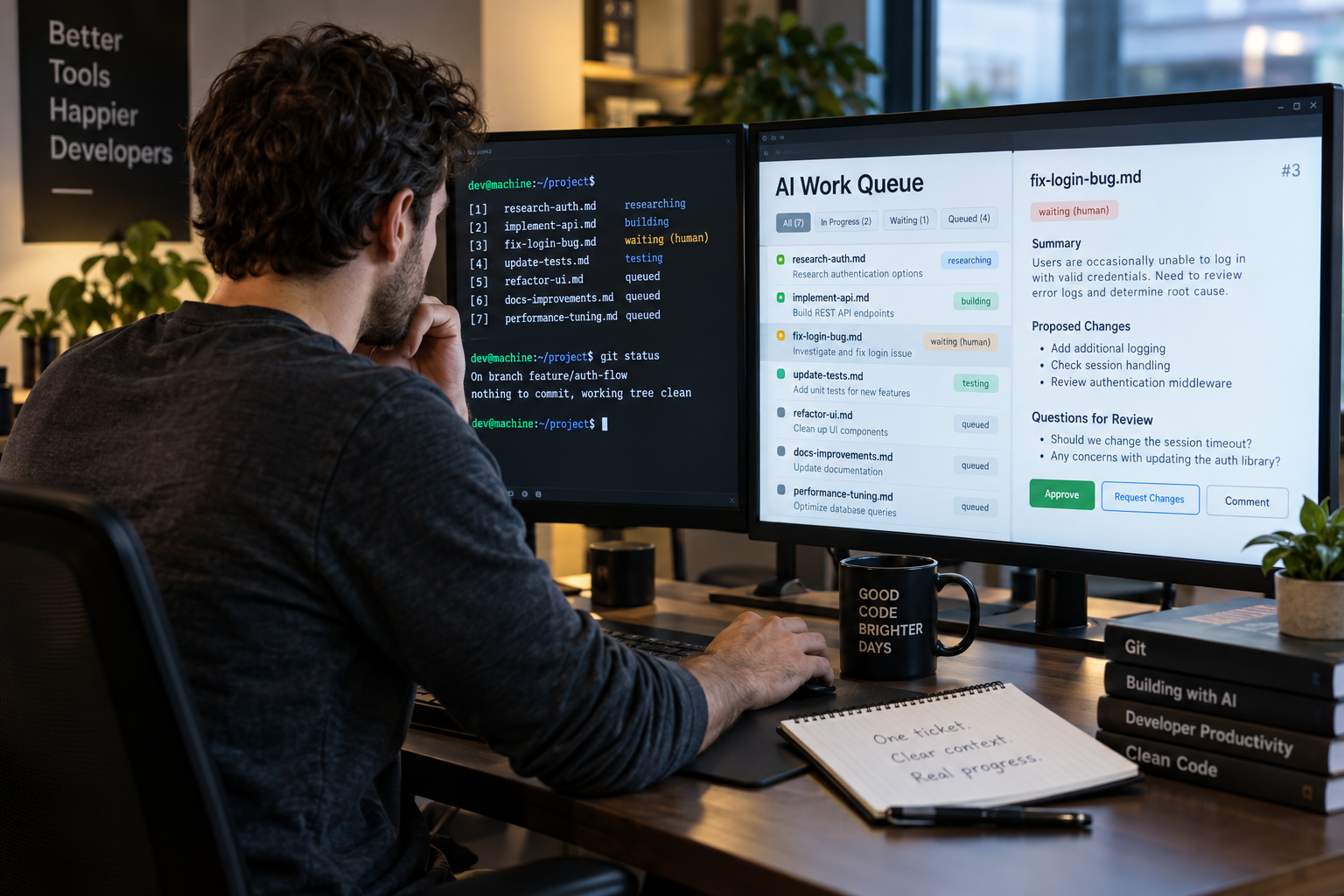
A developer who uses Claude Code and Codex from the terminal cut mental strain by replacing juggling roughly 20 chat threads with a git-based priority queue. Every ticket is a markdown file in the repository, an AI agent works the board in cycles, and anything needing human judgment goes to an owner inbox.
A developer who works with AI coding tools from the terminal says the mental strain of juggling many tasks at once had become unmanageable. Their fix was to stop switching between threads and start working through a queue.
The problem, as the developer describes it, starts with a familiar pattern. They launch a task with Claude Code or Codex, then start another while the first one is still running. When the first reply arrives, it needs a clarification, a follow-up or a side task, and each of those wants its own tab. Replies from other tabs keep coming in. Before long, the developer is hopping between roughly 20 threads and trying to hold every context in their head.
That, they say, is where things break down. Their brain gets exhausted, focus slips, and they lose track of what they were doing, where they started and where they were supposed to finish. Many people suggest taking breaks, thinking before typing or limiting scope. The developer decided to try a different approach aimed at two specific problems: sequencing and context.
How does a git-based work queue help developers manage AI coding tasks?
The solution works like a priority queue, and it lives in git. Every ticket is a markdown file stored in the repository, right next to the code it describes. The state of the board is a committed snapshot. The developer says nothing important lives in a chat window or in their memory. If a session crashes, the queue is still there.
An AI agent works the board in cycles. It researches new tickets and builds the ones a human has tagged as safe to build. It runs the tests and a browser check, and it verifies what is already deployed. For anything touching sensitive code, the agent builds on a branch and asks first. It never deploys to production. The developer keeps that step for themselves.
The agent cannot make decisions, so anything that needs the developer's judgment goes into what they call an owner inbox. A script reads the entire board and produces a prioritized list of items waiting on them. These might include reviewing a change, answering a question or ruling on a tradeoff.
How do developers review AI agent work without scrolling terminal output?
To review the work, the developer uses a Claude artifact, a single page rebuilt from git on every cycle. It mirrors the whole board and includes a review page for each ticket. Instead of scrolling back through terminal output to figure out what a change does, they open one link, read what was built and why, and give a verdict. That verdict is written back into git, onto the ticket's card. The web page is only a viewer. Git holds the record.
The developer says the most important step comes next. They take one item from the inbox, load its context, make a decision or request an action, and then close it by returning it to the queue. That closing step is what makes the system work, in their account. The ticket no longer lingers in their mind as something to remember. The context closes with it, so when they pick up the next item, they can focus on that one alone.
The work is still tiring, the developer acknowledges. But they say they no longer feel distracted or lost.
Getting there required solving practical problems in the tooling. The developer needed to deliver context in a readable form so that loading a ticket takes about a minute instead of twenty. They also had to keep tickets from cycling endlessly when they were blocked, waiting for a ruling that only the developer could make.
The developer describes the setup as a living system that they continue to refine. They say it marked a large step forward in their productivity with AI tools, which is why they decided to share it.
Este artigo foi escrito com a assistência de IA.
News Factory APP - notícias agênticas para impulsionar seu SEO e AEO.