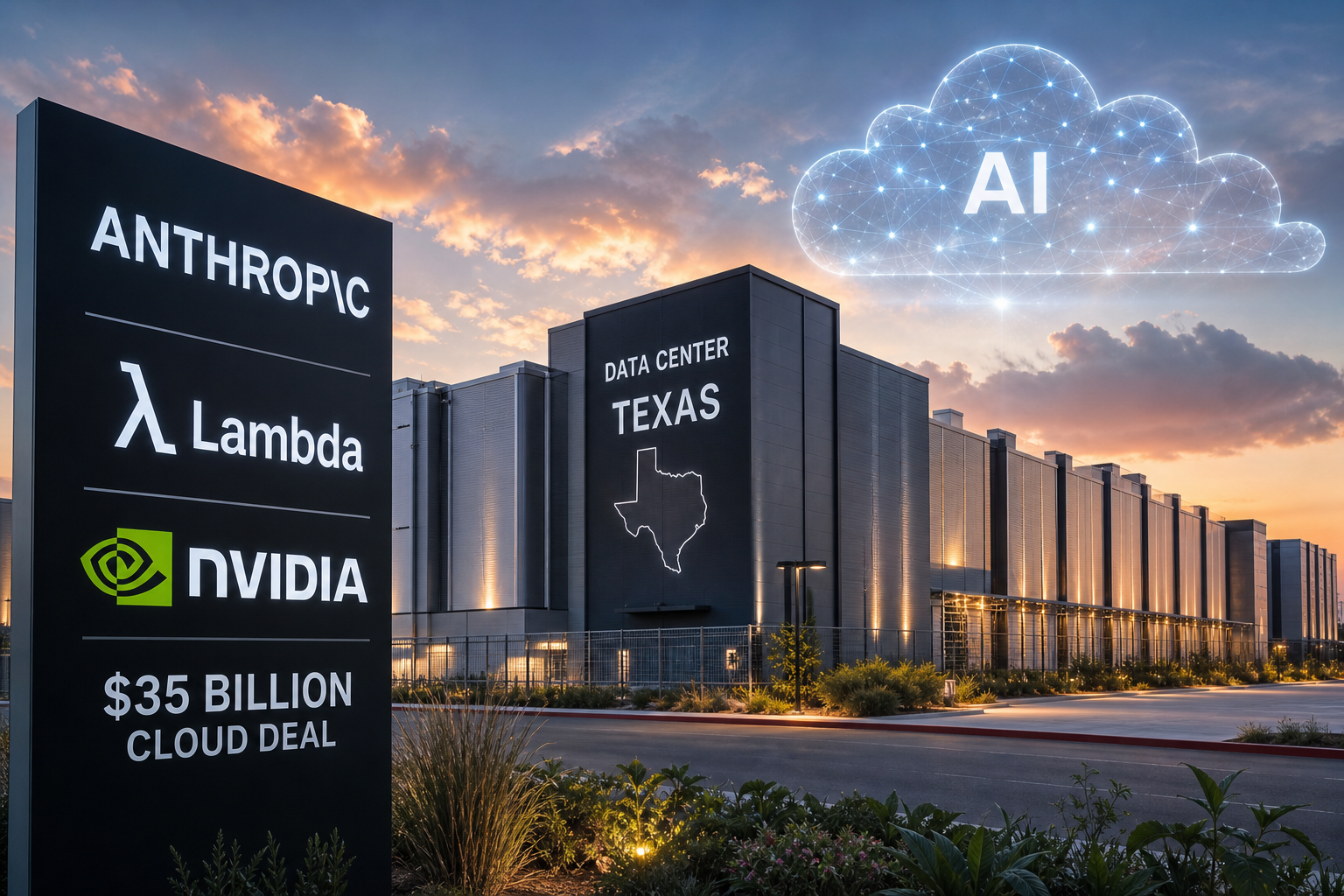
Anthropic has signed a massive $35 billion cloud deal with Lambda, a company backed by Nvidia, for capacity in a Texas data center. The deal, reported by The Wall Street Journal and confirmed by Reuters, marks one of several large commitments made by Anthropic in recent months. In July, the company agreed to spend $45 billion over six years with Nscale for capacity in West Virginia, and Amazon has separately announced that Anthropic will spend more than $100 billion on AWS over the next decade.
The Lambda deal is notable not only for its size but also for the complex structure behind it. Lambda holds the lease on a data center in Nueces County, Texas, developed by Hut 8, a former bitcoin miner. Nvidia, meanwhile, has a separate arrangement with Hut 8 to secure the capacity, and Lambda deploys Nvidia chips into the data center. This means that Nvidia appears at multiple points in the transaction, having invested in the tenant, contracted for the site, and supplied the hardware that fills it.
For Anthropic, the deal is part of a broader strategy to diversify its suppliers and reduce dependence on a single provider. The company has signed several large deals in recent months, including a $9.1 billion, 20-year deal with bitcoin miner Riot Platforms and a $10 billion arrangement with a week-old cloud startup. Anthropic has also been in early talks to lease $10 billion of compute from Meta, a company that competes with Anthropic for engineers and enterprise budgets.
The pattern behind these deals is clear: Anthropic is seeking to spread its contracts across multiple providers to reduce its dependence on any one company. However, this strategy also raises questions about concentration, as many of the providers Anthropic is working with are deploying the same vendor's chips in buildings that vendor helped secure. Bitcoin miners, in particular, are playing a key role in these deals, as they hold grid connections, land, and power contracts that are now the scarcest inputs in the industry.
Texas is also emerging as a key player in these announcements, thanks to its cheap land, separate grid, and permitting regime that moves faster than most. The state is becoming the default answer for companies that need a gigawatt of capacity in a hurry. However, it's worth noting that none of these commitments is a cost that has already been incurred. Instead, they are multi-year obligations against revenue that has been growing quickly but has not yet reached the scale the contracts assume.
Anthropic's run rate has been rising fast enough to make the arithmetic behind these deals defensible, having passed $30 billion earlier in the year. However, whether the company will reach the level these contracts assume is a different question from whether it is growing. That is the bet in every one of these deals: will demand continue to grow, and will the company be able to meet it with the capacity it is contracting for today?
Este artigo foi escrito com a assistência de IA.
News Factory APP - notícias agênticas para impulsionar seu SEO e AEO.