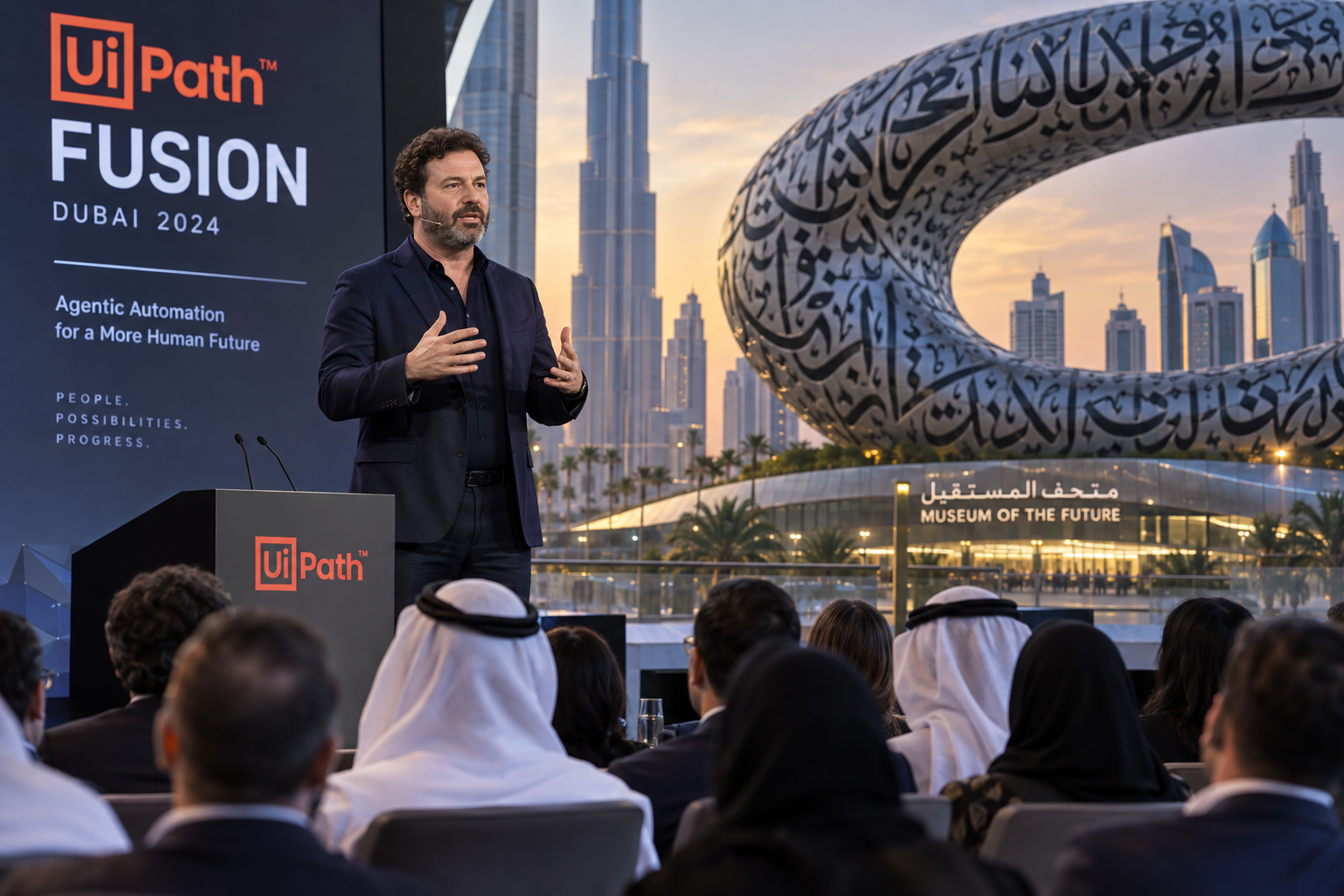
UiPath founder and CEO Daniel Dines told customers at the company’s FUSION event in Dubai on Monday that businesses will hand more and more work to artificial intelligence. People, he said, will have to steer that AI and answer for what it does.
Dines spoke at the Museum of the Future. He argued that the way people are trained has to change to match the shift. “We need to educate our people to take a lot more initiatives, because we’ll delegate a lot of the work to AI, and I think this is inevitable,” he said. “But for people, people will have to steer all this AI.”
He said today’s education system dates from the industrial revolution, roughly 200 years ago, when its job was to produce disciplined factory workers who followed orders from the top. That model, in his view, won’t hold up in an AI-driven economy. “This is not going to work in the world of AI,” he said.
Companies will need fewer narrow specialists and more people who understand whole systems, Dines said. He used lawyers as an example. An AI agent can learn the law from the books, he said, but it cannot know how that law applies inside a particular company.
Accountability stays with people
Accountability was one of three limits of AI that Dines laid out in Las Vegas in September, when UiPath launched Cartographer. The other two are that AI does not learn on the job and that it is not exact.
Who is responsible when an AI agent acts for a company?
In Dubai, he returned to that point with a practical warning. Once a company gives AI the autonomy to act, those actions carry consequences. Even an email an AI agent sends to a customer can commit the company to something. “So someone has to bear the consequences,” Dines said.
He also told companies not to use AI for work that ordinary software can already do reliably. Software can be tested, he said, and it gives the same answer every time. “If AI can do something, it doesn’t mean you have to.”
Instead, Dines suggested, AI should be used to build that software, with people reviewing and testing it before it runs. He drew on his experience writing his book, The Work That Remains, with AI. He said he rarely edited the text himself. “Believe me, guys, nobody is ever touching the code again,” he said.
Should companies keep hiring junior staff as AI takes on more work?
Dines also urged companies to keep hiring junior staff. Those workers, he said, need to work closely with senior colleagues from day one and see how decisions are made. “We have a responsibility for the young generation,” he said.
He called the UAE government “one of the most progressive” he works with on adopting AI and software, and described it as one of UiPath’s best partners.
Karl Crowther, who leads UiPath in the Middle East and Africa, opened the event. He has lived in the UAE for almost 20 years and described its people as resilient. Crowther said the companies that kept their core processes running through this year’s disruption were the ones that automated first. “Automation is almost like a shock absorber for what we’ve experienced,” he said.
Crowther said banks, government entities, retailers, and oil and gas companies in the UAE are already discussing advanced agentic automation with UiPath.
Este artigo foi escrito com a assistência de IA.
News Factory APP - notícias agênticas para impulsionar seu SEO e AEO.