What does Agentic Identity Broker do?
Zalando Engineering has released Agentic Identity Broker, a project designed to let AI agents reach third-party services on a user's behalf without ever holding that user's passwords or credentials. The tool sits in the path between agents and the services they call, handling the permissions, token storage and login handshakes that developers would otherwise build by hand.
Why do developers need an identity broker for AI agents?
The timing reflects a practical problem. An agent that needs to read a calendar, post to a company chat or open a code repository first has to prove it is allowed to do so. Today, that usually means a developer wires up OAuth2 flows for each service, stores the resulting tokens safely and keeps the arrangement running as systems change. The broker is built to take over that work.
According to the project documentation, the broker manages delegation chains for on-behalf-of flows, bridges separate OAuth2 infrastructures and includes a secure token vault. It is deployed inside the call path through gateways such as Agentgateway. The project says this offloads authentication tasks from both the people building agents and the people building Model Context Protocol servers, known as MCP servers.
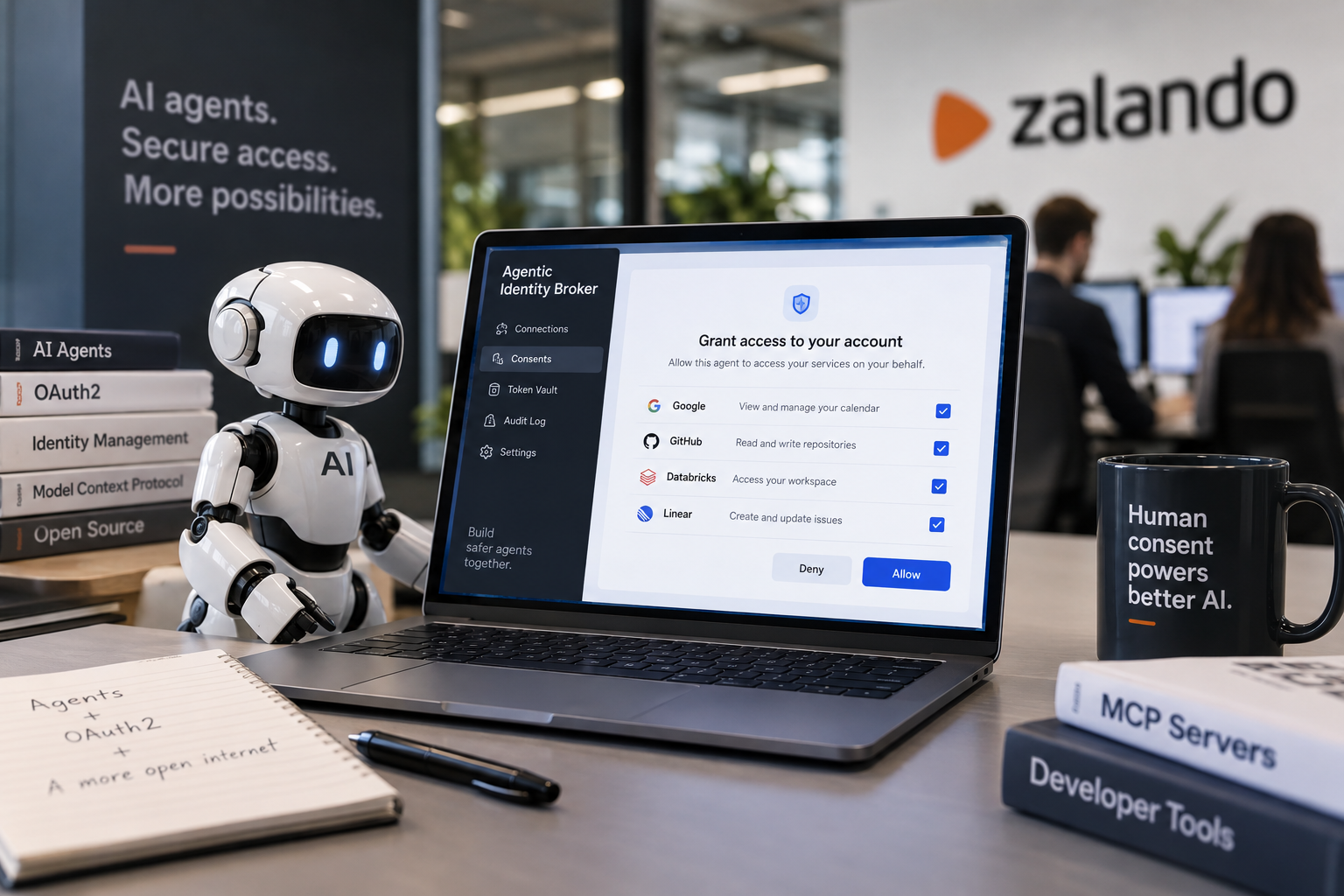
For end users, the most visible piece is a consent interface. The broker lets people grant agents granular permissions across services, and the project names Google, GitHub, Databricks and Linear as examples. The documentation describes a built-in consent management UI, and the scopes and consents it records can be managed without giving up control of the underlying accounts.
Why developers say they need it
The project's documentation lays out the current burden in some detail. Frameworks such as FastMCP can implement the full OAuth2.1 ceremonies that the MCP specification requires. But developers must configure that setup for every MCP server they deploy and then maintain it. They also need secure storage and, in effect, a collection of OAuth2 authorization servers running at once.
The broker aims to narrow that job. With the broker and a gateway in place, developers can concentrate on building the tools for the technology they are targeting. The OAuth2 ceremonies, token vaulting and token translation happen behind the scenes. Because token exchange runs centrally through a gateway, one agent can interact with hundreds of MCP servers through a single channel.
The documentation also describes several specific uses. Companies running internal MCP servers can skip per-server auth setup. Software-as-a-service providers that offer an MCP server to customers can use the broker as an additional consent point, keeping a record of which agents were used. Hosted agents can rely on a single user token that works across any number of MCP servers, with token procurement handled up front in a portal.
Two other features stand out. The impersonation function allows delegation chains to start from privileged clients, such as a bridge for Google Chat or Slack. The broker can be told to trust two independent machine identities to assume a particular user's session, which lets that user's permissions be applied in another third-party system. The tool approval feature, meanwhile, lets organizations enforce tool calls no matter which agent interface is in use. The project describes this as a last-resort check before an email is sent or a document is shared, with a central audit trail.
Security features and development status
What security features does the broker include?
The project lists several security measures, including redaction of sensitive values, prevention of command injection, cryptographic validation and a fail-closed architecture. It also produces structured JSON audit logs for compliance and security monitoring.
Zalando describes the project as still in active development. The team uses it in production internally for several MCP servers and says it has seen good potential. The project is being built in the open, and the team is asking users to share feedback and to open GitHub issues for features they need.
The project's roadmap lists three major areas: formalizing token exchange for agent-to-agent calls, intent-based authorization and user-facing activity logs. The documentation says the project was created by engineers with decades of experience in identity, including people who built multiple OIDC and OAuth2 providers. It also says every pull request is reviewed.
Agentic Identity Broker is a Zalando Engineering project. Developers can find the quickstart guide, concept documentation and API specifications on the project's website, along with contribution rules and test instructions in the repository.
Este artigo foi escrito com a assistência de IA.
News Factory APP - notícias agênticas para impulsionar seu SEO e AEO.