Will Google Penalize My AI Content?
The #1 question every business owner asks — and what Google actually says
Let's cut straight to the fear: you've been using ChatGPT or Claude to help write your blog posts, and now you're terrified Google will nuke your rankings. Maybe you read a headline about "thousands of AI sites deindexed." Maybe a competitor told you Google hates AI content.
Here's the truth, straight from Google's mouth.
On February 8, 2023, Google published its landmark guidance on AI-generated content. The heading said it all: "Rewarding high-quality content, however it is produced" [1]. Not "penalizing AI content." Not "preferring human content." Rewarding quality, period.
The blog post spelled it out explicitly: "Our focus on the quality of content, rather than how content is produced, is a useful guide that has helped us deliver reliable, high quality results to users for years" [1].
And Danny Sullivan, Google's Search Liaison, reinforced this in January 2023 when the CNET AI controversy erupted: "If content is helpful & created for people first, that's not an issue" [2].
Google's Bottom Line on AI Content
"Appropriate use of AI or automation is not against our guidelines. This means that it is not used to generate content primarily to manipulate search rankings."
— Google Search Central Blog, February 2023 [1]
So no, Google won't penalize you for using AI. But — and this is a critical "but" — Google will penalize you for publishing garbage. The distinction isn't about the tool you used. It's about whether the result actually helps the person reading it.
Google's same guidance also drew a clear line: "Using automation—including AI—to generate content with the primary purpose of manipulating ranking in search results is a violation of our spam policies" [1]. That's a very specific warning about intent, not about technology.
Or as the guidance put it most bluntly: "If you see AI as an essential way to help you produce content that is helpful and original, it might be useful to consider. If you see AI as an inexpensive, easy way to game search engine rankings, then no." [1]
The rest of this article breaks down exactly what happened since that 2023 guidance — the crackdowns, the data, the winners and losers — so you can use AI confidently and rank well doing it.
How Google's Stance Evolved
From 'written by people' to 'however it is produced' — a four-year shift
Google's relationship with AI content didn't start with a warm embrace. It evolved through a series of policy updates that tell a clear story: Google moved from skepticism to quality-agnostic acceptance, while tightening the screws on abuse.
Google's AI Content Policy Timeline
Key milestones from the first Helpful Content Update to today
First Helpful Content Update
Google targets content 'written by people, for people.' Aimed to reward satisfying user experiences and demote content created primarily for search engines.
Second Helpful Content Update
Expanded globally with improved low-quality content detection. Took 38 days to roll out fully.
Google's AI Content Guidance
Landmark blog post: 'Rewarding high-quality content, however it is produced.' Google officially accepted AI content as potentially valuable.
'Written by People' Removed
Google quietly removed the phrase 'written by people' from its guidance. New language: 'helpful content created for people.' A clear signal AI-authored content was acceptable.
Core Update Absorbs HCU
Helpful Content System folded into core ranking. Three new spam policies: scaled content abuse, expired domain abuse, site reputation abuse. 45% reduction in low-quality content.
Sullivan: 'SEO for AI Is Still SEO'
Danny Sullivan confirmed no special formatting needed for AI search. Content quality principles remain unchanged regardless of how search evolves.
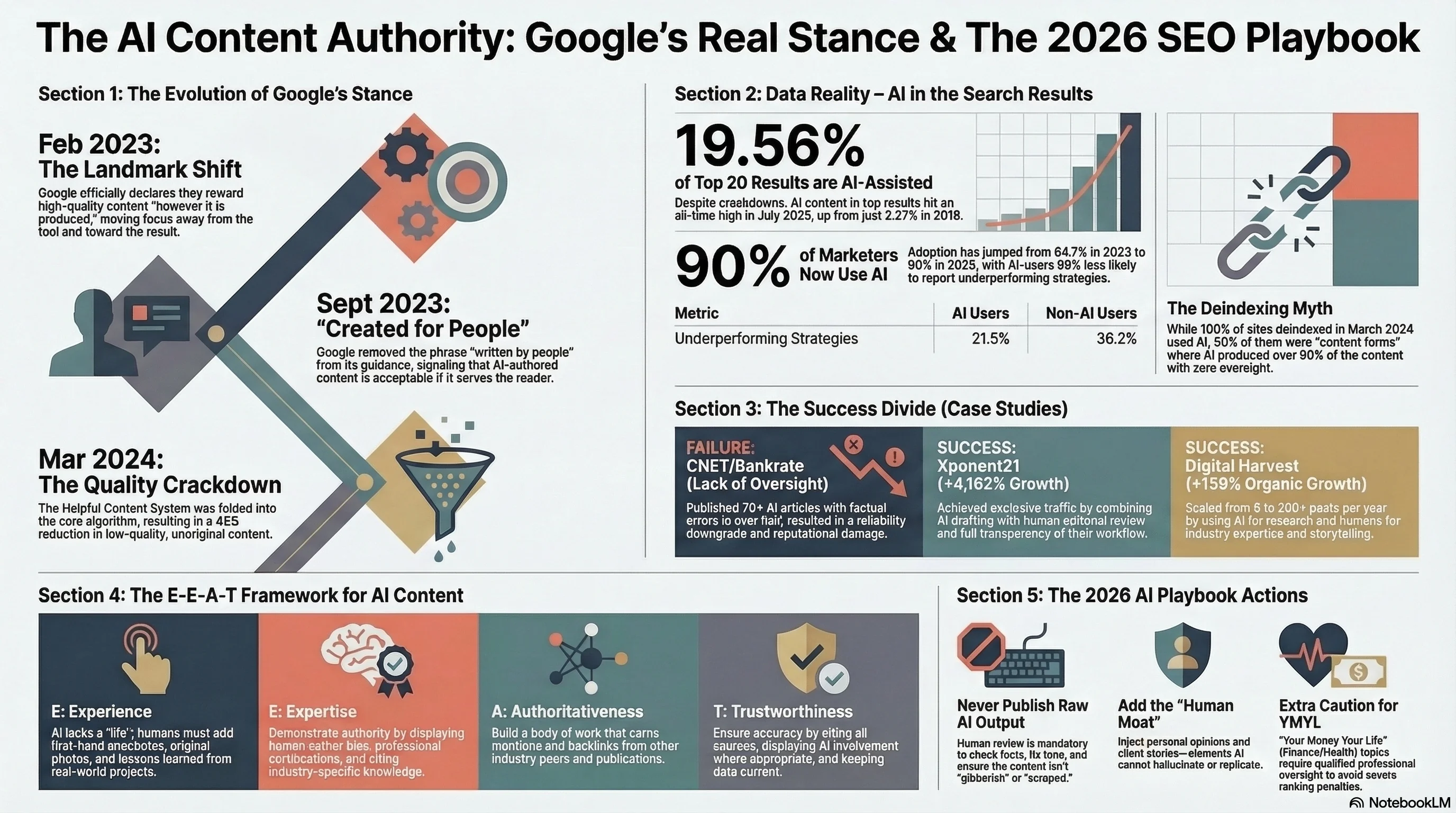
The most telling moment came in September 2023. Google quietly edited its guidance, removing the phrase "written by people" and replacing it with "created for people" [3]. That wasn't an accident. It was a deliberate signal: Google no longer cared who (or what) wrote the content. It cared whether the content served readers.
Then in March 2024, the Helpful Content System was absorbed entirely into Google's core ranking algorithm [4]. There's no separate "helpful content" signal anymore. As Danny Sullivan explained in September 2024: "We have a core ranking system that's assessing helpfulness on all types [of content]" [5].
Translation: every page gets evaluated on the same helpfulness criteria, regardless of whether a human, an AI, or a human-AI team created it.
Don't Confuse Policy Acceptance with a Free Pass
What the March 2024 Update Actually Targeted
Scaled content abuse, not AI — and the numbers prove it
The March 2024 core update was Google's biggest crackdown on low-quality content in years. But the narrative that it "targeted AI content" is wrong. It targeted scaled content abuse — and the distinction matters enormously [4].
Google introduced three new spam policies alongside the core update:
1. Scaled Content Abuse
Mass-producing pages to manipulate rankings, "no matter how it's created" — human or AI. The old "automatically-generated content" policy was renamed to focus on behavior, not method.
2. Expired Domain Abuse
Buying expired domains to host low-quality content, exploiting their existing authority.
3. Site Reputation Abuse ("Parasite SEO")
Third-party pages published on trusted sites without oversight, exploiting the host's ranking signals.
The result? Google announced on April 26, 2024 that the update delivered a 45% reduction in low-quality, unoriginal content — exceeding their own 40% target [6].
Now here's where the Originality.AI study becomes essential reading. They analyzed 79,000 websites after the March 2024 update and found 1,446 sites had been deindexed [7]. The headlines screamed "Google penalizes AI content!" But the details told a different story:
The March 2024 Deindexing Reality
Originality.AI study of 79,000 websites — what actually happened
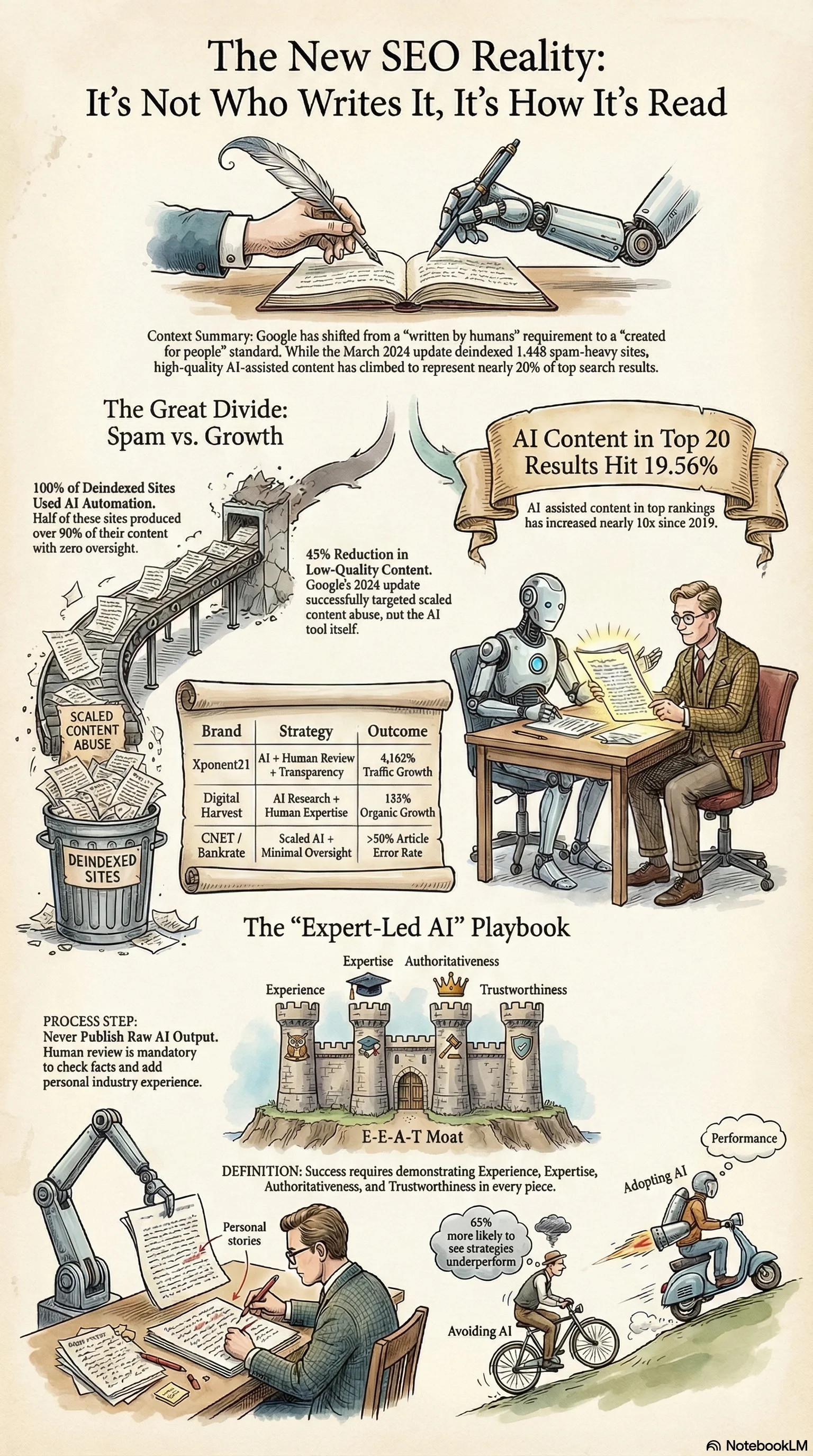
Yes, 100% of the deindexed sites used AI. But look at the context: 50% had produced over 90% of their content with AI automation [8]. These weren't businesses using AI as a writing assistant. They were content farms churning out hundreds or thousands of pages with zero editorial oversight, plastered with ads, offering nothing readers couldn't find elsewhere.
The "Pure Spam" manual action descriptions said it plainly: sites showed "aggressive spam techniques such as automatically generated gibberish, cloaking, scraping content from other websites" [9].
The takeaway isn't "AI content gets penalized." It's "lazy, scaled, unedited content gets penalized — and AI just makes it easier to be lazy at scale."
AI Content Is Climbing the Rankings
From 2% to nearly 20% of top results — and still rising
If AI content were truly being penalized, you'd expect to see less of it in Google's top results. The data shows the exact opposite.
Originality.AI has been tracking AI content in Google's top 20 search results since 2019, sampling 500 popular keywords bimonthly [10]. The trajectory is unmistakable:
AI Content in Google's Top 20 Results
Percentage of top-ranking content identified as AI-generated — Source: Originality.AI
Note the post-March 2024 surge: despite the crackdown, AI content in top results grew from ~7% to nearly 20%.
In February 2019, AI content made up just 2.27% of top results. By July 2025, that number hit an all-time high of 19.56% [10]. Even after the massive March 2024 crackdown, AI content in top results increased — from 7.43% pre-update to 10.18% immediately after, then continued climbing.
That's not a contradiction. The March 2024 update removed the worst AI content (spam farms, gibberish, scraped rewrites) while quality AI-assisted content continued to rank. The update raised the floor by clearing out garbage, and well-crafted AI content filled the space.
Meanwhile, adoption is skyrocketing. 90% of content marketers plan to use AI in their strategies — up from 64.7% in 2023 [11]. And here's the kicker: only 21.5% of marketers using AI report underperforming strategies, compared to 36.2% of those who don't use AI [11].
Content Marketers Using AI (Year over Year)
Source: Siege Media + Wynter annual surveys [11]
The Competitive Reality
The E-E-A-T Framework for AI Content
How to make Google's quality standards work for you, not against you
Google's February 2023 guidance said it directly: "However content is produced, those seeking success in Google Search should be looking to produce original, high-quality, people-first content demonstrating qualities E-E-A-T" [1].
E-E-A-T isn't a checklist Google's algorithm runs through mechanically. It's a framework — a set of qualities that Google's various ranking systems collectively assess across your content. Here's what each letter means and how to demonstrate it when using AI:
Experience
Has the author actually done, used, or lived what they're writing about?
Expertise
Does the author have credentials or demonstrated knowledge?
Authoritativeness
Is the author or site recognized as a go-to source?
Trustworthiness
Can the content be trusted? Is it accurate and transparent?
Google recommends evaluating your content through three questions: Who created it, How was it created, and Why was it created [1]. For AI-assisted content, that means being transparent about your process while making sure the "why" is always "to help the reader" — not "to fill a keyword gap."
YMYL Content: Extra Caution Required
Google's January 2025 Search Quality Rater Guidelines update made the distinction razor-sharp. The Lowest Quality rating applies when content is "copied, paraphrased, embedded, auto or AI generated or reposted from other sources with little to no effort, little to no originality, and little to no added value" [12]. Three conditions must all be true: little effort, little originality, little added value. Meet even one of those, and you're in the clear.
Before Publishing Any AI-Assisted Content, Verify:
Case Studies: What Went Wrong vs. What Went Right
The difference between deindexing and 4,162% growth
Nothing illustrates the AI content divide better than real examples. Some companies used AI and got crushed. Others used AI and saw explosive growth. The difference wasn't the technology — it was the approach.
🚫 What Went Wrong
CNET / Bankrate
>50% articles had errorsPublished 70+ AI articles with minimal disclosure, generic bylines, and factual errors in over half. Wikipedia downgraded CNET's reliability rating.
Lesson: No editorial oversight + deceptive disclosure = reputational damage
March 2024 Spam Sites
1,446 sites deindexedHundreds of sites mass-producing AI content at scale with zero editorial oversight, plastered with ads, providing no original value.
Lesson: Scaled content abuse — quantity over quality at extreme levels
CNET's story is particularly instructive. Between November 2022 and January 2023, CNET published over 70 AI-generated articles through CNET Money [13]. The articles targeted lucrative affiliate keywords (credit card sign-ups, financial products) under a generic "CNET Money Staff" byline. The Verge found factual errors in more than half of them [14]. CNET paused AI publishing in January 2023, and Wikipedia downgraded their reliability rating in February 2024 [15].
The problem wasn't AI. It was publishing AI content about financial products (a YMYL topic) with minimal editorial oversight, poor disclosure, and clear intent to chase affiliate revenue rather than help readers.
✅ What Went Right
Xponent21
4,162% traffic growthAI-assisted SEO content combined with human editorial review and public disclosure. Reached top results for competitive keywords by spring 2025.
Lesson: AI drafting + human expertise + transparency = compounding growth
Digital Harvest
159% organic growthScaled from 6 blog posts in 2024 to 200+ in 2025 using AI-assisted production with editorial oversight. Total traffic grew 144% and organic traffic grew 159% in one year.
Lesson: AI enables volume; human oversight ensures quality at scale
Xponent21's 4,162% traffic growth is the standout [16]. They used AI to draft content, then had their team review every piece, add expert insights, and publicly disclosed their AI-assisted workflow. The transparency didn't hurt them — it reinforced trustworthiness.
Digital Harvest scaled from 6 blog posts in all of 2024 to over 200 in 2025, growing organic traffic by 159% [17]. The unlock was using AI to handle research and first drafts, freeing their team to focus on what humans do best: adding industry expertise, client stories, and strategic insight.
The Pattern Is Clear
Every failure shares the same traits: no editorial oversight, no original value, deceptive or absent disclosure, and content designed for search engines rather than readers.
Every success shares the same traits: AI handles drafts and research, humans add expertise and review everything, disclosure is transparent, and the content genuinely helps readers.
Your AI Content Playbook
Six actionable steps to rank with AI content — starting today
You've seen the data. AI content ranks. It's everywhere in the top results. Google explicitly allows it. But the line between 4,162% growth and getting deindexed is clear. Here's your playbook for staying on the right side of it.
Every piece goes through human review. Check facts, add experience, fix tone. This alone separates you from the sites that got deindexed.
Personal anecdotes, client stories, local knowledge, professional opinions. This is your E-E-A-T moat.
Every stat needs a source. Every claim needs backing. AI hallucinates — you verify. This builds trustworthiness signals.
Google recommends disclosure 'for content where someone might think how was this created.' Don't list AI as the author — credit your human editorial team.
Ask: does this page answer a real question better than what's already out there? If not, improve it until it does.
Health, finance, legal content gets extra scrutiny. Always have a qualified professional review AI-generated YMYL content.
The businesses winning with AI content in 2026 aren't the ones producing the most content. They're the ones producing consistently helpful content at a pace their team can sustain. AI doesn't replace your expertise — it multiplies it. You still need to know your craft, understand your customers, and have opinions worth sharing. AI just handles the parts that used to eat your entire afternoon: research, structuring, drafting.
Think about the math. Digital Harvest went from 6 posts a year to 200+ in 2025 [17]. Not because they hired 30 writers. Because AI handled the heavy lifting and their small team focused on what matters: making each piece genuinely useful.
That's the model. And the data says it works. AI content in Google's top 20 results grew from 2.27% to nearly 20% [10]. 90% of marketers are using AI [11]. Those who don't are 68% more likely to underperform [11].
The Bottom Line
Google doesn't penalize AI content. Google penalizes bad content — and AI just makes it easier to produce bad content at scale if you're not careful. The businesses getting deindexed treated AI as a content-printing machine. The businesses growing treated AI as a drafting partner that still needs a human editor, a human expert, and a human reader in mind.
If you're a small business owner, you already have the hardest part figured out: real expertise, real experience, real customers. What you probably don't have is time to turn all of that into a steady stream of content that climbs the rankings.
That's where tools like News Factory come in — AI-powered content that builds on your expertise, goes through editorial oversight, and publishes at a pace that actually moves the needle. You bring the experience and E-E-A-T. The AI handles the scale. Google rewards the result.