Three phrases get thrown around as if they compete: AI content agent, AI writer, and traditional CMS. They do not compete. They sit at different points in the same pipeline, and buyers lose weeks - and budget - comparing tools that were never alternatives. This guide defines each one in a single extractable block, lays them side by side across the dimensions that actually matter, resolves the confusion, and ends with a plain decision guide for which one you need.
Insight
What Is an AI Content Agent?
The autonomous operator that runs the whole pipeline
An AI content agent is software that works across multiple steps on its own - it plans what to cover, researches with live tools, drafts, self-checks, and publishes on a schedule, with a human approval gate rather than a human doing each step by hand. The defining trait is autonomy: you set the goal and the guardrails, and the agent runs the loop.
This is the newest of the three categories and the one buyers understand least, because the label "agent" is used loosely. A true content agent does more than generate text. It uses tools - web search, RSS feeds, source URLs, translation, and your CMS's publishing API - to move a topic from idea to a live page. Industry analysts expect this pattern to become mainstream fast: Gartner projects that 40% of enterprise applications will feature task-specific AI agents by 2026, up from effectively zero in 2024, and that a third of enterprise software will include agentic AI by 2028.
Recommendation
What Is an AI Writer?
The single-step draft machine
An AI writer is a single-step tool that turns a prompt or keyword into a draft - you ask, it writes one piece, and it stops. It does not research the live web, it does not publish, and it does not run on its own. ChatGPT, Claude, Jasper, and most "AI blog post generator" tools live here. They are genuinely useful, and for many publishers they are all that is needed.
The key limitation is not quality - modern writers draft well. It is scope. A writer hands back text and returns control to you. Every subsequent step - checking the facts, adding sources, formatting, translating, uploading, scheduling - is yours to do by hand, every single time. That is fine at two posts a month and painful at twenty.
How Much of the Topic-to-Published Pipeline Each Covers
Coverage of plan → research → draft → check → publish, rated 0-10 (higher = more hands-off)
A traditional CMS scores low here because creation is not its job at all - it is the layer the finished piece is published into. A high score is not automatically "better"; it is only better if hands-off publishing is what you actually want.
What Is a Traditional CMS?
The system that stores and serves your pages
A traditional CMS (content management system) is the software that stores, formats, and publishes your content on the web - it manages pages, posts, and media, but it does not create the content for you. WordPress is the archetype, and it is not a niche one: as of August 2026 it powers 40.8% of all websites and holds a 59% share of the CMS market, according to W3Techs.
A CMS is a container and a delivery layer. It renders your pages, handles URLs and templates, schedules posts, and serves everything to readers and to search and answer engines. What it does not do is decide what to write or write it. The "AI" buttons now appearing inside CMS platforms are AI writers embedded in the container - helpful, but still single-step drafting, not autonomy. And a CMS carries its own ongoing cost: themes, plugins, security patches, and hosting are all yours to maintain.
Ongoing Maintenance Burden After Setup
How much hands-on upkeep each keeps demanding, rated 0-10 (higher = more forever-work)
Maintenance is the cost buyers forget. A CMS is cheap to start and expensive to keep secure and current. An agent front-loads the setup (niche, cadence, approval rules) and then mostly asks you to review a queue.
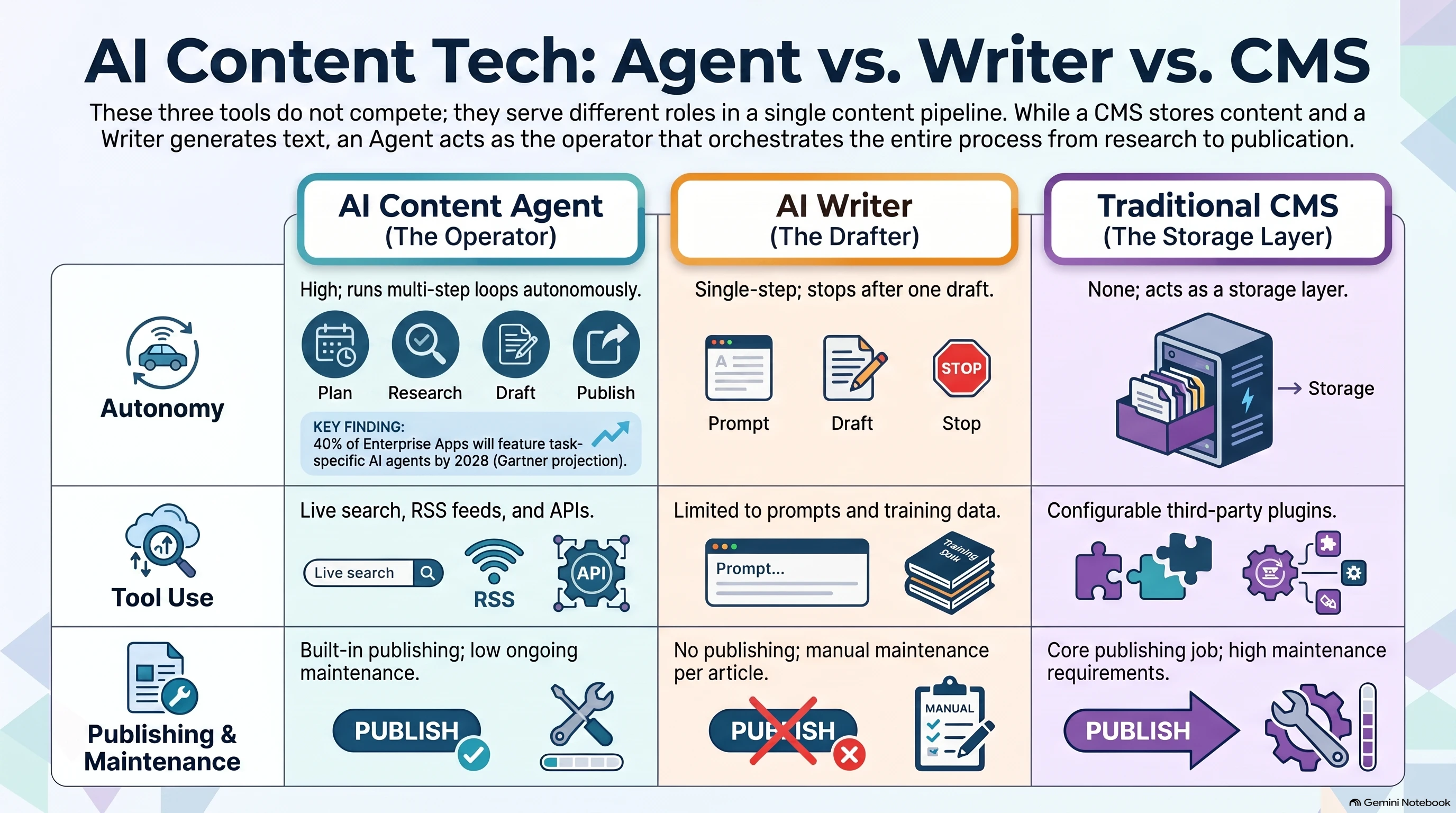
How Do They Compare Across Autonomy, Tools, Publishing, and Maintenance?
The three, side by side, on the dimensions that decide the purchase
Here is the whole comparison in one scan. Read each row against how you actually publish, not against the marketing label on the box.
AI Content Agent vs AI Writer vs Traditional CMS
Six dimensions, three categories (verified August 2026)
| Dimension | AI Content Agent | AI Writer | Traditional CMS |
|---|---|---|---|
| Autonomy | Multi-step, runs on its own | Single step, one draft | None (storage layer) |
| Tool use | Live: search, feeds, URLs, APIs | Prompt + training data | Plugins you configure |
| Publishing | Built in, scheduled | None - you paste it | Core job (renders + serves) |
| Maintenance | Low: set niche + rules once | Per-article, every time | High: updates, plugins, security |
| Creates content? | Yes, end to end | Yes, one piece at a time | No |
| Best-fit user | Publishers who want fresh volume hands-off | Writers who want fast drafts + control | Anyone who needs a place to publish |
AI Content Agent
An AI content agent is software that works across multiple steps on its own - it plans, researches with live tools, drafts, self-checks, and publishes on a schedule - with a human approval gate rather than a human doing each step.
Best fit: Publishers and small teams who need a steady stream of fresh, on-topic articles without writing each one.
AI Writer
An AI writer is a single-step tool that turns a prompt or keyword into a draft - you ask, it writes one piece, and it stops. It does not research live, publish, or run on its own.
Best fit: Anyone who wants fast first drafts and enjoys keeping full manual control of research and publishing.
Traditional CMS
A traditional CMS (like WordPress) is the system that stores, formats, and publishes your content on the web - it manages pages and media, but it does not create the content for you.
Best fit: Everyone who needs a home for content - it is the layer the other two ultimately publish into.
Why Do Buyers Confuse Them?
Four myths that cost real time and money
The confusion is not stupidity - it is vendor language. Everyone markets "AI," "automation," and "agents," so the words stop meaning anything specific. Here are the four mix-ups that come up most, and the plain reality of each.
“An AI writer and an AI agent are the same thing.”
A writer produces one draft from one prompt and stops. An agent runs a loop - it decides what to cover, gathers sources, drafts, checks, and publishes - without you prompting each step. Autonomy is the dividing line.
“My CMS has an AI button, so I already have an AI agent.”
An AI writing plugin inside a CMS is still a writer: it drafts when you click, then waits. It does not monitor your niche or publish on its own. The CMS is the destination; the agent is the operator that fills it.
“An AI content agent replaces my CMS.”
It does not. Agents create and schedule; the CMS still stores, formats, and serves the pages. A good agent publishes into your existing CMS (WordPress, Drupal, Joomla) rather than replacing it.
“More automation means no humans.”
Even a fully agentic setup keeps a person on the two ends: what is worth covering, and whether a piece is true and on-brand before it goes live. The middle is automated, not the judgment.
Warning
How Do They Work Together?
The agent orchestrates; it does not replace
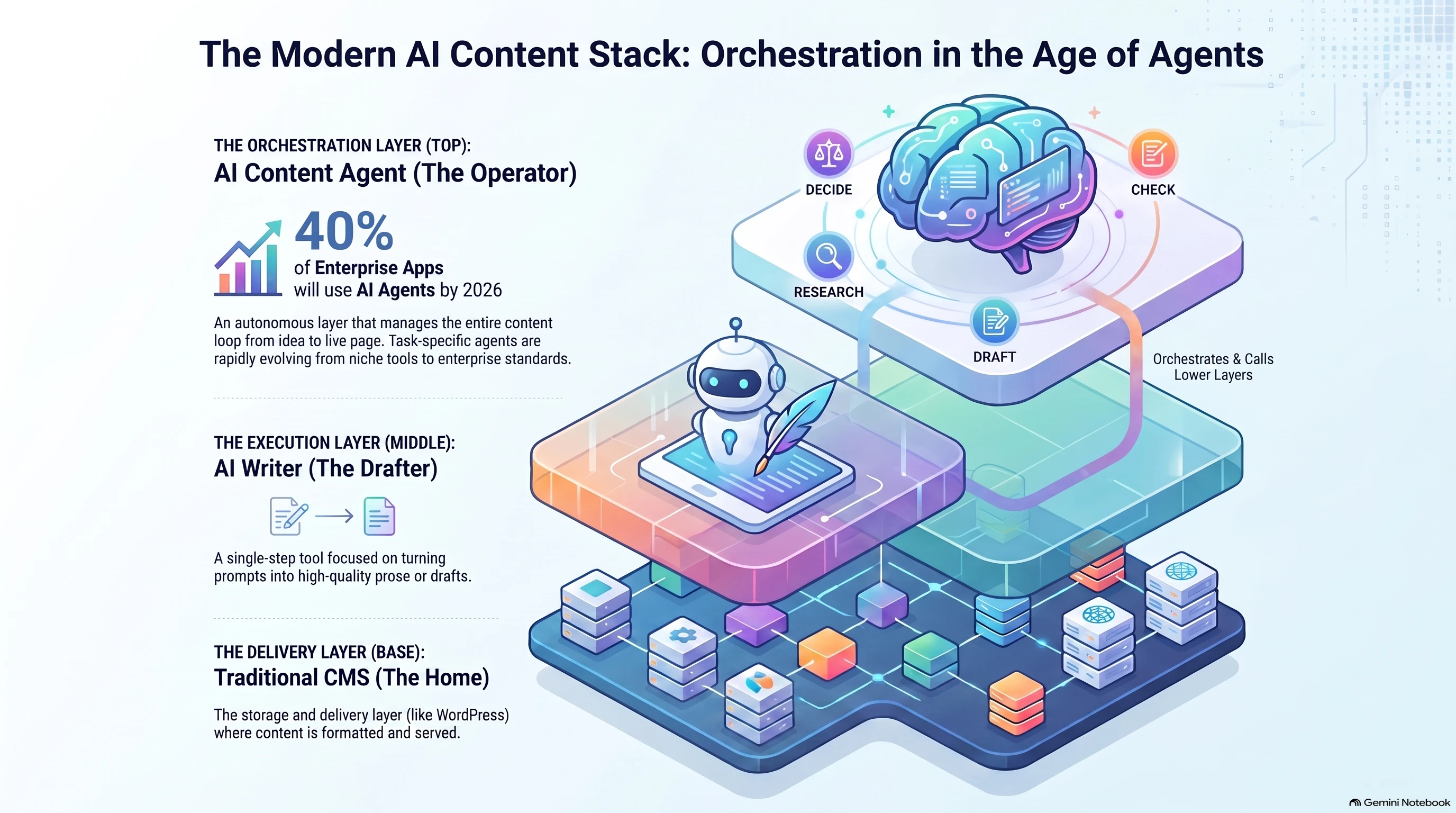
The most useful mental model is a stack, not a fight. These three are layers, and the agent is the one that ties the others together. It is not a replacement for your CMS, and it is more than a writer - it is the operator that uses a writer's drafting ability and a CMS's publishing ability to finish a job end to end.
AI Content Agent
The operator. Decides, researches, drafts, checks, and triggers publishing across the whole pipeline.
AI Writer
A tool the agent can call (or you use directly) to turn a brief into prose for a single piece.
Traditional CMS
The destination. Stores, formats, and serves the finished pages to readers and to search and answer engines.
News Factory is a working example of the agentic content agent category described in this article - the orchestration layer that sits above a plain AI writer and a traditional CMS. Its AI agents monitor RSS feeds in your niche, surface trending stories, research and draft full articles autonomously, and then auto-publish on a schedule you define (with an approve-before-publish gate or fully autonomous mode, your choice). It also handles multilingual publishing to up to 5 target languages and can auto-publish into WordPress, Drupal or Joomla. That combination - discover, write, and publish as one loop rather than three disconnected tools - is exactly what separates a content agent from an AI writer bolted onto a CMS.
Insight
Which One Do You Actually Need?
Start from how you publish, and the answer picks itself
You almost certainly already have a CMS. The real decision is what sits on top of it. Match your situation to a row and stop overthinking it.
If: You just need a place to publish and will write elsewhere
Pick: A traditional CMS (WordPress is the default) - it is the home your content lives in.
If: You write yourself and want faster first drafts
Pick: An AI writer bolted onto your CMS, with your own editing and fact-check pass.
If: You publish rarely and enjoy driving every step
Pick: A raw AI writer plus your CMS is plenty - automation would be overkill.
If: You need a steady stream of fresh, on-topic articles without writing each one
Pick: An AI content agent that orchestrates writing and publishes into your CMS on a schedule.
Recommendation
If that last case is you, an agentic system like News Factory is built for exactly that job: it keeps the blog active in your niche while you keep the final say on what goes live. If it is not you, one of the other two layers is the honest answer - and now you can tell which.
References & Sources
Article also available in: