You know you should be publishing content. Every marketing guide says so. The data confirms it — companies publishing 16+ blog posts per month get 3.5× more traffic than those posting 0–4 times. Small companies (10 employees or fewer) that publish 11+ posts per month see nearly 3× the traffic of those posting once or not at all.
But you're one person. You're the CEO, the sales team, the customer support, the accountant, and apparently now the content department. The average blog post takes 3 hours and 48 minutes to write. At that rate, publishing three posts a week would eat 11+ hours — more than a full workday — just on writing.
So most solopreneurs do what's natural: they start a blog, publish three posts in a burst of motivation, then go silent for six weeks. The calendar sits empty. The guilt piles up. And the "I should blog more" thought becomes background noise you've learned to ignore.
This guide is for you. Not a 50-person marketing team. Not an agency with writers on retainer. You. One person who needs a system that actually works — with the time you actually have.
The Content Calendar Reality Check
Why most solopreneurs fail at consistency — and what the data says about it
The gap between intention and execution in small business content marketing is enormous. 78% of small businesses now use content marketing. 79% of marketers actively run a blog. Yet the most common publishing frequency? Just 2–4 times per month. And that's the average — which means plenty of businesses are publishing even less.
The disconnect isn't lack of desire. It's lack of system. When you don't have a content calendar, every blog post becomes an existential question: What should I write about? Do I have time today? Is this topic even worth it? That decision fatigue alone kills more content programs than writer's block ever could.
Insight
Here's what the data says about what consistent publishing actually delivers:
Publishing Frequency vs Business Impact
Why consistency matters more than perfection
Sources: HubSpot benchmarking data [3], SQ Magazine 2025 [4], DemandSage 2026 [1]
Brands publishing weekly saw a 3.5× increase in conversions versus monthly publishers. Companies with blogs have 434% more indexed pages. The math is clear: more consistent, quality content = more traffic, leads, and revenue. The challenge is building a system that makes consistency possible when you're doing everything yourself.
Content marketing generates 3× more leads than outbound marketing and costs 62% less. The average ROI is $7.65 per $1 spent. You can't afford not to publish consistently — but you also can't afford to spend half your week writing. The solution isn't working harder. It's working systematically.
The Framework: Pillar + Cluster for One
How to plan content themes quarterly — without a strategy team
If you take one thing from this article, let it be this: stop brainstorming topics from scratch every week. The pillar + cluster model eliminates that problem entirely.
Here's how it works. A pillar page is a comprehensive, long-form resource (2,000+ words) covering a broad topic relevant to your business. Cluster pages are shorter, focused articles covering specific subtopics — each linking back to the pillar. The pillar links out to every cluster. You get a tightly interconnected content web that search engines love.
The results from real businesses are hard to ignore:
Pillar + Cluster Content Results
What topic clustering delivers for real businesses
Sources: Sedestral [11], Nation Media Design [10], Search Engine Land [9]
Properly built clusters generate ~30% more organic traffic and maintain rankings 2.5× longer than standalone articles. Nation Media Design reported a 46% average increase in organic traffic within six months for clients using content clusters. One HubSpot case study documented 37,900% traffic growth — from 500 to 190,000 monthly visitors — through systematic topic cluster implementation.
Recommendation
Example for a solo consultant:
Pillar: "The Complete Guide to Email Marketing for Small Businesses"
Clusters:
- Best email marketing platforms for solopreneurs
- How to write subject lines that get opened
- Email automation sequences for beginners
- How to grow your email list from zero
- Email marketing metrics that actually matter
- How to segment your audience with a small list
That's your pillar page plus six cluster posts — enough content for six weeks, all mapped out in one planning session. Every piece supports the others. Every link strengthens your authority. And you never had to stare at a blank page wondering what comes next.
Batch Creation: Your Secret Weapon
The methodology that turns 2 hours into a week of content
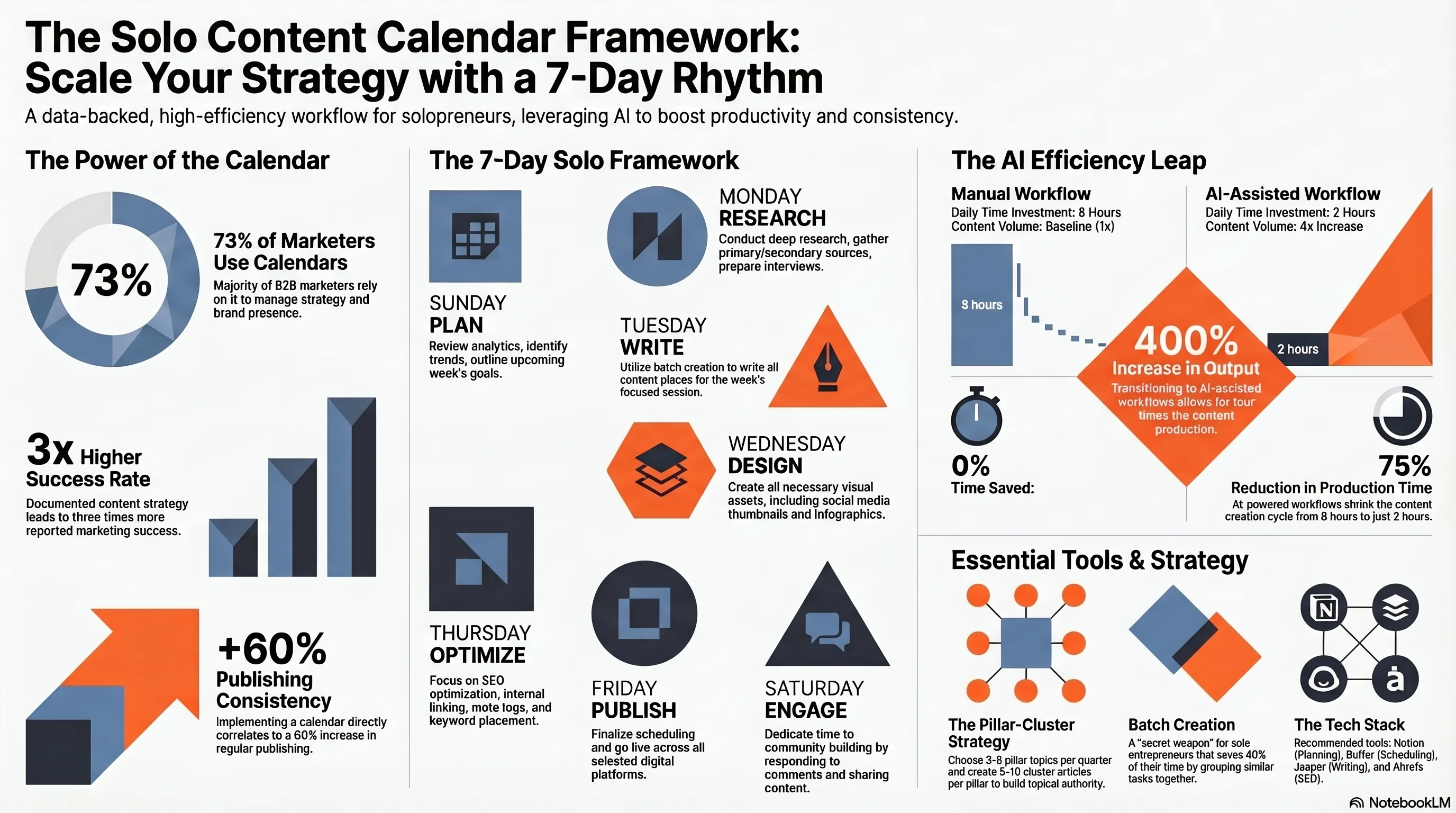
Batch content creation is the productivity hack that separates solopreneurs who publish consistently from those who don't. The concept is simple: instead of writing one post Monday, designing one graphic Tuesday, and drafting one email Wednesday, you do all the writing in one focused session, all the design in another, and all the scheduling in a third.
Context-switching is a productivity killer. Every time you shift from "writer mode" to "designer mode" to "editor mode," you lose 15–25 minutes getting back into flow. Batching eliminates that. You stay in one mode, build momentum, and produce more in less time.
Combined with repurposing (which we'll cover next), batch creation can save you 60–80% of creation time compared to starting every piece from scratch.
The 2-2-2 Method for time-crunched solopreneurs:
2
Long-form pieces per month
Blog posts, videos, or podcast episodes. These are your pillar and cluster content.
2
Social posts per week
Derived directly from your long-form content. Repurpose, don't recreate.
2
Hours per week total
That's it. Two focused hours. Batched, systematized, consistent.
The weekly rhythm that works:
- Monday (30 min): Plan and outline the week's content. Review what's already queued. Adjust based on last week's analytics.
- Tuesday–Wednesday (focused blocks): Batch writing and creation sessions. Do all the writing in one sitting. All the visuals in another.
- Thursday (30 min): Edit, add visuals, schedule everything for the week ahead.
- Friday (30 min): Engage with your audience. Review analytics. Note what performed well for future planning.
Successful solopreneurs with an established batch system report spending only a couple of hours per month on content once the flywheel is running. The upfront investment is in building the system. Once it's built, maintenance is minimal.
Repurpose Everything
One blog post → 10+ pieces of content. The multiplication framework.
Only 35% of marketers actively repurpose content across channels. That's a massive competitive advantage for you — because the solopreneurs who do repurpose see a 40% increase in content output without proportionally increasing time or resources.
The numbers on repurposing are striking:
Content Repurposing Impact
Why creating once and distributing everywhere is the solopreneur advantage
Sources: AutoFaceless/BlogHunter 2026 [5], SQ Magazine 2025 [4]
The multiplication framework — one blog post becomes:
One research session. One core piece of content. Ten or more distribution formats. AI-driven content repurposing reduces production costs by up to 65% and can accelerate content creation by 200%. You write (or co-create with AI) one solid article — then let AI transform it into every other format.
Yet 49% of marketing teams already reuse content across platforms. The smart ones treat every piece of content as raw material, not a finished product. The blog post isn't the destination — it's the starting point.
AI as Your Content Team
The hybrid approach that outperforms both pure AI and pure manual workflows
89% of small business owners and marketers already use AI for content marketing and SEO. 95% of B2B marketers use AI-powered marketing applications. Only 5% of marketers don't use AI at all — down from 65% just 24 months earlier. If you're not using AI in your content workflow, you're competing with one hand tied behind your back.
But here's the critical nuance most people miss: marketers who use AI to write complete articles are the least likely to report "strong results." The hybrid approach — AI for scaffolding, research, and drafts; humans for expertise, voice, and quality — produces the best outcomes.
Warning
Here's how AI adoption breaks down across marketers today:
AI Adoption in Content Marketing (2026)
What marketers actually use AI for — and how much
Sources: DemandSage 2026 [1], Content Marketing Institute [6], Taboola [7], SQ Magazine [4]
What AI does well for solopreneurs:
- Brainstorming topic ideas and angles (the #1 use case at 62%)
- Generating content outlines and first drafts
- Repurposing one piece of content into multiple formats
- SEO keyword research and competitor analysis
- Writing social media captions and email subject lines
- Summarizing research into digestible takeaways
What you must add yourself:
- Your actual experience with the topic — stories, lessons, failures
- Opinions that AI won't take (it hedges everything by default)
- Specific examples from your business or industry
- Your brand voice and personality
- Fact-checking and accuracy verification
- The "would I actually recommend this to a friend?" gut check
Companies that adopted AI in content workflows report a 120% increase in organic traffic and a 20% increase in marketing ROI. AI saves content creators 5+ hours per week on average. For a solopreneur, that's the difference between publishing consistently and not publishing at all.
Your Weekly Content Calendar Template
The actual system — fields, rhythm, and a ready-to-use framework
A content calendar doesn't need to be complicated. In fact, the simpler it is, the more likely you'll actually use it. You can build this in Google Sheets, Notion, Trello, or any tool you already have. The tool matters far less than the habit.
Essential fields for every content piece:
📝 Content title/topic
What you're creating
📋 Content type
Blog post, video, social, email, podcast
🎯 Target platform
Where it will be published
📅 Publish date
When it goes live
🔄 Status
Idea → Draft → Review → Scheduled → Published
🏷️ Pillar / theme
Which pillar topic it supports
🔍 Target keyword
Primary SEO keyword for blog/web content
♻️ Repurposing notes
How this adapts for other platforms
Monday — Plan & Outline
Review last week's analytics (15 min). Check what's scheduled. Outline any new pieces for the week. Update your calendar status fields. Set your priorities for writing sessions.
⏱ ~30 minutes
Tuesday — Batch Writing
This is your primary creation day. Write or co-create (with AI) your blog post or long-form content. Draft all social media captions for the week. Write your email newsletter if applicable. Stay in writing mode — no design, no scheduling.
⏱ 1–2 hours (AI-assisted) or 3–5 hours (manual)
Wednesday — Create & Design
Create all visual assets: blog images, social graphics, thumbnails, infographics. If you batch-wrote enough Tuesday, use Wednesday to start next week's outlines. Record video or audio content if applicable.
⏱ 30–60 minutes
Thursday — Edit & Schedule
Final edit pass on all written content. Add visuals to posts. Schedule everything using Buffer, Hootsuite, or your CMS scheduler. Queue social posts for the next 7 days. Test all links.
⏱ ~30 minutes
Friday — Engage & Analyze
Respond to comments and messages. Check engagement metrics. Note what performed well (save for future reference). Share interesting content from your industry. Update your content ideas backlog with inspiration from the week.
⏱ ~30 minutes
The monthly cadence for a solopreneur following this system: 1 pillar or long-form piece per month (or per quarter), 2–4 blog posts derived from the pillar, 8–12 social media posts repurposed from blog content, and 2–4 email newsletters. That's a professional content operation — running on a couple of hours per week.
The Math: Manual vs AI-Assisted
Weekly time commitment, cost analysis, and the ROI case for a hybrid approach
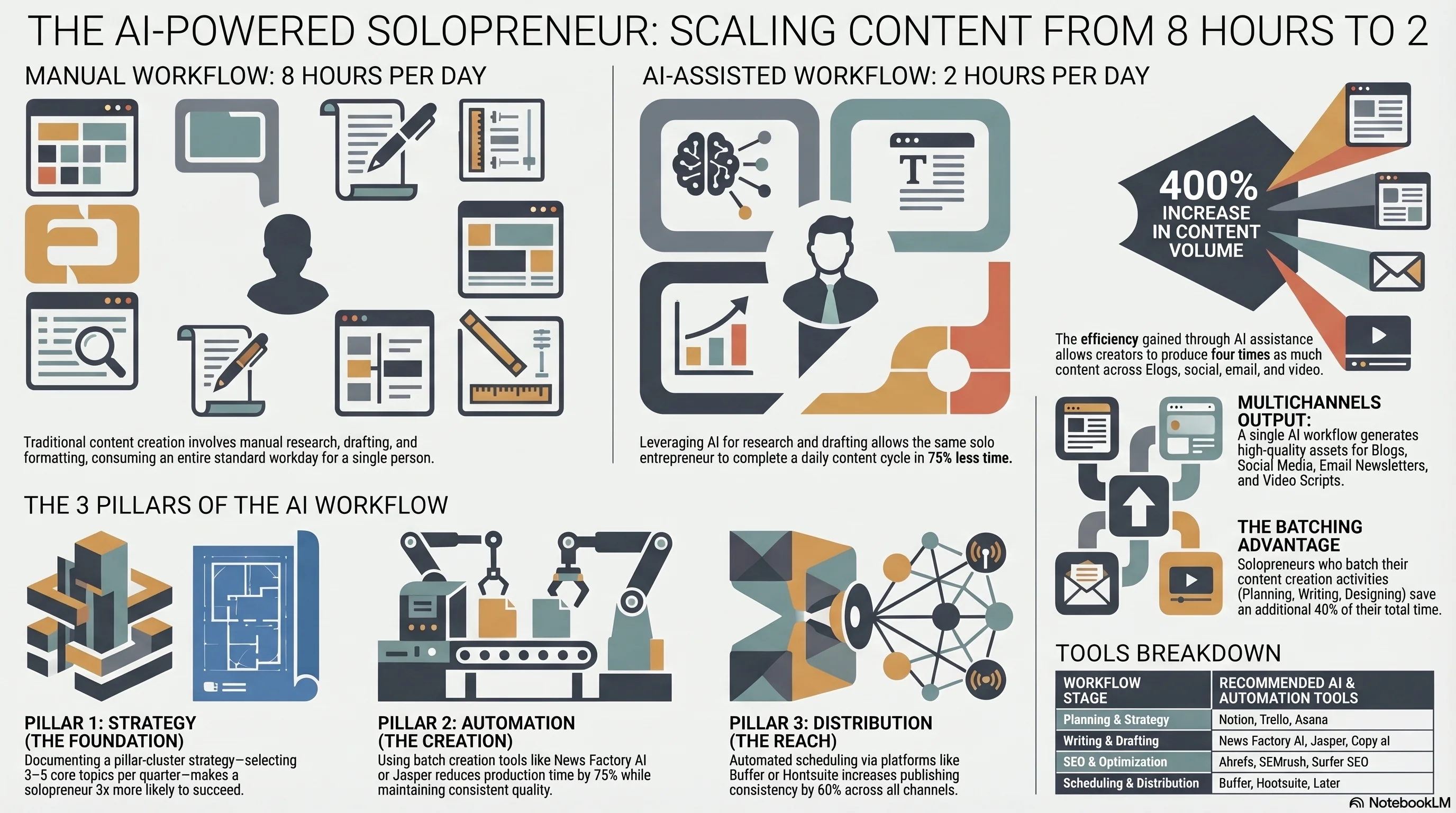
Let's put real numbers on this. Here's what a typical week of content creation looks like — manual workflow versus AI-assisted — based on survey data from Orbit Media, WP AI Builder, and industry benchmarks:
Weekly Time: Manual vs AI-Assisted
Task-by-task breakdown for a solopreneur content workflow
🔴 Manual Workflow
🟢 AI-Assisted Workflow
📊 Weekly Total
Sources: Orbit Media 2024/2025 [2], WP AI Builder [8], NAV43 [12]
The difference is stark: 10–15 hours per week manually versus 3–5 hours with AI assistance. That's a 65–70% time savings — roughly 7–10 hours returned to your week for running your actual business.
The cost analysis:
Manual: The Hidden Cost
• 12.5 hours/week × $50/hr (your time) = $625/week
• $2,500/month on content creation time alone
• Output: 1–2 blog posts, basic social presence
• Burnout risk: high. Consistency: low.
AI-Assisted: The Math Changes
• 3.5 hours/week × $50/hr = $175/week
• $700/month + ~$50–100/month for AI tools
• Output: 2–4 blog posts, full social + email
• Burnout risk: low. Consistency: high.
Insight
And here's the fact that should settle any remaining debate: 55% of businesses said that creating more content and posting more often was the single most important factor in their content marketing success. The bottleneck for solopreneurs was never strategy or knowledge — it was time. AI eliminates that bottleneck.
As Joe Pulizzi, founder of the Content Marketing Institute, put it:
"Those people who decide to drop blogging because of AI will be making a poor strategic decision. When more businesses consider dropping blogging, it creates an opportunity for those who continue."
The opportunity isn't theoretical. 97% of content marketers say their program is successful in 2026 — up from 73% in 2025. Content marketing revenue is expected to reach $107 billion by 2026. The businesses winning are the ones who publish consistently, use AI to remove the time constraint, and add genuine human expertise to every piece.
You don't need a team. You need a system: pillar + cluster planning, batch creation, ruthless repurposing, and AI handling the heavy lifting while you add what only you can add — your experience, your opinions, and your voice.
Start with one pillar topic this quarter. Map out four clusters. Block two hours on Tuesday for batch creation. Repurpose everything. That's your content calendar. It's not complicated. It just needs to exist — and you need to follow it.
If building that system still feels like one more thing on your already-full plate, News Factory handles the entire content pipeline for solopreneurs and small businesses — from planning and creation to publishing and repurposing — so you can focus on the work that actually requires you.
References & Sources
Article also available in: