The most common ecommerce SEO problem isn't a lack of products. It isn't a slow site, a weak backlink profile, or a missing keyword tool. It's a content gap — the thin layer of buying guides, comparisons, category copy, and educational content that should connect a stranger's "best [thing] for [situation]" Google search to your store, but doesn't, because it was never written.
Stores that win at ecommerce SEO in 2026 do three things at once: they make their product pages worth ranking, they treat category pages as the highest-leverage real-estate they own, and they staff their blog as a mid-funnel pipeline that ends at a PDP, not at a "subscribe to our newsletter" pop-up. Stores that lose do the opposite — they rely on manufacturer-supplied product copy, leave category pages as bare grids, and either don't blog at all or treat the blog as a parking lot for "10 reasons our brand is great" press releases that no one searches for.
This guide is the ecommerce SEO playbook synthesized from the four sources every serious ecommerce SEO leans on: Google's own documentation, the Spiegel Research Center's review-conversion data, Baymard's cart-abandonment work, and the Wolfgang Digital revenue benchmarks. Every claim below is sourced; every percentage carries a citation. The numbers are confronting in places — most stores are leaving the equivalent of a full-time hire's salary in revenue on the table because they treat content as an afterthought.
The Content Gap That Kills Conversions
Why great products with no content layer never get found
Run this thought experiment. A shopper Googles "best running shoes for flat feet". The first page of results is a mix of: a Healthline-style content site, two specialty-runner publications, a Reddit thread, a YouTube video, and — eventually — a single retailer's buying-guide post. Click through any of those and you'll find recommendations that link to specific PDPs at retailers who happened to have the buying guide.
The shopper never saw the retailers who didn't have the guide. They never saw their PDPs. The retailers who don't write buying guides aren't competing for that query — they're just absent from it. Aleyda Solis, the international SEO consultant whose 2025 ecommerce report has become the de-facto reference for the field, captured this migration in three words: "clicks are leaving."[10] Her data shows organic clicks on mobile across most product verticals are increasingly going to Reddit, Instagram, TikTok, YouTube, and content sites — not to retail PDPs and PLPs.
Where Ecommerce Revenue Actually Comes From
Wolfgang Digital 2020 KPI Report — the most-cited industry benchmark, still referenced in 2025-2026 [20]
Search (paid + organic) drives 67% of ecommerce revenue combined. Organic alone, at 33%, is larger than direct, email, and social combined. The "we rely on social media" ecommerce strategy is mathematically a fringe play.
The implication is straightforward. Search is where the money is — and within search, the queries that actually convert are spread across three intent buckets: transactional ("buy [X]" — won by PDPs and PLPs), commercial-investigation ("best [X] for [Y]", "[X] vs [Y]" — won by buying guides, comparisons, and roundups), and informational ("how to choose [X]", "why does [X] do [problem]" — won by educational content). Most ecommerce stores try to compete only in the first bucket. They lose 60-70% of the addressable search demand by default.
The fatal mistake in one sentence
The stores that close this gap don't do so by writing more product descriptions. They do it by writing the layer above the products — the buying guides, comparisons, "how to choose" articles, and use-case posts that match the queries shoppers run before they're ready to buy. That layer then routes those shoppers, with intent already half-formed, into specific PDPs and PLPs through internal links. None of this is exotic. All of it is routinely ignored.
Product Page (PDP) Optimization
Unique descriptions, schema, reviews, Q&A — the bottom-of-funnel essentials
Product pages carry transactional intent — the moment a shopper lands here, they've decided to buy something, and the question is whether they buy it from you. Google's job is to send commercial-intent traffic to PDPs that match the query. Your job is to make every PDP the kind of page a search algorithm has no reason not to rank.
The duplicate-description problem (and what Google actually says)
The single most common PDP failure pattern in 2026 is exactly what it was in 2016: ecommerce platforms shipping with manufacturer-supplied product descriptions that hundreds of competing retailers are also using verbatim. Google's official position has been remarkably consistent — and it's been misrepresented for almost a decade.
John Mueller, Google's longest-serving Search Advocate, has said directly that there is no algorithmic penalty for duplicate product descriptions, and that rewriting "100 color-variant pages of the same T-shirt" is "a waste of time."[11] What actually happens is more subtle. When fifty retailers ship the same manufacturer copy, Google's deduplication systems pick one canonical representative for that text — usually the highest-authority site or the page with the strongest behavioural signals — and the other forty-nine pages lose visibility. It's not a penalty. It's dilution. The practical outcome is identical to a penalty, but the framing matters because it tells you what to fix: the goal is to be Google's pick, not to avoid being smacked.
Aleyda Solis' 2025 prescription is the most-cited working answer:
Aleyda Solis on PDP content
That's not a word count. There's no minimum length Google has ever published, and "long copy = ranks better" is folklore at best. Industry benchmarks for competitive PDPs in retail tend to land in the 300-800-word range for the description block, but the variance by category is enormous — a $4,000 espresso machine PDP sensibly runs longer than a $9 phone charger PDP, and Google ranks both perfectly happily.
Product schema: the only "free CTR boost" left
Structured data on PDPs is the rare ecommerce SEO investment with a measurable, undisputed payoff. Google's documentation specifies the recommended schema types — Product, Offer, AggregateRating, Review — and the rich-result variants they trigger.[15] The catch most ecommerce SEOs miss is that Mueller has been equally direct that schema is not a direct ranking factor.[16] Misuse won't sink your rankings; it just removes your eligibility for rich results.
The reason to do it anyway is that the rich results themselves drive measurable CTR uplifts that compound across every PDP you rank for.
Rich-Snippet CTR Uplift vs Plain Text Result
Compilation across Search Engine Journal, Moz, and Inboundsys benchmarks [17]
A 30-40% CTR uplift across thousands of impressions is the difference between a product line that breaks even on paid traffic and one that scales on organic alone. Validate every PDP at search.google.com/test/rich-results.
Reviews and Q&A: the conversion accelerator
The most-cited piece of ecommerce conversion research in print is the Spiegel Research Center's "How Online Reviews Influence Sales" study, originally published by Northwestern's Medill School and still referenced across the industry literature in 2025-2026. The headline numbers are extraordinary, and they justify almost any investment in review collection and display.
Reviews → Purchase Likelihood (Spiegel Research Center)
Displaying just 5 reviews triples purchase likelihood. The lift is largest on higher-priced items. [8]
"As products begin displaying reviews, conversion rates escalate rapidly." — Spiegel Research Center, Medill Northwestern. The lift is largest on higher-priced products because reviews de-risk larger purchase decisions. Verified-buyer reviews skew significantly more positive than anonymous reviews.
Two practical caveats. First, the sweet-spot star rating is roughly 4.0-4.7; a perfect 5.0 actually reduces purchase intent because shoppers read it as "too good to be true."[8] Second, reviews hidden in a tab or below a "Read more" fold are functionally invisible. The Spiegel data assumes the reviews are visible without a click; bury them and you've thrown the asset away.
Q&A blocks earn a separate mention. They're underused on most stores and disproportionately effective: they capture long-tail informational queries the PDP itself rarely ranks for, they answer objections at the point of purchase (the highest-leverage moment in the funnel), and the user-generated content compounds — a single well-asked question, answered well, gets crawled and ranks for years.
The PDP optimization checklist
| Action | Effort | Why it matters |
|---|---|---|
| Replace boilerplate manufacturer descriptions with unique copy | High | Google picks one canonical when 50 retailers ship the same copy — yours often isn't the chosen one. Mueller calls a penalty 'a myth' but dilution is real. |
| Validate Product schema (Product + Offer + AggregateRating + Review) | Low | Free CTR uplift of +30-40% from rich snippets; +25% from star-rating snippets alone. Validate at search.google.com/test/rich-results. |
| Display 5+ verified-buyer reviews on every PDP | Medium | Spiegel: +270% purchase likelihood at 5 reviews. Hide them in a tab and you've thrown the whole asset away. |
| Add a Q&A or FAQ block targeting buyer questions | Medium | Captures long-tail informational queries that PDPs rarely rank for, and answers objections at the point of purchase. |
| Descriptive image filenames + alt text + WebP/AVIF + lazy-load | Low | Image-pack rankings are non-trivial traffic for visual products. The 60-second filename rename is the cheapest SEO win in ecommerce. |
| Self-referencing canonical on the main PDP, not the variant | Low | Color/size variants frequently splinter ranking signal across near-duplicate URLs. Pick the canonical product and consolidate. |
| Internal links from PDP to relevant blog/buying-guide content | Low | NOVOS' 'links should flow both ways' rule. Sends shoppers who need education back into the funnel instead of out the back door. |
Category Pages: The Most Underused Real-Estate
Why PLPs outrank PDPs for head terms — and what 'good' category content looks like
Category pages — Shopify "collections," WooCommerce taxonomy archives, BigCommerce categories, Magento category pages — are the single most underleveraged asset in most ecommerce SEO programs. They target head terms ("running shoes", "office chairs", "cordless drills") that PDPs realistically can't rank for, they consolidate ranking signal across every product they contain, and they're where almost every shopper journey routes through on the way to a purchase.
Kevin Indig, ex-VP of SEO at G2 and previously at Shopify, made the canonical case for category-page firepower:
Kevin Indig on category pages
The point isn't that you need 7 million pages. It's that the asset class — curated PLPs that match real search demand — scales in a way PDPs and blog posts don't. Etsy didn't write 7 million product descriptions; they generated 7 million pages by composing categories, tags, and faceted attributes that real shoppers were already searching for, and they ranked them through internal linking and structural signals.
The "SEO content block" debate, settled by data
For years, the question of whether to add explanatory copy to category pages has been a religious debate in ecommerce SEO. Mueller has been on record warning against keyword-stuffed paragraphs above the fold; agency consensus has been that "category content blocks" boost rankings. The argument was finally resolved by SearchPilot, the controlled SEO testing platform, with a real A/B test on a travel-sector ecommerce client.[5]
The setup: SearchPilot removed the below-the-fold "SEO copy" from a set of category pages. The hypothesis was that the copy was contributing to rankings. The result: −3.8% organic sessions, roughly 9,800 lost organic sessions per month. The relevant freelance-written copy was demonstrably contributing to rankings; removing it caused measurable, statistically-significant traffic loss.
Mueller's caveat about above-the-fold keyword stuffing is also true. Both can be reconciled with one rule:
The category-page content rule
What "useful editorial content" actually looks like, in practice:
| Action | Effort | Why it matters |
|---|---|---|
| Short visible intro above products (1-2 sentences max) | Low | Theme-default long descriptions above the grid hurt UX and conversion. The intro is for context + the head keyword in H1, not for SEO copy. |
| Useful 'SEO content block' BELOW the product grid | Medium | SearchPilot A/B test: removing this copy cost a travel client -3.8% organic sessions. It works — but it has to be useful, not keyword stuffed. |
| Contextual internal links to subcategories + buying guides | Low | Distributes authority through the subfolder; gives the category page topical breadth without bloating the visible grid. |
| Faceted filter URLs canonicalized to the parent (or noindex,follow) | Medium | Index-worthy facets (e.g. /trainers/blue/leather) get self-referencing canonicals. The rest get noindex,follow + eventual robots.txt disallow. |
| Category schema: ItemList + BreadcrumbList markup | Low | Helps Google understand the page is a curated collection, not duplicated product content. Surfaces breadcrumb rich results. |
| Hand-curated featured products + buying-guide block | Medium | Editorial signals to Google that this is a content page, not just a database query. Reduces apparent thin-content risk on long-tail PLPs. |
One platform-specific note. On Shopify, the category URL pattern is /collections/<handle>, and most themes render the collection description above the product grid by default. That default is exactly wrong for SEO: it pushes products below the fold and shows long descriptive copy where Mueller's keyword-stuffing caveat bites. The fix in 2026 is the same as it was in 2020 — split the description into a short "intro" liquid section above and a longer "outro" liquid section below the grid, and only use the outro for the substantive content.
Blog → PDP/PLP: The Mid-Funnel Engine
Why an ecommerce blog isn't 'thought leadership' — it's funnel coverage
The most damaging idea in ecommerce content marketing is that the blog is for "thought leadership." It isn't. The blog's job, on a working ecommerce site, is to capture mid-funnel and top-of-funnel queries that PDPs and PLPs can't rank for, and route the resulting traffic into the right shop pages through internal links. Every other framing leads to dead blogs full of "10 tips for staying productive" articles that no one searches for.
Among top-performing Shopify stores, 84.7% maintain an active blog.[22] That's the top cohort. The long tail of small Shopify stores looks very different — most don't blog at all, or stopped after the first six posts when nothing converted directly. The reason most small-store blogs fail isn't that blogs don't work; it's that the posts were the wrong type, written for the wrong intent, with no internal-link plan.
The mid-funnel content matrix
The right blog plan starts with a content-type matrix tied to search intent. Each post type has a specific job, ranks for a specific intent class, and routes traffic to a specific destination on your store.
| Content type | Intent | Internal-link target |
|---|---|---|
Buying guide ('How to choose a [X]') Educational content for shoppers in research mode. The single highest-ROI ecommerce blog format. | Mid-funnel | Category page (PLP) + 2-3 specific PDPs as examples |
Comparison ('X vs Y' or 'Best X for Y') Captures comparison queries before the shopper hits a competitor's PDP. Ranks ahead of brand-vs-brand pages. | Mid-funnel | PDPs for each compared product + relevant PLP |
'Best of' / roundup post High-volume commercial-investigation queries. Often outranks shop pages because the SERP wants editorial. | Mid-funnel | PDPs of featured products + PLP for the category |
How-to / problem-solving article Fixes the user's underlying problem; product is mentioned only where genuinely relevant. Builds topical authority. | Top-of-funnel | Buying guide + 1-2 PDPs as 'recommended for this use' |
Use-case / inspiration content ('5 ways to use X') Discovery content for shoppers who don't yet know they want the product. Strong on Pinterest/Google Discover. | Mid-funnel | Specific PDPs for each use case + parent PLP |
Industry trend / data report Builds backlinks (other sites cite your data) and brand authority. Slow to convert directly. | Top-of-funnel | Brand/about page + relevant PLP for context |
The single highest-ROI format on this list is the buying guide. "How to choose a [thing]" posts capture commercial-investigation queries with clear purchase intent, rank well above PDPs because the SERP wants editorial content for these queries, and route shoppers — already with intent half-formed — straight into specific PDPs and the parent PLP. They're the closest thing ecommerce has to a free-money format.
Internal linking: the link must flow both ways
Most ecommerce sites half-implement blog ↔ shop linking. They eventually add some blog-to-PDP links inside the blog content. They almost never add the reverse — links from PDPs and PLPs back to relevant blog content. That's a mistake. NOVOS, an ecommerce SEO agency that runs the math on this, frames it cleanly: "Adding links from PLPs and PDPs to relevant blog posts can help customers who need inspiration or advice."[23] The link should flow both directions because the shopper journey does.
Neil Patel's 2025 take on internal-link target priority adds a useful refinement: when blog content links into the shop, prefer linking to collections (PLPs) rather than individual PDPs.[23] The PLP is more durable (a discontinued product breaks the link; the PLP it lived in usually doesn't), it distributes link equity across every product in the category, and it matches the navigational behavior of shoppers who want to see a range before they commit. PDP links from the blog still have a place — for "I recommend this specific product" call-outs — but the PLP should be the default.
The Pottery Barn / West Elm pattern, documented in Search Engine Land's ecommerce internal-linking guide, takes both ideas further: above-footer "Related Searches" rows with long-tail keyword anchor links pointing to subcategories, supplemented by contextual links inside blog content pointing to PDPs and PLPs.[12] The "Related Searches" pattern in particular is dramatically underused in small-to-mid ecommerce — it's a 1-hour theme tweak that adds 8-12 internal links per page across the entire site, and it works.
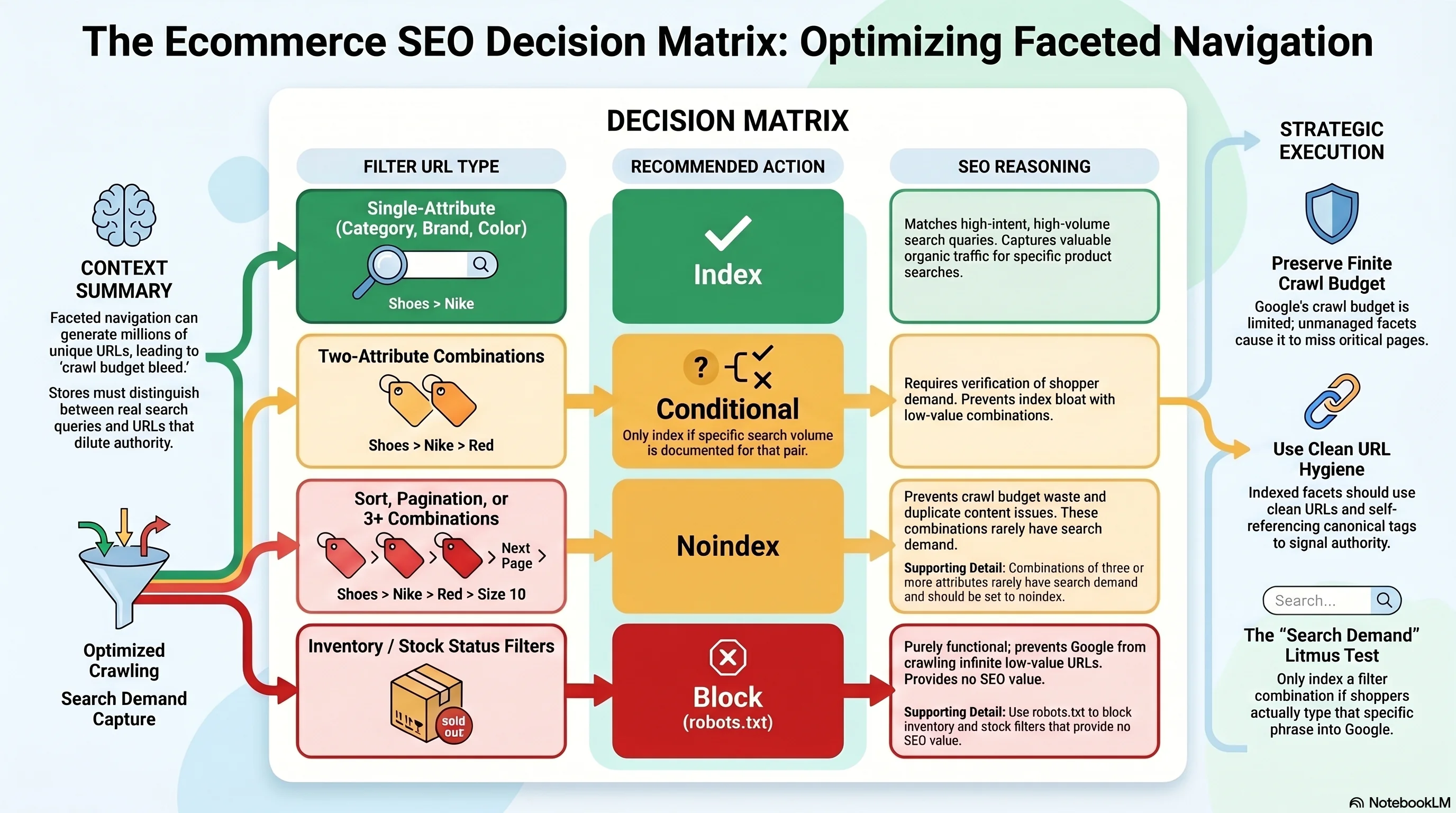
Faceted navigation — the filter rails on category pages that let shoppers narrow by colour, size, brand, price range, and so on — is the place most Shopify and WooCommerce stores quietly hemorrhage crawl budget. Every filter combination generates a unique URL. Most stores have eight to twelve facets per category, two to three values per facet, and tens to hundreds of categories. The combinatorial math runs into millions of URLs almost immediately, and Google's crawl budget is finite.
% of Crawl Budget Wasted on Faceted/Parameter URLs
Audit data across configuration tiers — Metrics Rule [24] / Search Engine Journal [13]
A poorly-configured store can spend a third of its crawl budget on URLs that drive zero organic traffic. The same crawl budget reallocated to PDPs and PLPs is the difference between Google indexing your full catalog promptly and leaving half of it stale.
Google's official documentation gives two routes through this problem.[14] Either you don't want facet URLs indexed at all (block crawling via robots.txt or nofollow the facet anchor tags), or you want a curated subset indexed (clean URLs, self-referencing canonicals, sensible internal linking, included in sitemap). The decision turns on whether the facet combination matches a real search query.
The faceted-navigation decision matrix
| Facet type | Example URL | Treatment | Reason |
|---|---|---|---|
| Index-worthy single-attribute facet | /trainers/blue, /trainers/leather | 200, self-referencing canonical, in sitemap, internally linked | Real demand exists ('blue trainers' is a query). One filter = one indexed page = one ranking opportunity. |
| Index-worthy two-attribute combo | /trainers/blue/leather | 200 + self-referencing canonical IF traffic exists; otherwise noindex,follow | Validate via Search Console + keyword tools that the combo has real search volume before indexing it. |
| Three-or-more attribute combo | /trainers?color=blue&size=42&price=50-100&brand=nike | noindex,follow OR canonical to parent | Combinatorial explosion of low-value pages. Almost never have search volume; consume crawl budget. |
| Sort orders / pagination filters | ?sort=price-asc, ?page=2 (with ?orderby) | noindex,follow + rel=prev/next removed (no longer used by Google) | Sort orders are user-state, not content. Pagination is now self-contained per-page indexing. |
| Out-of-stock / low-inventory filter | ?availability=in-stock | Disallow in robots.txt | Pages content depends on stock; index churn on every restock. Low value, high crawl cost. |
Platform-specific gotchas
Shopify
Native collection filters generate URLs like /collections/{handle}?filter.v.option.color=Blue. Out of the box these are usually canonicalized to the parent collection. The risk is third-party search/filter apps (Boost, Searchanise, Rapid Search) — they often break the default canonicalization and create indexable parameter URLs. Audit via Search Console > Pages, looking for "Alternate page with proper canonical tag" and "Crawled — currently not indexed" reports.
WooCommerce
Filter URLs use ?filter_* and sort orders use ?orderby=*. By default these are crawlable and most stores never block them, leading to massive parameter bloat. Fix: disallow filter parameters in robots.txt, set self-referencing canonicals on the clean category URLs, and consider Yoast/Rank Math's parameter handling settings. Your hosting log files will tell you in an hour how much of Googlebot's time is currently being spent on filter URLs.
BigCommerce
Native faceted-search uses query parameters that BigCommerce canonicalizes to the parent category by default. The risk profile is similar to Shopify — third-party search/filter apps can break the default. Verify by inspecting any filtered URL with the URL Inspection tool in Search Console.
Magento (Adobe Commerce)
Layered navigation produces URLs like ?cat=12&color=4&size=2. Out-of-the-box Magento exposes more facet URL combinations than Shopify or BigCommerce. Magento's stock canonical handling is reasonable but doesn't address noindex'ing low-value combinations — extensions like Mageworx Layered Navigation or Amasty Improved Layered Navigation cover this.
Real Before/After Case Studies
Documented organic-traffic outcomes from category, content, and PDP work
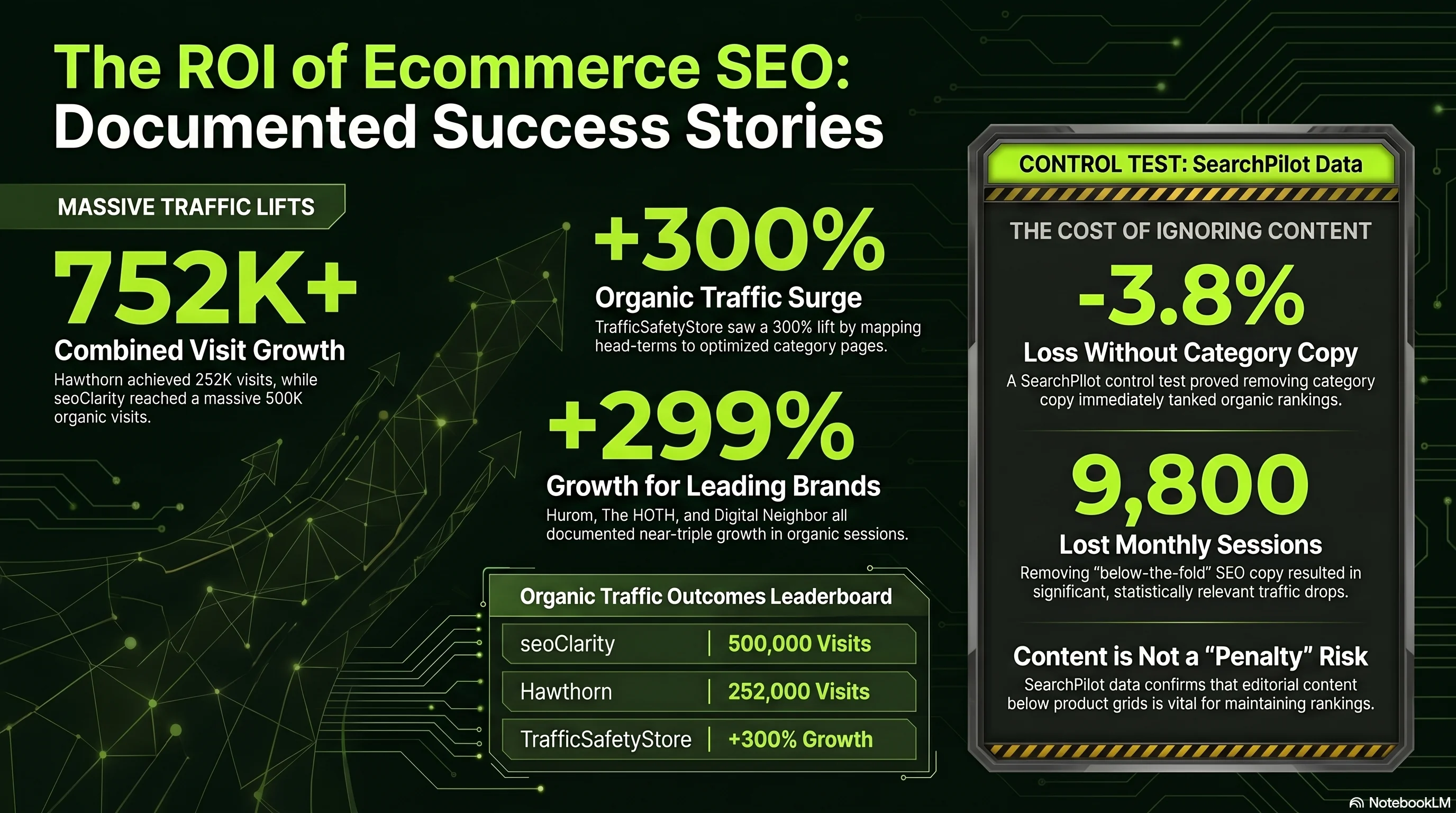
The case studies below are all from published sources with documented before/after numbers. Each one isolates a specific tactic and reports what it produced. The pattern across them is consistent: the wins come from the content layer (category copy, buying guides, PDP detail) more often than from technical SEO alone.
Documented Ecommerce SEO Lifts (Selected Case Studies)
Each lift sourced and dated; SearchPilot's negative result is included as a control [1][2][5][6]
SearchPilot's −3.8% result is plotted as a control: removing relevant category copy demonstrably costs traffic. The positive lifts come from adding category content blocks, intent-mapped content programs, and full ecommerce SEO programs across PDPs and PLPs.
| Brand | Tactic | Result | Timeframe |
|---|---|---|---|
| Hawthorn (CBD ecommerce)[1] | Content + technical SEO program | 252K monthly visits achieved | 5 months |
| TrafficSafetyStore.com[2] | Category content blocks targeting head terms | 300%+ traffic & revenue growth | Multi-quarter |
| Hurom (juicer brand)[3] | PDP & collection content (NOT blogging) | Owner attributed 'real SEO results' to product/collection content with FAQs and buying guides | Sustained |
| Anonymous shoes/apparel store (HOTH)[4] | Full ecommerce SEO program from low base | 100 → 2,300 monthly visitors (~22× lift) | Multi-quarter |
| Anonymous travel client (SearchPilot A/B test)[5] | REMOVED category SEO copy below the fold | −3.8% organic sessions, ~9,800 lost monthly sessions — proves the copy was working | A/B test window |
| Ecommerce client (Digital Neighbor)[6] | Keyword + intent-mapped content program | +299% sales attributable to organic | Multi-quarter |
| 7 retail brands aggregate (seoClarity)[7] | Ecommerce SEO across category + product page optimization | 500K combined monthly traffic gain | Multi-quarter |
The TrafficSafetyStore case is worth special attention. Nick Eubanks documented a 300%+ traffic and revenue lift driven primarily by mapping head-term keywords ("roll up construction signs", etc.) to category pages and adding content blocks targeting those terms — not by writing more PDPs and not by doing technical SEO.[2] The same playbook scales to most product-led ecommerce categories.
The SearchPilot result is the controlled-experiment counterpart. They removed below-the-fold "SEO copy" from a travel client's category pages, and traffic dropped 3.8% — a small percentage that translates to ~9,800 lost monthly organic sessions in that test window.[5] It's the only published controlled SEO A/B test on category copy. Both directions of the result matter: remove the copy and you lose traffic; don't have the copy in the first place and you never had the traffic.
Fatal Mistakes & How to Fix Them
The eight failure patterns that cap most stores' organic ceiling
The eight mistakes below appear in roughly the same order across every audit. They aren't exotic. They're the default state of most ecommerce stores running on default configurations. The good news: each one has a fix, and the highest-impact fixes are usually the cheapest to implement.
Boilerplate manufacturer descriptions
HighNot penalized — but Google picks one canonical when 50 retailers ship the same copy. The other 49 die in the index.
No product schema (or broken schema)
CriticalFree CTR on the table. Rich snippets convert at +30-40% CTR vs plain text. Validate with Google's Rich Results Test.
Asking for reviews — but never displaying them
CriticalSpiegel data is unambiguous: 5 visible reviews = +270% purchase likelihood. Hidden in a tab = wasted asset.
Indexable filter URLs (over-faceting)
High?color=red&size=m&price=50-100 × thousands of products = millions of useless URLs eating crawl budget. Default on most stores.
Thin or duplicated category pages
HighNo intro, no outro copy, no internal links — just a product grid. SearchPilot proved removing relevant category copy COSTS traffic.
No blog, or a dead blog
CriticalZero entry points for 'best [X]', '[X] vs [Y]', 'how to choose [X]'. Reddit, YouTube, and competitors take that traffic instead.
Blog posts with no internal links to PDPs/PLPs
HighBuying guides that don't link to the products they discuss. Pure traffic that never reaches the cart.
SEO content block above the fold
MediumJohn Mueller specifically called this out as keyword-stuffing-adjacent. Useful content goes BELOW the product grid.
Cart abandonment is its own problem
Top Reasons for Cart Abandonment (Baymard 2025)
Excludes natural browsing — shares are of abandoners citing each reason [9]
The single biggest leak — extra costs surfaced at checkout — is fixable in shipping and tax presentation, not in SEO. But every other reason is a trust signal that PDP optimization, reviews, and schema all improve.
The Publishing Cadence Problem
Why most ecommerce blogs die at six posts — and what to do about it
Every recommendation in this guide depends on something most ecommerce store owners can't sustain alone: a consistent publishing rhythm. Buying guides, comparisons, "best of" roundups, and seasonal content only work as a mid-funnel engine if they keep arriving — fresh enough to rank, abundant enough to cover the long tail of commercial-investigation queries, and on-topic enough that internal links route traffic to PDPs and PLPs.
The math of "the store owner writes the blog themselves" doesn't work for most operators. A buying guide that ranks usually takes five to eight hours from research to publish. Two posts per week, sustainably, is forty hours a month — a week of work that competes with merchandising, customer service, fulfilment, and everything else a store owner already does. The result is what we see in the long-tail Shopify data: most small stores' blogs die at six to ten posts and stay dead.
The fix the rest of the store can't deliver alone
Whatever you use to produce the content layer — an in-house writer, a freelance team, an AI-assisted pipeline like News Factory, or a hybrid — three principles apply equally:
- Write for intent, not for word count. A 1,200-word buying guide that answers a real question outranks a 4,000-word "ultimate guide" that pads with platitudes. Length is a side-effect of doing the work, not a target.
- Internal-link every post into shop pages. Two to four links per post, going to relevant PLPs first and PDPs second. A blog post with no shop links is a billboard pointing nowhere.
- Refresh, don't just publish. Posts that ranked once will rank again with a 30-minute update — new data, fresh examples, current product links. Most "old content" needs editing, not replacing.
The store owners who win the next decade of ecommerce SEO won't be the ones with the slickest theme or the cheapest paid traffic. They'll be the ones whose product pages are worth ranking, whose category pages have something to say, and whose blog quietly compounds — month after month, post after post — into a mid-funnel engine that turns research-mode Google queries into checkout-mode shoppers. News Factory is one way to keep that engine running on a schedule you set; the rest of this guide is the playbook of what to put through it.