If you run a small business website, you've probably heard horror stories about Google's "Helpful Content Update" wiping out entire sites overnight. Maybe you've even experienced a sudden traffic drop and wondered what happened.
Here's the short version: Google built a system that rewards genuinely useful content and punishes the stuff that exists only to game search rankings. Since March 2024, it's no longer a separate "update" — it's woven into Google's core algorithm permanently. That means every single core update Google rolls out (roughly four per year) evaluates your content through this lens.
The good news? If you're a small business owner creating real content about what you actually know, you've already got an advantage over the content farms. The bad news? If your site is full of thin, generic pages — whether written by a human or an AI — Google's going to notice. Let's break down exactly what's happening, what Google actually penalizes, and what you can do about it.
What Is the Helpful Content System?
The plain-English explanation — no jargon, no fluff
Google's Helpful Content system is an automated classifier — think of it as a filter — that evaluates whether your website's content was made to help real people or just to rank in search results. It doesn't look at individual pages in isolation. It assesses your entire site.
That distinction matters. If you've got 100 pages and 30 of them are thin, keyword-stuffed filler, the classifier doesn't just ignore those 30. It drags down the other 70 too. Your whole site gets a "helpfulness score," and if it skews negative, every page suffers in rankings.
Warning
The system uses machine learning to evaluate signals like: Does the content demonstrate first-hand experience? Does it provide genuine value compared to what's already ranking? Would a real person find this useful, or would they hit the back button and try another result?
Google's search advocate John Mueller put it bluntly:
"I wouldn't think about it as AI or not, but about the value that the site adds to the web…"
That quote captures everything. Google doesn't care how your content was created. They care whether it's worth reading.
Timeline: From Update to Core Algorithm
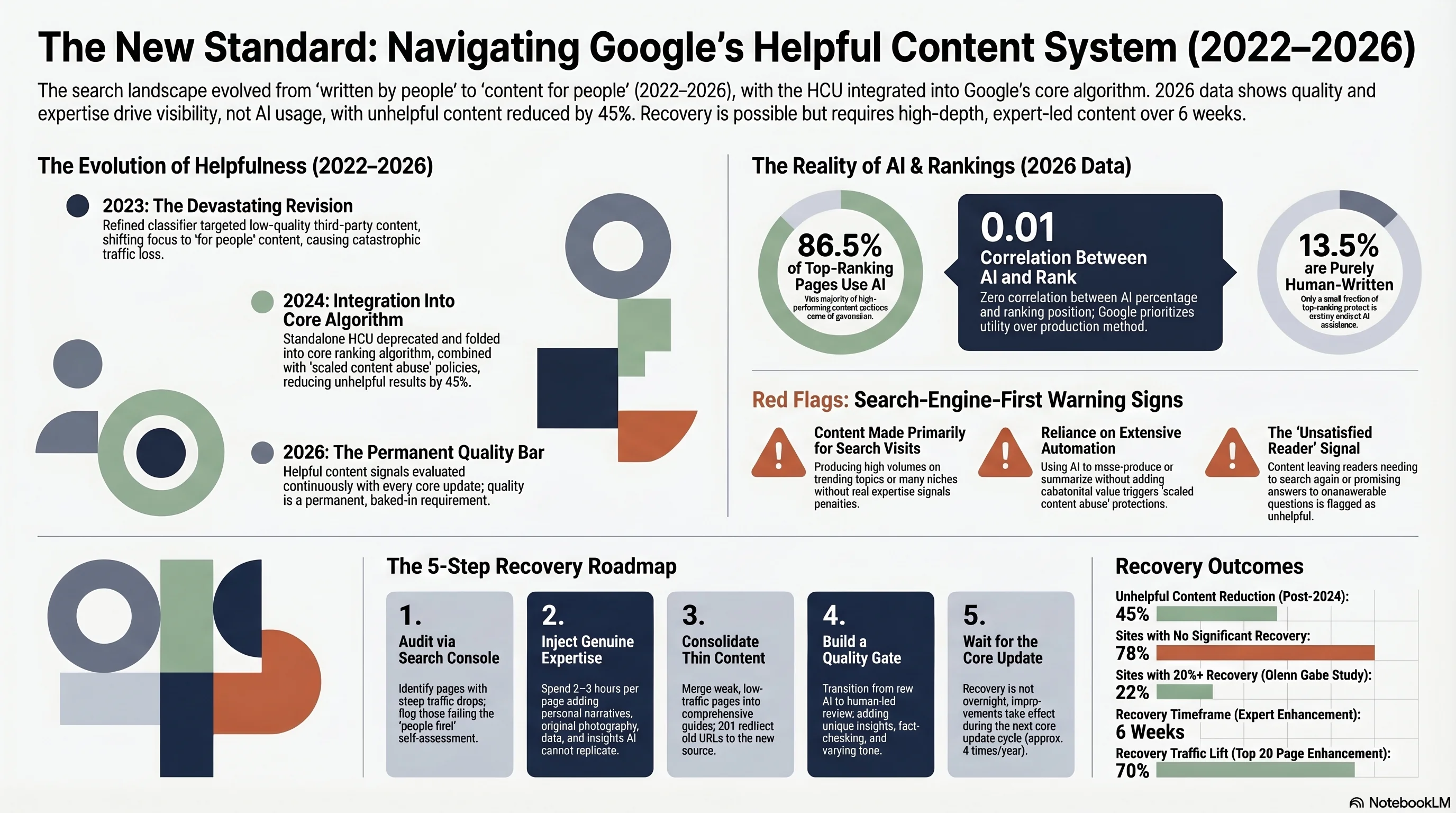
August 2022 → March 2024 integration → 2025–2026 core updates
Understanding the timeline helps you see where we are now — and why 2026 is different from 2022. This system evolved fast, and the March 2024 integration was the moment everything changed.
Helpful Content Timeline
From standalone update to permanent core algorithm signal
Helpful Content Update Launches
Google introduces a site-wide ranking signal using an automated ML classifier. Targets content "written by people, for people." Initially English-language only.
Global Expansion
The Helpful Content Update expands to all languages worldwide. Every site on earth is now subject to the classifier.
The Devastating Revision
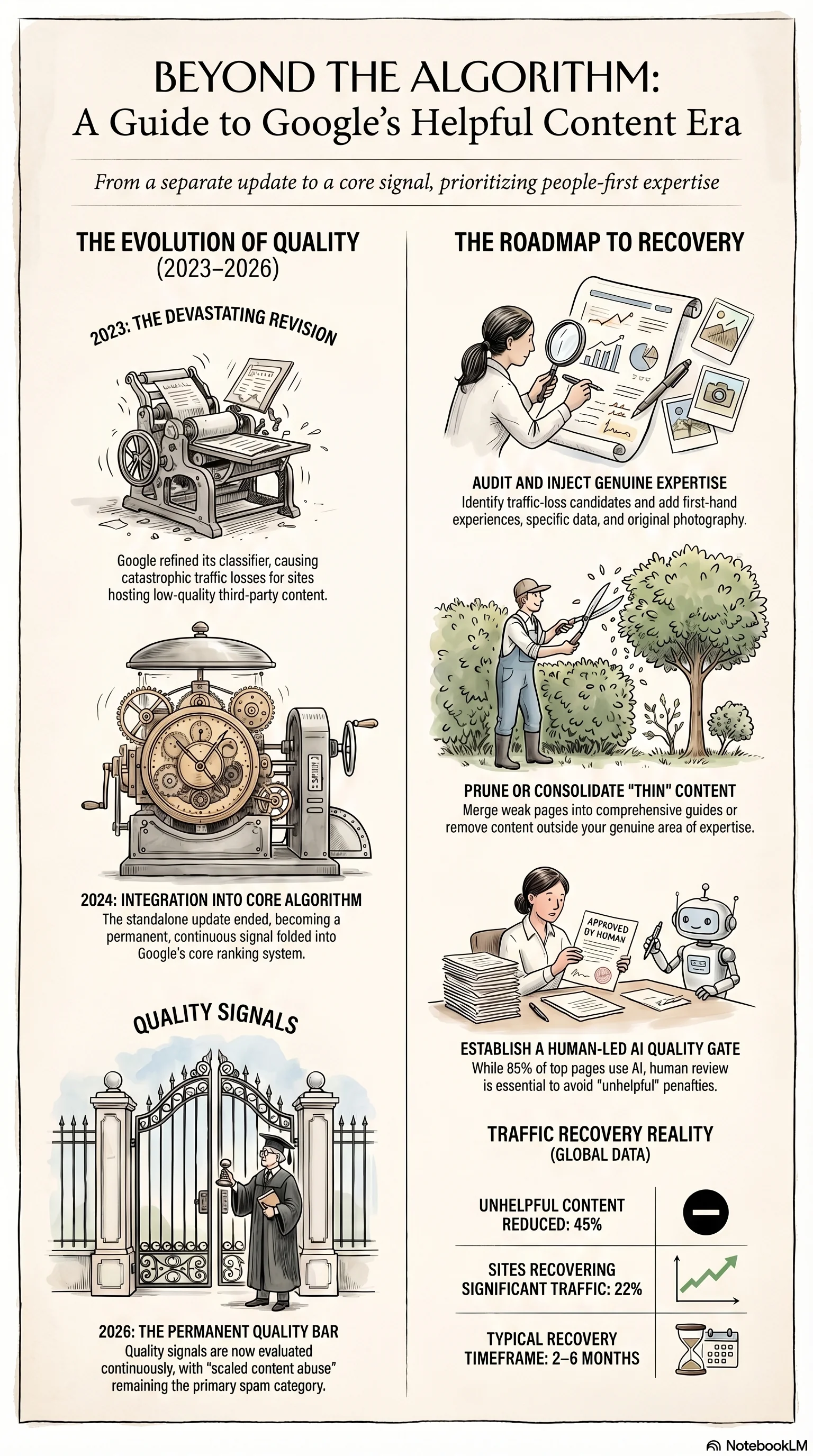
Massively refined classifier. Sites with low-quality third-party content (even on subdomains) get hit. Google drops "written by people" — shifts to "for people." Hundreds of independent publishers lose catastrophic traffic. No recoveries reported for nearly a year.
Integration Into Core Algorithm
THE landmark change. Google deprecates the standalone HCU and folds helpful content signals into the core ranking algorithm. Combined with new "scaled content abuse" spam policies. Result: 45% reduction in unhelpful search results.
First Recovery Signals
The August core update brings the first signs of life for September 2023 victims. Glenn Gabe tracks 47 out of 380+ sites surging in the first week. Lily Ray documents one site up +590% from its low.
Core Update Reinforcement
Continued quality signal reinforcement. Some previously hit sites see 19% organic traffic boosts. Google Quality Rater Guidelines updated to explicitly address AI content.
Quality Bar Raised Again
Core update tightens expectations across the board. Sites enhancing top 20 affected pages with genuine depth recover ~70% of lost traffic within 6 weeks.
Helpful Content Is Permanent
No longer a separate update — it's baked into the core algorithm forever. Quality signals evaluated continuously with every core update. "Scaled content abuse" remains the primary spam category.
Insight
The September 2023 update deserves special attention. It was devastating for independent publishers. Sites like Retro Dodo and HouseFresh — well-regarded, niche content creators — saw catastrophic traffic drops. No recoveries were reported for nearly a year. When people talk about being "HCU'd," this is usually the update they mean.
Google's Self-Assessment Checklist
Google literally tells you how to evaluate your own content — here's the full list
This is the most underused resource in SEO. Google published a detailed self-assessment checklist in their official documentation that tells you exactly what they're looking for. Most business owners have never seen it. Print this out. Score your top 10 pages against it. You'll know within an hour whether you've got a problem.
The checklist breaks into four categories. The first three are positive signals — you want to answer YES. The fourth is warning signs — answering YES to any of those means trouble.
Answer YES to these — they signal quality content
Does the content provide original information, reporting, research, or analysis?
Does the content provide a substantial, complete, or comprehensive description of the topic?
Does the content provide insightful analysis or interesting information beyond the obvious?
If drawing on other sources, does it avoid simply copying and instead provide substantial additional value?
Does the main heading provide a descriptive, helpful summary of the content?
Does the heading avoid exaggerating or being shocking in nature?
Is this the sort of page you'd want to bookmark, share with a friend, or recommend?
Would you expect to see this content in a printed magazine, encyclopedia, or book?
Does the content provide substantial value compared to other pages in search results?
Is the content free from spelling or stylistic issues?
Is the content well-produced, not sloppy or hastily produced?
Is the content NOT mass-produced or outsourced to many creators without care?
Answer YES — these build E-E-A-T signals
Does the content present information that makes you want to trust it — clear sourcing, evidence of expertise, author background?
Would someone researching the site come away with an impression that it's well-trusted or recognized as an authority?
Is this content written or reviewed by an expert or enthusiast who demonstrably knows the topic well?
Is the content free from easily-verified factual errors?
Answer YES — your content exists for real humans
Do you have an existing or intended audience that would find the content useful if they came directly to you?
Does your content clearly demonstrate first-hand expertise and depth of knowledge?
Does your site have a primary purpose or focus?
After reading, will someone feel they've learned enough to help achieve their goal?
Will someone reading your content leave feeling they've had a satisfying experience?
Answer YES to ANY of these = you have a problem
Is the content primarily made to attract visits from search engines?
Are you producing lots of content on many different topics hoping some might perform well?
Are you using extensive automation to produce content on many topics?
Are you mainly summarizing what others say without adding much value?
Are you writing about things simply because they seem trending?
Does your content leave readers feeling like they need to search again for better information?
Are you writing to a particular word count because you've heard Google has a preferred word count? (Google doesn't.)
Did you decide to enter a niche topic area without any real expertise, mainly to get search traffic?
Does your content promise to answer a question that actually has no answer?
Are you changing the date of pages to make them seem fresh when the content hasn't substantially changed?
Are you adding/removing lots of content primarily to seem "fresh"?
Recommendation
AI Content: The Truth About What Google Penalizes
Spoiler: it's not AI. It's bad content.
Let's kill the biggest myth right now: Google does not penalize AI content for being AI-generated. They've said this consistently since February 2023, and nothing has changed. Their stated principle is "helpful, reliable, people-first content" — regardless of who or what created it.
The data backs this up. An Ahrefs study of 600,000 top-ranking pages found that 86.5% contain some AI-generated content. The correlation between AI content percentage and ranking position? Just 0.011 — statistically meaningless. Only 13.5% of top-ranking pages are purely human-written.
AI Content in Top Search Results
Ahrefs study of 600,000 pages — the reality might surprise you
Source: Ahrefs study on 600,000 pages (July 2025). AI-ranking correlation: 0.011.
So if Google doesn't penalize AI content, what does it penalize? The answer is scaled content abuse — mass-produced content with no quality review, generated at scale to manipulate rankings. That applies whether a human or an AI wrote it.
As EdgeBlog's 2026 analysis put it: "Google penalizes behavior patterns, not AI use."
✓ What Ranks Fine
• AI-assisted content that's edited, fact-checked, and enhanced by humans
• Content where AI handles drafting while humans add insights and experience
• AI content that demonstrates genuine E-E-A-T signals
• Content serving real user needs — regardless of creation method
✕ What Gets Penalized
• Mass-produced content with no quality review at any scale
• Identical templates stamped across hundreds of pages
• Content with no original analysis, insight, or unique value
• Unsourced or fabricated claims (AI hallucinations published raw)
Insight
Google's Quality Rater Guidelines (updated early 2025) are explicit about this: AI content is rated as "Lowest" quality only when it "lacks human oversight and review." Content that's been edited, fact-checked, and improved by humans doesn't get that rating — period.
Keywords Everywhere summed it up well: "Google cares far more about outcomes than origins. If a page feels helpful, specific, and genuinely written to answer a question, it passes. If it feels automated, generic, or padded just to rank, it doesn't."
Recovery Stories: Real Sites, Real Numbers
What actually worked — and what the data says about recovery odds
Let's talk numbers. The reality of Helpful Content recovery is sobering but not hopeless. SEO expert Glenn Gabe tracked over 380 sites severely impacted by the September 2023 update. His findings over the next year tell an honest story.
Recovery Rates from HCU Impact
Glenn Gabe, 380+ sites tracked Sep 2023 — Nov 2024
Only about 1 in 5 severely impacted sites showed meaningful recovery. That's a hard pill. But the sites that did recover followed clear, repeatable patterns. Here are the specific case studies with real numbers.
Recovery Case Studies
Real sites, real metrics, real timelines
Glenn Gabe's 380+ Site Study
Multi-site analysis · Hit by: September 2023 HCUOnly 22% of tracked sites showed 20%+ improvement after August 2024 core update. Most saw zero lifts.
Niche SaaS Brand
B2B SaaS · Hit by: March 2024 core updateComplete content audit of blog and landing pages. Removed/improved thin content. Enhanced remaining pages with genuine expertise.
Mid-Sized Travel Platform
Travel content · Hit by: Late 2024 core updateShifted from generic destination guides to personal narratives with verified traveler experiences, professional photography, and genuine expertise.
E-commerce Brand
Online retail · Hit by: March 2025 core updateRefreshed product pages with Generative Snippet Engineering. Result: 19% organic boost and 34% increase in forum referral traffic.
December 2025 Recovery Case
Content publisher · Hit by: December 2025 core updateTook top 20 affected pages, spent 2–3 hours per page adding genuine expertise depth. Not rewriting — enhancing.
One standout detail from Lily Ray's tracking: a single HCU-impacted site surged +590% from its lowest point during the August 2024 core update. Sounds amazing — but as Ray noted, "It's still nothing compared to what they lost." Recovery doesn't happen overnight. It builds over weeks and aligns with core updates.
Warning
But there's a pattern in the success stories. The niche SaaS brand that recovered 95% within 90 days did a complete content audit and ruthlessly cut thin pages. The travel platform that fully recovered shifted from generic guides to genuine first-hand narratives. The December 2025 recovery case spent just 2–3 hours per page — but those hours added real depth, not cosmetic rewrites.
Depth over breadth. Expertise over volume. That's the recovery playbook.
Your Action Plan: 5 Steps to Helpful Content
A practical checklist for small business owners — no SEO degree required
You don't need to be an SEO expert to fix this. The pattern across every recovery story is the same: audit what you have, add genuine expertise, cut what's thin, fix your process, and be patient. Here's the breakdown.
Audit Your Existing Content
2–4 hoursPull up Google Search Console. Sort pages by clicks (last 6 months). Identify pages that lost traffic dramatically — those are your HCU candidates.
Add Genuine Expertise to Every Page
2–3 hours per pageThis is the #1 recovery pattern across every case study. Generic content fails. First-hand experience, specific details, and real opinions win.
Kill or Consolidate Thin Content
1–2 daysIf you've got 50 blog posts that each get 3 visits a month, you probably have a thin content problem. Fewer, better pages outperform many weak ones.
Fix Your Content Production Process
OngoingUsing AI to write content? That's fine — 86.5% of top-ranking pages do. But raw, unedited AI output will sink you. Build a quality gate.
Be Patient — Recovery Takes Time
2–6 monthsYou won't recover overnight. Changes take effect at the next core update (every few months). Keep improving content and wait for Google to notice.
Recommendation
One last thing. Don't obsess over the algorithm. Obsess over your customers. Write the page you'd want to find if you were searching for what your business offers. Add the details only an insider would know. Take a position. Be specific. That's it. That's the whole strategy.
If you want to use AI to help — and you should, since 86.5% of top-ranking pages already do — just make sure you're adding your fingerprint to every piece. Your experience, your data, your opinion. The AI drafts; you make it real.
That's how you build a site Google considers genuinely helpful. Not through tricks or templates, but through content that actually helps the people you serve.
Need help creating consistent, high-quality content for your small business? News Factory helps small businesses publish expert-quality content at scale — with human oversight built into every step of the pipeline.
References & Sources
Article also available in: