Why AI Citations Are the New Rankings
When an AI answers the question, a handful of cited sources get the credit while everyone else disappears
Ask ChatGPT, Perplexity, or Google's AI Overviews a question today and you don't get ten blue links. You get one synthesized answer with a small handful of citations, the two to seven sources the model decided to trust [2]. If your business is in that set, you're the answer. If you're not, you're invisible, no matter how good your website is.
This is the biggest shift in discovery since Google itself. Google's AI Overviews now appear on roughly half of all searches [1]. ChatGPT has over 800 million weekly users, and Gemini is growing more than 200% year over year [2]. And 62% of people now begin a search with an AI tool rather than a traditional search engine [6].
The traffic stakes are concrete. Pages cited inside an AI Overview earn 35% more organic clicks than non-cited competitors on the same results page [1]. Meanwhile, organic click-through rate drops 61% for queries where an AI Overview appears [6], so the citation isn't a bonus, it's the difference between getting the click and losing it. And the visitors who do arrive from AI convert at up to 9–11x the rate of standard organic traffic [2].
Citations Are Extremely Concentrated
The top 20% of cited domains capture 80% of all AI references [6]. Getting into the cited set isn't luck, it follows patterns you can reverse-engineer. And more than half of brands still have no plan for it, which is exactly why the window is open.
The practice of earning these citations has a name: Generative Engine Optimization (GEO), sometimes called Answer Engine Optimization (AEO). Where classic SEO earns blue-link rankings, GEO earns AI citations. This guide is the practical version, how each engine actually decides what to cite, and the exact steps to become one of the sources it trusts.
Every Engine Sources Differently. Stop Treating Them as One
A citation in one engine is not a citation in all. The mechanics are genuinely different
Here's the mistake almost everyone makes: treating "AI search" as a single channel. It isn't. An analysis of 680 million citations found that only 11% of domains are cited by both ChatGPT and Perplexity [1]. Each engine pulls from a different index and follows different logic.
The gap in how often engines even cite brands at all is staggering. A 2026 study of 34,234 AI responses found a 46-times difference in brand citation rates between platforms [1]:
Brand Citation Rate by Platform
Share of AI responses that cite brands, 2026 study of 34,234 responses (via Leapd)
The reason is architecture. ChatGPT's web retrieval runs on Bing. Claude runs on Brave. Google's AI Overviews and AI Mode run on Google's own index, powered by Gemini. Perplexity blends its own index with multiple external sources and cites prolifically [2]. Ask the same question in each and you can get completely different sources back.
Their favorite sources differ too. ChatGPT's single most-cited domain is Wikipedia (7.8% of all its citations), signalling a preference for encyclopedic, neutral authority. Both Google AI Overviews and Perplexity lean heavily on Reddit, signalling a taste for real community discussion and recency [1].
One Campaign Won't Cover Them All
Optimizing for "AI search" as a single category is like running the identical campaign on LinkedIn and TikTok. There is a universal foundation that makes you eligible everywhere, but the final lever that wins a citation is engine-specific. You need both.
What Every AI Engine Rewards
Get the universal foundation right and you're eligible everywhere before you optimize for any single engine
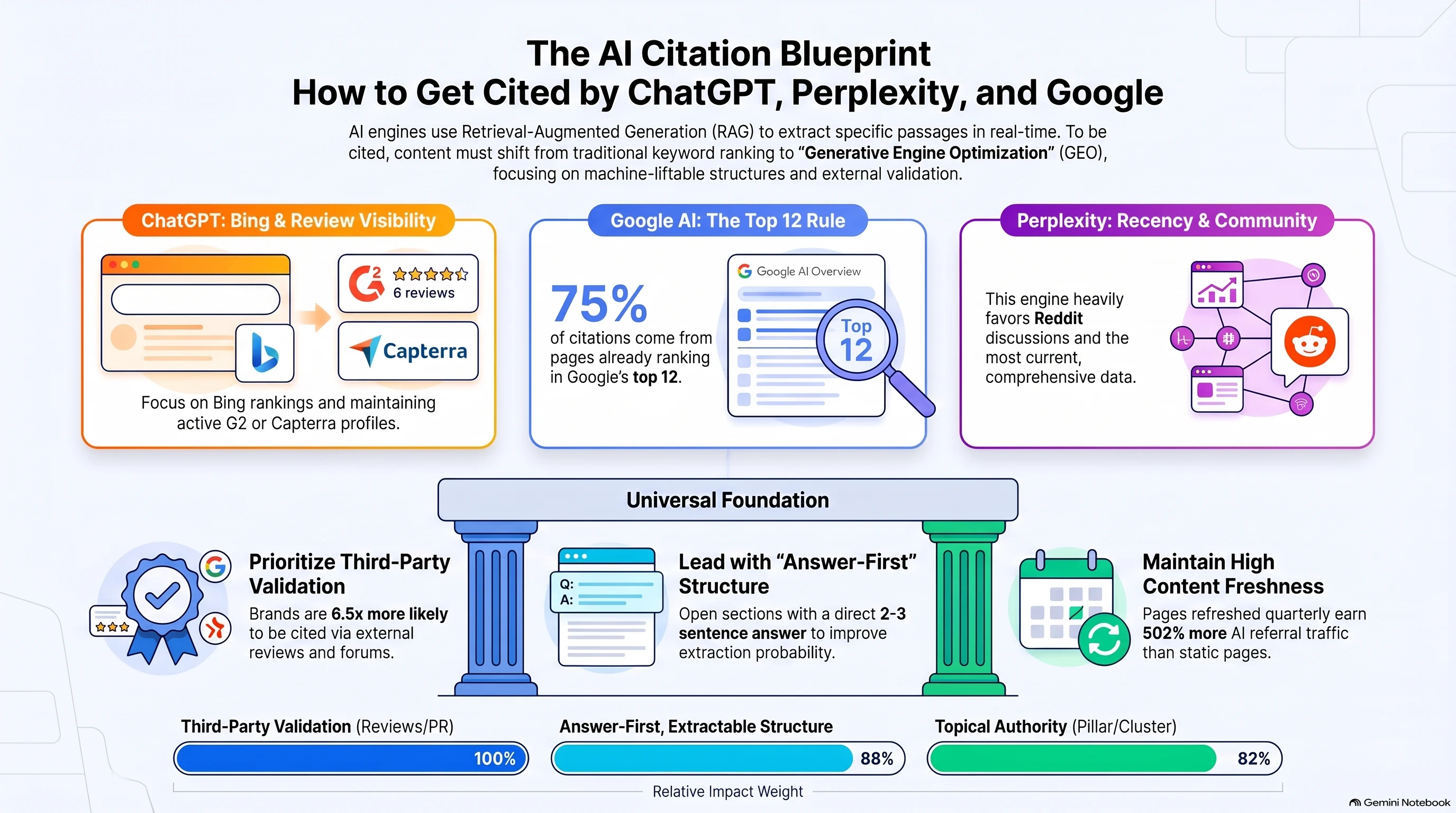
AI engines don't rank pages the way Google does. Most use Retrieval-Augmented Generation (RAG): the model pulls the most relevant passages in real time, synthesizes an answer, and cites what it drew from. Crucially, this happens at the passage level, not the page level [6]. Your job is to make individual passages easy to lift and trust.
Across every engine, the same four things move the needle. Here's their relative weight, built from the 2026 citation studies:
What Wins AI Citations (Relative Impact)
Composite of Leapd, The HOTH and Frase 2026 findings
Brands are ~6.5x more likely to be cited via third-party sources than their own site
FAQ schema + inline citations earn ~40% higher citation weighting in ChatGPT
Engines cite sources that show consistent, validated expertise across a topic
Pages refreshed quarterly earned 502% more ChatGPT referral traffic than static pages
~75% of AI Overview links come from pages already in the top 12 organic results
The most surprising finding for most business owners: your own website is not the main lever. Research found brands are about 6.5x more likely to be cited through third-party sources, publications, reviews, and forums, than through their own site [2]. Where the engines already look matters more than what you say about yourself.
Two more universal signals are worth calling out. First, structure: pages with FAQ schema and inline citations receive roughly 40% higher citation weighting in ChatGPT's source selection than pages without them [1]. Second, freshness: pages refreshed quarterly earned 502% more ChatGPT referral traffic than static pages [2]. AI systems favor current content, and they revisit sources that keep moving.
Engine-by-Engine: The One Lever That Matters Most
The universal foundation makes you eligible; these are the specific levers that win each engine
Once your foundation is solid, you tune for the engines that matter to your audience. Here's how each one sources answers and the single biggest lever for getting cited by it:
ChatGPT
Index: Bing retrieval + training data
Top cited source: Wikipedia (7.8% of citations)
Biggest lever: Bing visibility for commercial queries, FAQ schema, G2/Capterra profile
Google AI Overviews / AI Mode
Index: Google's own index (Gemini)
Top cited source: Reddit (2.2%)
Biggest lever: Rank in the top 12 organic results; answer-first structure; freshness
Perplexity
Index: Own index + multiple external sources
Top cited source: Reddit (6.6%)
Biggest lever: Recency, community presence, comprehensive well-cited pages
Gemini
Index: Google's index
Top cited source: Overlaps Google AI Overviews
Biggest lever: Strong classic SEO + clear entity signals
Claude
Index: Brave search index
Top cited source: Brave-ranked pages
Biggest lever: Brave visibility; clean, structured, extractable content
Copilot
Index: Bing
Top cited source: Bing-ranked pages
Biggest lever: Same Bing lever as ChatGPT retrieval
A few practical implications fall out of this table. If commercial-intent buyers ask ChatGPT "what's the best [your category] tool," you need Bing visibility and a presence on review sites, commercial-intent prompts trigger ChatGPT's web search 53.5% of the time, versus just 18.7% for informational queries [1]. Domains with active G2 or Capterra profiles show 3x higher citation probability in ChatGPT [1].
For Google AI Overviews and Gemini, classic SEO is the lever: roughly 75% of AI Overview links come from pages already ranking in the top 12 organic results [2]. Encouragingly, AI Mode has proven more willing than expected to cite mid-authority sources, good news for small sites [2]. Claude is the odd one out: because it runs on Brave, Brave visibility is the lever most people forget entirely.
Prioritize by Where Your Buyers Actually Ask
You don't need to win all six engines at once. Pick the two your audience uses most, for many B2B buyers that's ChatGPT and Google AI Overviews; for researchers it's Perplexity, and pull those specific levers first. The universal foundation carries over to the rest for free.
The 7-Step Citation Playbook
A repeatable framework for business owners, not developers, to start earning AI citations this quarter
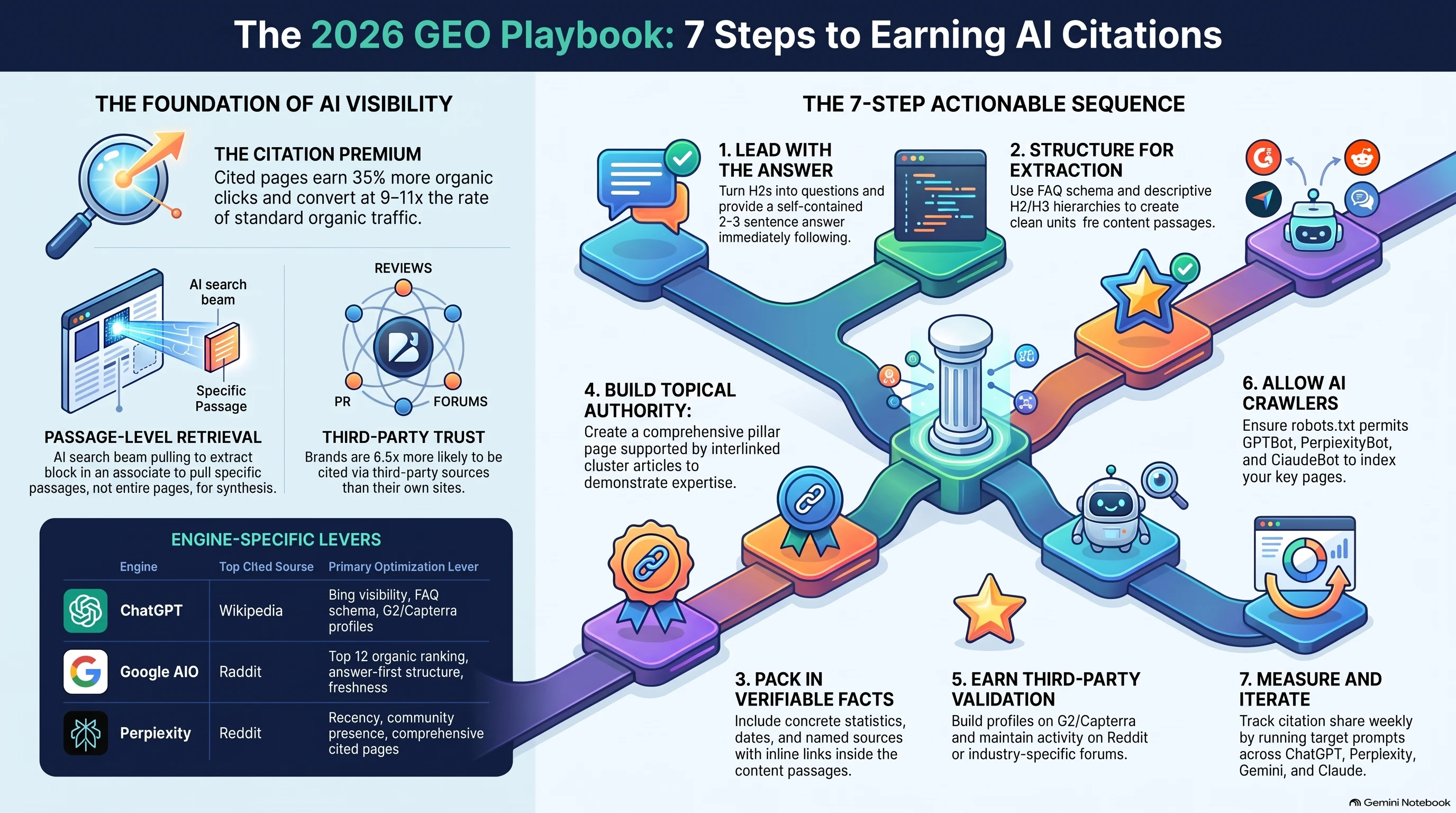
Enough theory. Here is the step-by-step framework distilled from the 2026 citation research. It's built for small business owners and solo operators, and it works whether you write everything yourself or use a tool to help.
AI engines scan for the clearest, most direct response to a query. A section that opens with "we're a leading provider" answers nothing and gets skipped. Open with the actual answer, then support it.
Citation happens at the passage level, not the page level. Hand the model clean, quotable units it can lift without ambiguity.
RAG systems reward factual density: concrete statistics, dates, named sources and inline links inside the passage itself, not buried in a footer.
Engines cite sources that demonstrate consistent expertise across a topic, not one-off pages. Cover the subject comprehensively with a pillar page and supporting cluster articles.
The single biggest lever: brands are about 6.5x more likely to be cited through third-party sources than through their own website. Get mentioned where the engines already look.
You cannot be cited by an engine that cannot read you. Blocking AI bots to protect content is the fastest way to become invisible in AI answers.
You can't optimize what you don't track. AI answers change constantly, so treat citation like a weekly feedback loop, not a one-time project.
Answer-First Is the Highest-Leverage Habit
One audit of enterprise sites found roughly 80% opened with generic "we're a leading provider" messaging, and none were structured for AI citation [2]. Simply rewriting each section to open with a direct, quotable answer puts you ahead of most of the web instantly.
The through-line across all seven steps is the same: make your expertise machine-liftable and externally validated. Answer-first structure hands the model a quotable unit; topical authority and third-party mentions tell it that unit is trustworthy; freshness keeps you in the retrieval set. None of these are hacks, they're what genuinely helpful, well-covered content looks like.
There is one honest catch. Getting cited rewards exactly the behavior that's hardest to sustain by hand: comprehensive topic coverage, consistent answer-first structure, and content that stays fresh quarter after quarter. That's the publishing rhythm News Factory automates, its AI agents research and draft full articles on a schedule you define, keep a topic cluster growing, and publish across up to five languages, so the coverage and freshness AI engines reward keep compounding without a newsroom. The strategy above works either way; the important thing is to start and keep going.
Measuring Whether It's Actually Working
AI answers change constantly, treat citation as a weekly feedback loop, not a one-time project
Traditional SEO metrics only tell half the story now. You can rank #1 and still never be cited; you can be cited without ranking at all. So measure the thing you actually want: appearances in AI answers.
The simplest method is manual and reveals ground truth. Pick 10–20 prompts your customers would realistically ask, and run them weekly through ChatGPT, Perplexity, Gemini, and Claude. Document which sources each engine cites and whether you appear [5]. Patterns emerge fast, you'll see which engine likes you, which competitor keeps showing up, and which third-party source keeps getting the citation you want.
To scale beyond manual checks, dedicated GEO trackers like Profound and Amplitude AI Visibility monitor citation share across engines automatically [4]. The metric that matters is shifting from keyword rank to citation share: of all the answers to the questions you care about, what fraction cite you?
The businesses that win at AI citation in 2026 aren't the ones with the biggest budgets. They're the ones that answer real questions clearly, cover their topic comprehensively, earn a few trusted third-party mentions, and keep their best pages fresh, then measure and repeat. The window is open precisely because most brands still haven't started.
References & Sources
Primary sources cited in this article
- Leapd, How ChatGPT, Google AI Overviews, and Perplexity Source Information in 2026
leapd.ai/blog/ai-visibility/how-chatgpt-google-ai-overviews-and-perplexity-source-information-in-2026
680M citation analysis; only 11% domain overlap ChatGPT/Perplexity; 46x citation-rate spread; Wikipedia 7.8% top ChatGPT source; FAQ schema +40% weighting; G2/Capterra 3x; AIO on ~50% of searches; cited pages +35% clicks. - The HOTH, How to Get Cited in AI Overviews: An Engine-by-Engine Guide for 2026
thehoth.com/blog/how-to-get-cited-in-ai-overviews/
Engine indexes (ChatGPT→Bing, Claude→Brave, Google AIO/AI Mode→Google); 800M+ ChatGPT weekly users; Gemini +200% YoY; 2–7 citation slots; third-party 6.5x; quarterly refresh +502%; 75% of AIO links from top 12; AI visitors convert 9x. - Silicon Chips Services, Generative Engine Optimization for Publishers: 2026 Guide
siliconchips-services.com/insight/generative-engine-optimization-for-publishers/
Answer-first structure ("answer first, evidence second"); question-shaped headings; self-contained summaries for AI Overviews. - Sapt, AI Search Optimization: How to Get Cited by ChatGPT, Perplexity & Google AI (2026)
sapt.ai/insights/ai-search-optimization-complete-guide-chatgpt-perplexity-citations
GEO tracking tools (Amplitude AI Visibility, Profound); citation-share measurement across engines. - AI Magicx, GEO: Getting Cited in ChatGPT, Claude, and Perplexity in 2026
aimagicx.com/blog/generative-engine-optimization-chatgpt-perplexity-2026
Weekly manual prompt testing across ChatGPT, Claude, Perplexity, Gemini to document cited sources. - Frase, Mastering AI Citations: The Ultimate GEO Playbook
frase.io/blog/how-to-get-cited-by-ai-search-engines-the-complete-geo-playbook
Organic CTR -61% when AIO appears, +35% when cited; RAG passage-level citation; 62% start with AI; top 20% of domains = 80% of references; 50%+ brands have no GEO strategy. - Growth Memo, State of AI Search Optimization 2026
growth-memo.com/p/state-of-ai-search-optimization-2026
Citation concentration data: top 20% of cited domains capture 80% of all AI references. - Search Engine Land, AI Traffic Up, SEO Rewritten
searchengineland.com/ai-traffic-up-seo-rewritten-459954
AI-referred sessions up 527% Jan–May 2025; 1.13B AI referral visits in June 2025 (+357% YoY).
Available in other languages