If you've spent any time reading SEO content, you've been told two things about link building that can't both be true. Thing one: backlinks are still one of Google's most important ranking signals, and you can't compete in organic search without them. Thing two: building backlinks costs anywhere from $361 per link on the average paid marketplace to $600+ on a DR 50+ site,[5][6] with monthly campaigns running into the thousands.
For a solopreneur or a three-person small business, those numbers are absurd. Spending $1,800 on five backlinks is the same money you spent on a year of hosting and tools combined. So the obvious question is: can a small business actually build links without a budget and without a PR team?
The honest answer: yes, but slower, and only with tactics that depend on time and relationships rather than money. This guide is the small-business playbook — the directory submissions worth doing (and the spammy ones that hurt you), the HARO replacements that actually exist now that HARO doesn't, guest posting in 2026, broken link building done in the small-niche-site way that actually converts, the linkable-asset approach, and the local + podcast tactics most "link building" articles skip entirely. We'll also list the black-hat tactics that are still being sold to small businesses every day, and explain why they fail.
The thesis we'll come back to at the end: 5-10 quality links from real, topically relevant domains in six months beats 100 links from a private blog network in a week, every time. Links you can't lose are the only links worth building.
The Reality of Link Building Without a Budget
What you actually get when you can't pay for placements
Three numbers reframe the whole conversation. Ahrefs' analysis of paid-link marketplaces, cited via BuzzStream and replicated across LinkBuilder.io, SaaSLinkBuilder, and StellarSEO in 2025-2026, found the average cost of a paid backlink (excluding the labor cost of outreach) is $361.44.[5][17][18] Ahrefs separately documents the cost of placing a link on a site with a Domain Rating of 50 or higher at ~$600.[6] Industry-wide, monthly link-building campaigns range from $2,000 at the low end to $20,000+ at the high end.
Now run the small-business math. A solopreneur charging $5,000 a month gross would burn 12% of revenue on a single link at $600. A retainer-class link-building campaign would consume the entire marketing budget. The economics are why every "link building service" pitch a small business gets is some flavor of: cheap PBN ($25-50/link), cheap "niche edit" marketplace ($150-300), or templated guest-post outreach ($100-200). All three of those are exactly the tactics that don't work anymore, which we'll cover in the black-hat section.
What actually works at zero or low budget is a small set of tactics that trade money for time and craft: directories and local citations that take 15 minutes per submission; HARO replacements that take 20 minutes a day; one-time linkable assets that cost a weekend to build and earn links for years; podcast guesting that costs nothing once you have a good story; broken-link sweeps on niche sites that cost an evening of focused work. The published response and acquisition rates from Backlinko (2026), LinkPanda (2026), and Viral-Impact (2026) tell us roughly what to expect when we run those tactics:
Tactic ROI for a Solo Operator
Quality links earned per ~10 hours of focused work, calibrated against published response rates from LinkPanda [9], Viral-Impact [8], and Backlinko [2]
Methodology: links-per-10-hours estimates derived from documented reply rates (5-12% on broken-link, 8% on personalized cold pitches), HARO-platform placement rates (~18% reply→placed), and directory-submission completion rates. Ranges are illustrative for a focused solo operator without retained outreach support.
Insight
Tactic ROI: What Actually Works for Solo Operators
The published response rates, the realistic placements, and where to spend your hours
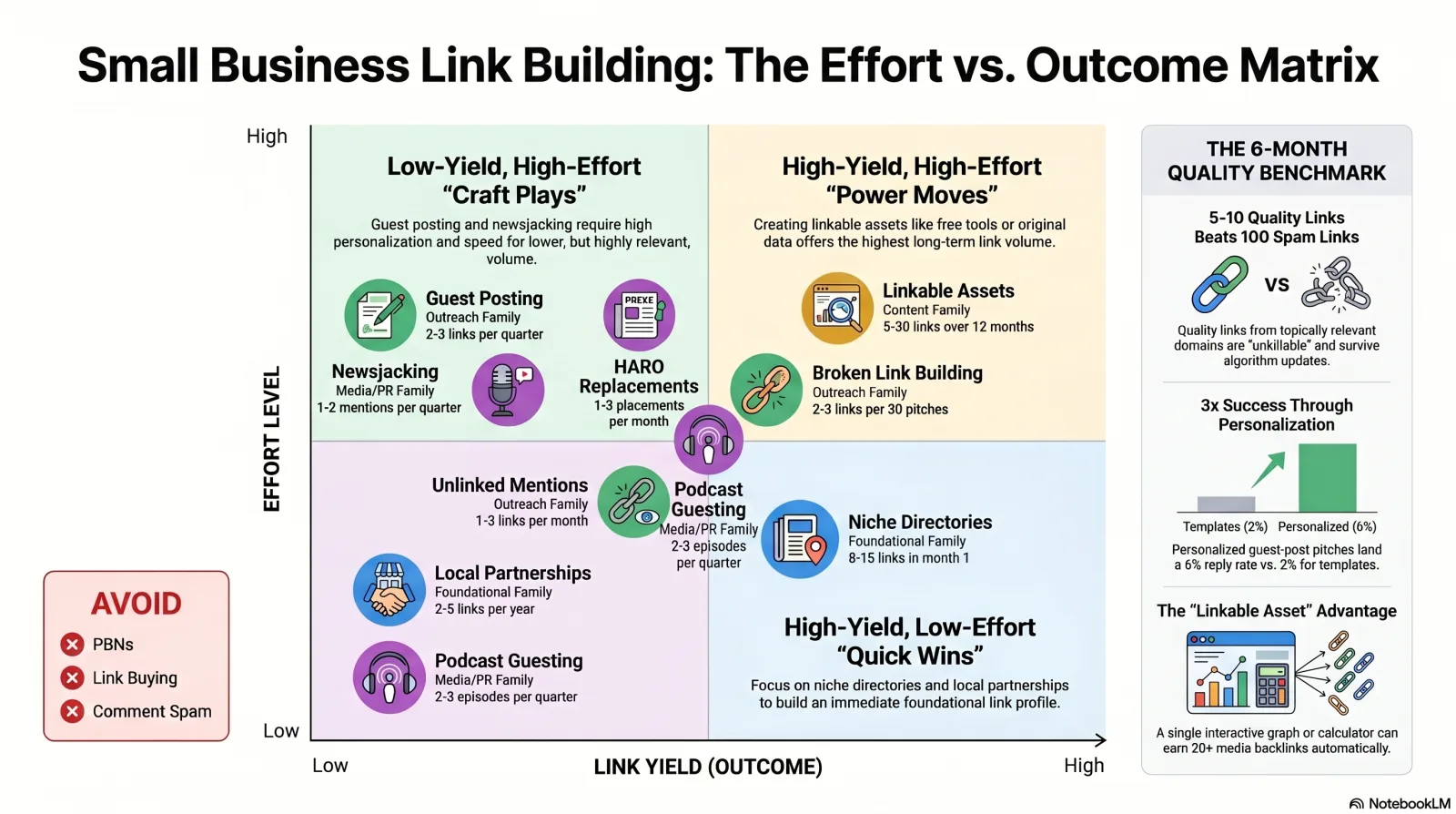
Most small business owners pick link-building tactics by feel — they read one article, try one approach, and either get discouraged or get lucky. The numbers below replace feel with rough benchmarks. Reply rates and placement rates are taken from published 2025-2026 outreach studies; effort estimates are based on what a focused solo operator can sustain at 3-5 hours per week.
Outreach Reply Rates by Tactic
Reply / placement rates from published 2025-2026 outreach data
Sources: SearchX Pro (2025) on broken-link reply rates 5-10%, Viral-Impact (2026) on 8-12% niche-site rates, LinkPanda (2026) on overall benchmarks, LaGrowthMachine (2026) on cold-pitch personalization differential.
Two patterns jump out of that chart. First, personalization is the biggest free lever in outreach: a templated cold guest-post pitch lands at ~2% reply rate, while a personalized one lands at ~6% — three times the placements for maybe twice the per-pitch effort. Second, the platforms where journalists and writers actually want to hear from you (Qwoted, MentionMatch, Featured) convert much better than cold pitches because the demand is already there. You're answering an existing question instead of interrupting someone's day.
The full white-hat tactic list with realistic outcomes:
| Tactic | Effort | Realistic outcome |
|---|---|---|
| Niche directories + chamber/industry associations | Low | 8-15 links in month 1. Boring. Foundational. Rank for branded + 'near me' queries. |
| Unlinked-mention reclamation (Google brand name in quotes) | Low | 1-3 links per month if you have any press history at all. |
| HARO replacements (Qwoted / MentionMatch / Featured) | Medium (15-30 min/day) | 1-3 expert-quote placements per month at typical reply quality. |
| Linkable assets (free tools, calculators, original data) | High (one-time + promotion) | 5-30 links over 12 months if the asset is genuinely useful + promoted. |
| Broken link building on DR 20-50 niche sites | Medium | 8-12% reply rate; 2-4 placements per 30-pitch campaign. |
| Podcast guest appearances | Medium | 2-3 episodes per quarter for an interesting founder story; show notes typically include a link + NAP. |
| Guest posting on relevant niche blogs | High | 2-3 placements per quarter on DR 30-60 sites if your pitches are personalized and your content is genuinely good. |
| Local partnerships (suppliers, neighbors, sponsorships) | Low | 2-5 links from local-partner pages per year. High trust, naturally relevant. |
| Newsjacking + commentary on niche-publication stories | Medium | 1-2 mentions per quarter when you have a credible POV on a fast-moving topic. |
Outcome ranges synthesized from Backlinko [2], Neal Schaffer [16], Ahrefs [14], and published outreach benchmarks.
Directories & Citations: The GOOD Kind
The boring foundation everyone skips, plus the trash to avoid
Directory submissions have a bad reputation because most articles about them are written by SEOs who lived through the 2010-2015 era of "submit your site to 500 directories for $25." That era ended. The directories that remain useful in 2026 fall into three legitimate categories — and the ones that don't fall into those categories should be ignored entirely.
1. Industry-specific directories. Trade associations, professional bodies, niche review sites that cover your specific industry. Examples: HVAC contractor directories for HVAC businesses, photographer directories on industry-association sites, legal directories like Avvo or Justia for law firms. These are fantastic because the link is topically relevant — Google reads "lawyer linked from a lawyer-association page" as a signal of legitimacy, not spam.
2. Local citations. Google Business Profile, Bing Places, Apple Business Connect, Yelp, Better Business Bureau, your local Chamber of Commerce, regional business directories. These primarily help local SEO (you'll show up for "near me" queries), but they also count as foundational links and consistency signals (NAP — Name, Address, Phone — must match exactly across all of them). For local businesses, claiming the top 15-25 citations is the highest-leverage 3-4 hours of link work you can do.
3. Curated/editorial directories. Listings where there's a human reviewing whether your business deserves to be there. Examples: Built In for tech companies, ProductHunt for product launches, niche subreddit "tools" sidebars, hand-curated newsletter lists. These take effort to qualify for, which is exactly why their links carry weight.
What to skip: auto-submission services that promise "500 directory links in a week," paid "premium" directory listings on sites that exist solely to host paid listings, generic "best of the web" directories with no editorial curation, and any directory whose own homepage looks like 2009 GeoCities. The link equity of a bad directory is zero or negative; you're better off not bothering.
Recommendation
HARO Is Dead — Here's What Replaced It
The 2025 shutdown of Connectively (HARO) and the platforms small businesses should use instead
Help a Reporter Out (HARO) was the single most cited free link-building tactic for over a decade. If you haven't heard: it's gone. HARO was acquired by Cision, rebranded as Connectively in 2024, and fully shut down in 2025.[3] If your link-building advice still says "respond to HARO queries," that advice is from before the shutdown.
The good news: the entire ecosystem of journalists-need-quotes-from-experts didn't disappear with HARO. It fragmented across half a dozen platforms, several of which are free and arguably better than HARO ever was. The current landscape:
| Platform | Pricing | Best for | Notes |
|---|---|---|---|
| Qwoted | Free tier + paid (~$149/mo) | B2B + B2C, business journalists | Most-cited HARO successor in 2025-2026 roundups (Backlinko, Prowly). Free tier is enough for most small businesses. |
| MentionMatch (formerly Help a B2B Writer) | Free | B2B SaaS, marketing, sales, tech | Acquired by Superpath (Jimmy Daly) in 2023. Smaller volume than Qwoted, but high signal-to-noise for B2B. |
| Featured (formerly Terkel) | Free + paid expert plans | Roundup-style articles, expert quotes | Heavy use by content marketers. Quotes get aggregated into round-up posts that often link back. |
| SourceBottle | Free | Australian / UK media, lifestyle | Free, lower volume in US. Worth scanning for niche / regional opportunities. |
| JustReachOut | Paid (~$197/mo) | DIY proactive journalist outreach | Not a query-board — you proactively pitch journalists found via the platform. More work, more control. |
| ProfNet (Cision) | Paid (enterprise) | Established businesses with PR budget | Higher quality, higher cost. Generally overkill for solo operators. |
Sources: Backlinko HARO alternatives review [2], MentionAgent shutdown timeline [3], Prowly comparison [4]. As of early 2026.
Practical playbook: create accounts on Qwoted (free tier) and MentionMatch. Spend 15-20 minutes a day skimming queries, and only respond when:
- You're a credible expert on the topic — not a generic answer pulled from your blog.
- You can provide a specific, quotable, original angle in 2-4 sentences.
- You can include one piece of proof (a stat, a customer story, a case from your own work) that other respondents won't have.
Mass-spamming generic responses to every query is the fast way to get blacklisted by writers; quality responses tied to genuine expertise convert at the ~18% reply-to-placed rate documented above. At 1-2 quotes per month landed, that's 12-24 expert-positioned backlinks per year from genuinely high-DR publications. Most of those publications would charge $500+ for the equivalent placement on their guest-post submission form.
Format your response in four short paragraphs and the placement rate roughly doubles vs. a wall of text:
- Credibility line (1 sentence). "I'm [name], owner of [business], and I've been [doing the relevant thing] for [N years]." Writers verify quotes; this saves them a step.
- The angle (1-2 sentences). The specific, quotable opinion the writer can drop into their piece. Not "link building is hard"; instead "the median small business will earn 5-10 quality links in six months from podcast guesting alone, far more than from any cold-pitch campaign."
- The proof (1-2 sentences). A concrete example, customer story, stat, or anecdote. Without proof, the quote is generic and gets cut.
- Logistical line (1 sentence). "Happy to elaborate or clarify — full headshot and bio at [link]."
Total length: 80-120 words. Writers love it because they can drop it straight into their piece. Most respondents send 400-word essays full of irrelevant tangent — yours stands out.
Guest Posting That Still Works in 2026
The narrow definition that still earns links — and the version Google has been devaluing for years
Guest posting is the most over-flogged tactic in SEO. Google has been openly hostile to "large-scale article marketing or guest posting campaigns with keyword-rich anchor links" — that exact phrase appears in their spam policies.[1] Mass guest posting is dead. Targeted, topical guest posting on sites that genuinely match your niche is alive and well.
The version that still works has three properties:
- Topical relevance. A landscape architect guest-posting on a gardening blog: relevant. A landscape architect guest-posting on a cryptocurrency blog: not relevant, and Google can tell. The link only carries weight if the topic of the host site overlaps meaningfully with your topic.
- Editorial standards. The host site rejects bad submissions. There's a real editor or editorial process. The post you contribute is genuinely better than what their regular contributors produce, not a thinly-veiled ad.
- Anchor-text restraint. Your in-content link uses your brand name or a natural phrase, not "best small business SEO consultant" anchored 47 times across the post. Exact-match anchors at scale is the single fastest way to earn an algorithmic devaluation.
The pitch process for sites that actually meet those bars:
- Identify 20-30 niche blogs in your topical space. Read the last 6 months of their posts; if guest contributors appear regularly with bylines, they accept submissions.
- Personalize the pitch. Reference 2-3 of their recent posts by title; pitch a topic that fills a real gap in their archive (use Search Console to find what queries their existing posts almost rank for); offer 3 outline-level topic ideas, not a single take-it-or-leave-it pitch.
- Write the post like it's your best work. Not your fifth-best repurposed-from-your-own-blog work. Publishers know the difference, and the reciprocal effect — they recommend you, link to other things you've written, share your work — is worth more than the single dofollow link.
Realistic outcome: 2-3 placements per quarter on DR 30-60 niche blogs if your pitches are personalized and your content is good. That's 8-12 quality, topical guest-post links per year — fewer than a paid campaign would promise, but each one is on a site that wouldn't take spam money even if you offered it. Those are the links that survive Google updates.
Warning
Broken Link Building, Realistically
Why the technique still works on small niche sites — and why it fails on the big ones
Broken link building has a complicated reputation. The 2026 LinkPanda survey found 13.3% of marketers actively use it, but only 5% rated it as their highest-ROI tactic.[9] Reply rates run 5-12% across the published studies — Viral-Impact reports 8-12% on niche sites,[8] SearchX puts the overall average at 5-10%. So it works, but not as well as the 2018 SEO blog posts claimed.
Where it fails: high-DR sites get dozens of broken-link pitches a week, and most have editorial processes that don't allow easy content updates. As LaGrowthMachine documented in early 2026, "high-domain-authority sites ignore broken link outreach... broken link building works better on smaller niche sites (DR 20-50) where site owners actively manage content and appreciate the heads-up."[10] That's the version that still works in 2026.
The 6-step playbook:
- Pick a target topic you have (or can write) genuinely good content on. The whole pitch hinges on offering a quality replacement.
- Find 50-100 broken outbound links on DR 20-50 sites in your niche. Tools: Ahrefs Site Explorer (free trial), Check My Links Chrome extension, or Wayback Machine spelunking on resource pages.
- Verify each broken link manually. Auto-detected "broken" links are often soft 404s, region-blocked, or temporarily down. Open each one.
- Confirm the replacement angle. Your content should be a credible replacement for what the broken link was, not a self-promotional substitute that pretends to be the same thing.
- Send the pitch: 2-3 sentence email naming the specific broken link, why you noticed (you were referencing their post), the replacement URL, and a short reason why the replacement is solid. Two follow-ups maximum, at 5 days and 12 days. After that, move on.[10]
- Track the wins. Backlinko's data, cited via Searchlab in March 2026, shows that broken-link outreach combined with a quality replacement article increases success rates by 40-60% compared to offering existing content.[7] The replacement article matters as much as the pitch.
Realistic outcome for a 30-pitch campaign on niche sites: 3-4 replies, 2-3 placements. That's 8-12 quality, topical links from a few hours of outreach over a couple of weeks. Repeat quarterly with a different content angle and you have a sustainable 8-12 links per quarter from this single tactic.
The Linkable-Asset Approach
Build something other people want to cite, then promote it once and earn links for years
The single highest-leverage tactic for a small business with limited time is a good linkable asset. SEOProfy's 2025 linkable-assets guide put it cleanly: "A small tool that answers a question your audience types into Google every day can outperform many long blog posts in terms of backlinks."[11] The Backlinko Skyscraper case study itself accumulated 7,500+ backlinks from being treated as the canonical reference on its topic.[13]
The principle: most link building is interruption (you reach out to someone and ask). A linkable asset inverts the work — you build the thing once, and the people writing related articles come to you because you're the citation that makes their post stronger. Outreach flips from "please link to me" to "here's a tool that solves the problem your post is about."
The taxonomy of assets that earn links for small businesses:
| Asset type | Why it works | Example |
|---|---|---|
| Free tool / calculator | Solves a recurring problem people Google. People link to tools because telling someone 'use this calculator' is easier than explaining the math. | Breezit's Orange-County wedding-venue pricing graph (interactive, filterable) — Woorank documented 20+ media + business backlinks earned. |
| Original data study (your customers / industry survey) | Journalists need numbers; if you have proprietary numbers nobody else has, you become the citation. | Any 'we surveyed 500 X' or 'we analyzed 10,000 Y' study with a methodology section publishers can quote. |
| Definitive long-form guide on a specific question | Becomes the page everyone else lazily links to instead of writing their own. Brian Dean's Skyscraper case study has 7,500+ backlinks for exactly this reason (G2 Learn, 2025). | Backlinko's 'Skyscraper Technique' post — became a linkable asset with 7,500+ referring backlinks. |
| Comparison / 'vs' page (your category vs alternatives) | Writers covering category overviews link to comparison pages because they save them research. Particularly strong for SaaS and services. | Any honest 'X vs Y vs Z' page that doesn't pretend you're objectively best. |
| Templates and downloadables | Spreadsheet templates, contract templates, content templates — anything with utility someone bookmarks gets linked when others recommend the same thing. | HubSpot's free template library is the canonical example; small businesses can replicate at category level. |
| Industry-state / 'year in review' annual report | Becomes the citation for your industry once published 2-3 years in a row. Compounds because each new edition gets linked back to previous editions. | Backlinko's annual SEO statistics roundup; smaller niches have room for the equivalent. |
Sources: SEOProfy [11], Woorank [12] (Breezit case), G2 Learn [13] (Backlinko Skyscraper).
The Breezit case (Orange-County wedding-venue pricing graph) is the clearest small-business analog in the public record. Woorank documented Breezit earning 20+ backlinks from media outlets and other business websites from a single interactive graph — not a 4,000-word guide, not a paid campaign, just a focused interactive visualization that answered a question their potential customers were already asking.[12]
The build-and-promote loop for a small business:
- Pick a question your audience Googles. Use Search Console for your existing site and any related communities (Reddit niches, LinkedIn comment threads, Facebook groups in your industry). The question should be specific, recurring, and not yet served well by a tool.
- Build the asset. Spreadsheet-driven calculator with simple JS, a single-page interactive chart, a 60-row comparison table, a 12-page PDF guide with proprietary methodology — the format depends on the question. The bar is "useful enough that a journalist would link to it instead of explaining it themselves."
- Promote it ONCE, intensely. 30 personalized outreach emails to journalists/bloggers covering related topics, 5 podcast pitches, 1 LinkedIn post per week for 6 weeks, 1 industry Slack/forum mention. Most of the links come in the first 90 days; after that the asset earns slowly through search.
- Refresh the asset annually. New data, new screenshots, new examples. Each refresh is a new excuse to do another round of promotion, and previous links keep compounding.
Podcasts, Local Partnerships & Shoestring PR
The link-building tactics most SEO blogs skip entirely
The three tactics in this section are under-discussed because they don't fit the SEO-blog template. They're not outreach, not technical SEO, not content marketing in the usual sense. But for a small business with no budget and a credible founder story, they're frequently the highest-ROI links available.
Podcast guesting
Podcasts that interview small-business owners are surprisingly underserved. Niche industry podcasts often run weekly and need a steady supply of guests; if you have an interesting founder story, a contrarian take on your industry, or a specific case study to talk about, you can get booked. Each episode produces backlinks from the show notes, the transcript page, and the guest profile page — and as Ahrefs documented in 2022, the show typically links to your website plus any specific resource you mention during the conversation.[14]
For local businesses, podcast guesting carries a hidden bonus: hosts often include your full NAP (name, address, phone) in the episode summary, which counts as a high-quality local citation alongside the link.[15]
Practical pitch: identify 10-15 niche podcasts in your industry or city. Email each host with a specific 4-line pitch — your story, the angle they haven't covered, why their listeners would care, and a logistical line. Expect 2-3 bookings out of 10 personalized pitches; that's 2-3 high-quality links plus the brand exposure of being introduced to a relevant audience.
Local partnerships
Look at every business in your real-world supply chain or partnership network. Suppliers. Vendors. The graphic designer you hired. The local printer. The accountant. The bookkeeper. Many of them have a "trusted partners" page, "clients we work with" section, or testimonial wall on their website — all of which are link opportunities you don't have to outreach for; you already have the relationship.
Same logic applies to community sponsorships: a $200 sponsorship of a local 5K, charity event, or school program almost always produces a sponsor-acknowledgement page link with your name, logo, and URL. The local relevance signal is strong (if you serve a city, links from that city's sites help local SEO disproportionately) and the trust signal is genuine — you actually sponsored the thing.
Realistic: 2-5 partnership links per year from this approach, all from real, locally-relevant domains. Slow but unkillable.
Shoestring digital PR
"Digital PR" sounds like agencies and $5,000 retainers. The small-business version is much simpler: when something news-adjacent happens in your industry, have an opinion in writing, fast, before everyone else does. The opinion goes on your blog and on LinkedIn the same day; you tag 2-3 reporters who cover the topic; you respond to anyone discussing it on X / LinkedIn / Reddit with a link to your take. This is "newsjacking" and it's basically free.
The other small-business PR move: local press. Every regional newspaper and chamber-of-commerce newsletter is hungry for stories about local businesses doing interesting things. New product launch, milestone reached, founder story angle, charitable partnership — pitch the local business reporter directly with 80-120 words and a photo. Acceptance rates run 20-40% on a personalized pitch with a real local angle, and the resulting links are from .org and regional publications that are extraordinarily hard to acquire any other way.
Black-Hat Tactics to AVOID (And Why)
The tactics small businesses still get pitched constantly — and why every single one of them fails over time
If you're a small business owner, you get pitched at least one of these tactics every month. They sound cheap, they show short-term results, and they are uniformly bad investments. The list below covers what each tactic is, why it fails, and what Google's spam policies actually say about it.[1]
#1: PBNs (Private Blog Networks)
Why it fails: Networks of expired domains stitched together to point links at one money site. Footprints (shared hosting, registration patterns, template overlap) are easy for Google to detect and entire networks get deindexed periodically.
Google's stance: Explicit violation of Google's link-spam policy. Manual actions issued in waves; algorithmic devaluation continuous.
#2: Buying links from 'guest post marketplaces' that sell to anyone
Why it fails: Marketplaces aggregating sellers and buyers create predictable patterns. The same sites accept the same money from competing brands; Google's spam systems pattern-match these networks at scale.
Google's stance: Paid links without rel=sponsored or rel=nofollow violate the link-spam policy. Listed explicitly in spam guidelines.
#3: Comment spam / forum profile spam
Why it fails: Auto-posted, generic, or mass-blasted comments and forum signatures. Almost always nofollow today and aggressively de-weighted even when followed.
Google's stance: Listed in Google's spam policies as 'links generated programmatically.' Treated as worthless or harmful.
#4: Reciprocal link schemes / link wheels
Why it fails: 'Link to me, I'll link to you' arrangements at scale, or three-site wheels designed to disguise the exchange. Pattern-matchable, common across thousands of sites.
Google's stance: Excessive cross-linking listed in spam policies. Devalued algorithmically.
#5: Footer / sitewide widget links from 'free templates'
Why it fails: Embed a widget on someone's site → automatic sitewide footer link. Used to work in 2010. Today every footer link from a widget points to a brand, which Google trivially clusters and discounts.
Google's stance: Listed as 'large-scale article marketing or guest posting campaigns with keyword-rich anchor links.'
#6: Mass-mailed templated guest-post pitches
Why it fails: Same email to 500 sites → 1-2% reply rate, near-zero placement rate, plus you've trained spam filters to flag your domain. Damages your sender reputation faster than it earns links.
Google's stance: Not a Google penalty per se, but the resulting links are explicitly flagged as 'large-scale article marketing campaigns with keyword-rich anchor links.'
#7: Web 2.0 link blasts (Tumblr, Blogspot, Medium auto-posting)
Why it fails: Auto-generated profiles on free hosts pointing back at one site. Footprint detection is mature and these get devalued en masse.
Google's stance: Treated as 'low-quality directory or bookmark site links' — listed in spam policies.
Warning
The other dimension worth naming: even when a black-hat tactic doesn't earn a manual penalty, the algorithmic devaluation is silent and continuous. Your DR climbs from cheap links, then quietly gets discounted. Your "100 backlinks for $200" campaign produces zero ranking effect because Google's link graph already reweighted your domain to ignore them. You spent the money for nothing. Whereas a single guest post on a topical niche blog might be worth more than 100 spam links in cumulative traffic over 5 years.
A Realistic 6-Month Roadmap
What a solo operator can actually do at 3-5 hours per week, in priority order
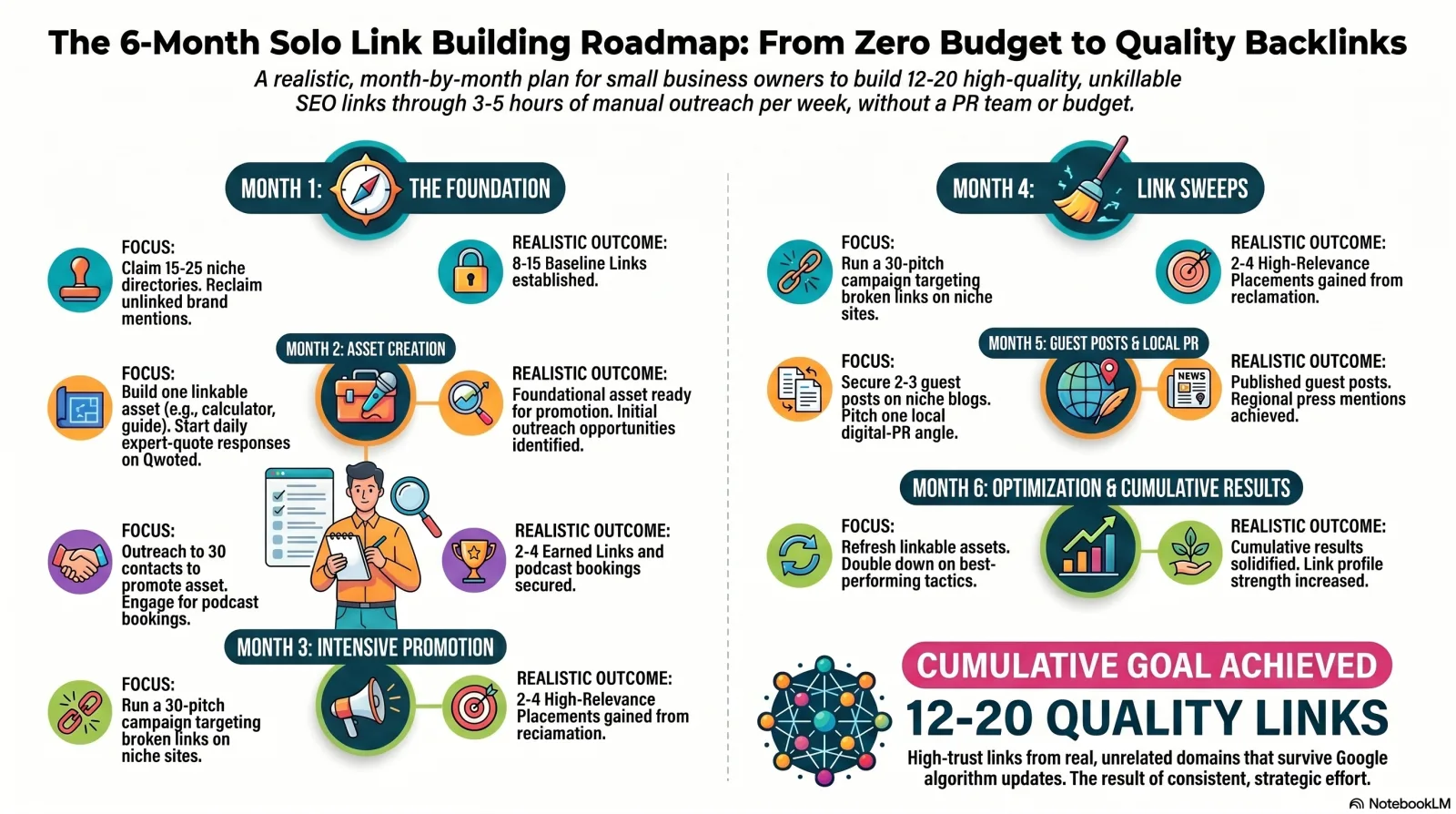
The roadmap below is for a solopreneur or 1-3 person small business with no link-building budget and roughly 3-5 hours per week to allocate. It's deliberately conservative — most "6-month link-building plans" online assume a full-time SEO and 20+ hours per week. This one assumes neither.
| Month | Focus | Realistic outcome |
|---|---|---|
| Month 1 | Foundation: claim 15-25 niche directories + chamber + supplier mention pages. Audit existing brand mentions for unlinked-mention reclamation. | 8-15 baseline citation links, 2-3 unlinked-mention reclaims |
| Month 2 | Build ONE linkable asset (free tool, calculator, or original-data post). Start daily HARO-replacement responses (Qwoted, MentionMatch, Featured). | 1 asset live, 1-2 expert-quote placements landing |
| Month 3 | Promote the linkable asset: 30 personalized outreach emails, 5 podcast pitches, 1 LinkedIn post per week. Continue daily HARO replies. | 2-4 earned links to the asset, 1-2 podcast bookings |
| Month 4 | Broken-link sweep: find 100 broken outbound links on DR 20-50 niche sites pointing to dead resources you can replace. Send 30 personalized pitches. | 2-4 broken-link replacements live, podcast episodes airing |
| Month 5 | Guest-post on 2-3 niche blogs (DR 30-60) with topical alignment. Pitch a digital-PR angle to local press: data from your own customers, founder POV, seasonal trend. | 2-3 guest posts, 1-2 local press mentions |
| Month 6 | Refresh the linkable asset with new data + republish, retire dead pitches, double down on the channels that produced the first links. | Cumulative: 12-20 quality links from real, unrelated domains |
The cumulative target after six months: 12-20 quality, topically-relevant backlinks from real, unrelated domains. That's far below what any "link-building service" pitches you, and it's also far above what most small businesses actually achieve when they try ad-hoc tactics without a plan. The discipline of the roadmap is what produces the result, more than any single tactic on it.
Realistic Expectations: 5-10 Beats 100
What a small business should actually plan for at different effort levels
Setting the expectation right is the most important non-tactical thing in this guide. A solo operator without a budget, doing this well, should plan for the table below — not for the agency-pitch numbers, not for the SEO-blog hype, and definitely not for what a PBN seller is going to promise.
| Profile | 6 months | 12 months |
|---|---|---|
| Solo operator, no budget, ~3 hrs/week | 5-10 quality links from real domains | 12-25 quality links + 1 strong linkable asset |
| Solo operator, $200-500/mo tools/promo | 10-20 quality links + 1 PR mention | 30-50 quality links + 2-3 linkable assets |
| Small team (2-3), part-time SEO | 20-40 quality links + 2-3 PR mentions | 60-100 quality links + repeatable system |
The single most important comparison to internalize: 5-10 links from real, topically relevant, unrelated domains in 6 months will move your rankings more than 100 PBN links built in a week. The first set is unkillable; the second set will be devalued or de-indexed within 6-18 months and the recovery from that is brutal. There is no version of small-business SEO where the second strategy wins.
Two practical sanity checks for any link you're about to acquire (paid or earned):
- The Wayback Machine test: would this same site link to a comparable business if you asked? If yes, the link is real. If no — if they only link because you paid them, or because they sell links — Google's pattern-matching probably already knows.
- The "would I buy from this domain" test: would you, as a customer, trust a recommendation made on this site? If the answer is "no, this site looks like a content farm," it's a content farm and Google treats it as one.
The frustration of small-business link building is that the right answer is slow. But the slow answer compounds; the fast answer doesn't. Five to ten genuinely-earned links in 6 months becomes 30 in 18 months as those links produce referral traffic that creates more links, the linkable asset earns links from people who found it organically, and your improved authority makes guest-post pitches easier to accept. Two years in, you have a link profile that's defensible, that survives algorithm updates, and that's worth several multiples of what the same money would have bought from any agency.
None of the tactics above replace the foundation: fresh, well-researched content on your site that other people actually want to reference. The publishing cadence — turning out the guides, data posts, and supporting articles that surround your linkable assets — is the part that's exhausting to do by hand. Tools like News Factory can keep that content engine running on a schedule you set, so the linkable assets you've built stay current and your blog keeps shipping the kind of articles other people want to cite. They don't replace outreach, and they don't pitch journalists for you. But they do solve the part of the equation a solo operator can rarely sustain alone: consistent, on-topic content production around the assets you're trying to earn links to.