Why Local SEO Is Your Biggest Opportunity
Nearly half of all Google searches are looking for something nearby — and most of those searchers are ready to buy
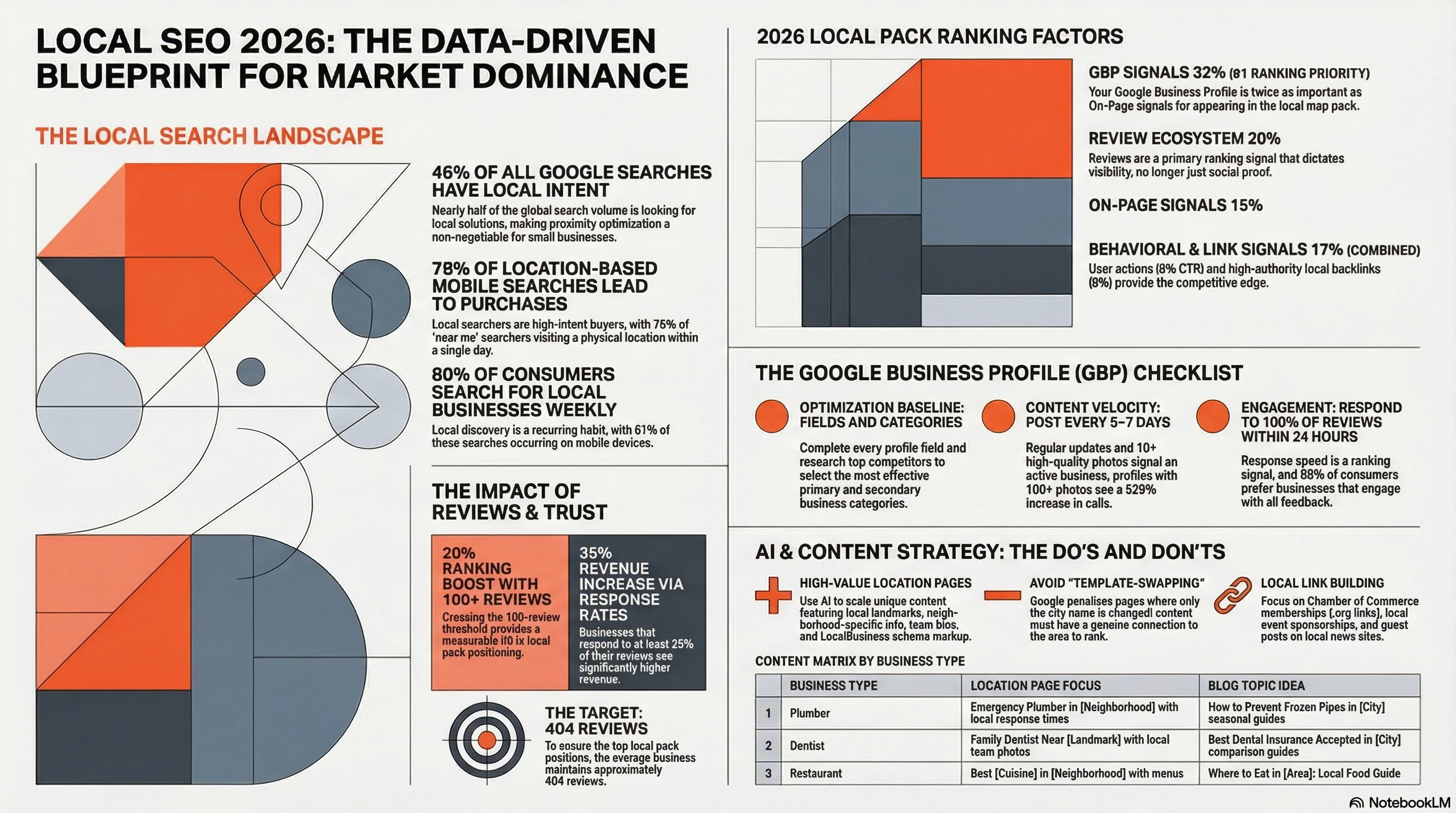
If you run a local business — a dental practice, a plumbing company, a restaurant, a law firm — there's a number you need to know: 46% of all Google searches have local intent [5]. That's nearly half of every search, every day, from people looking for businesses, services, and products near them.
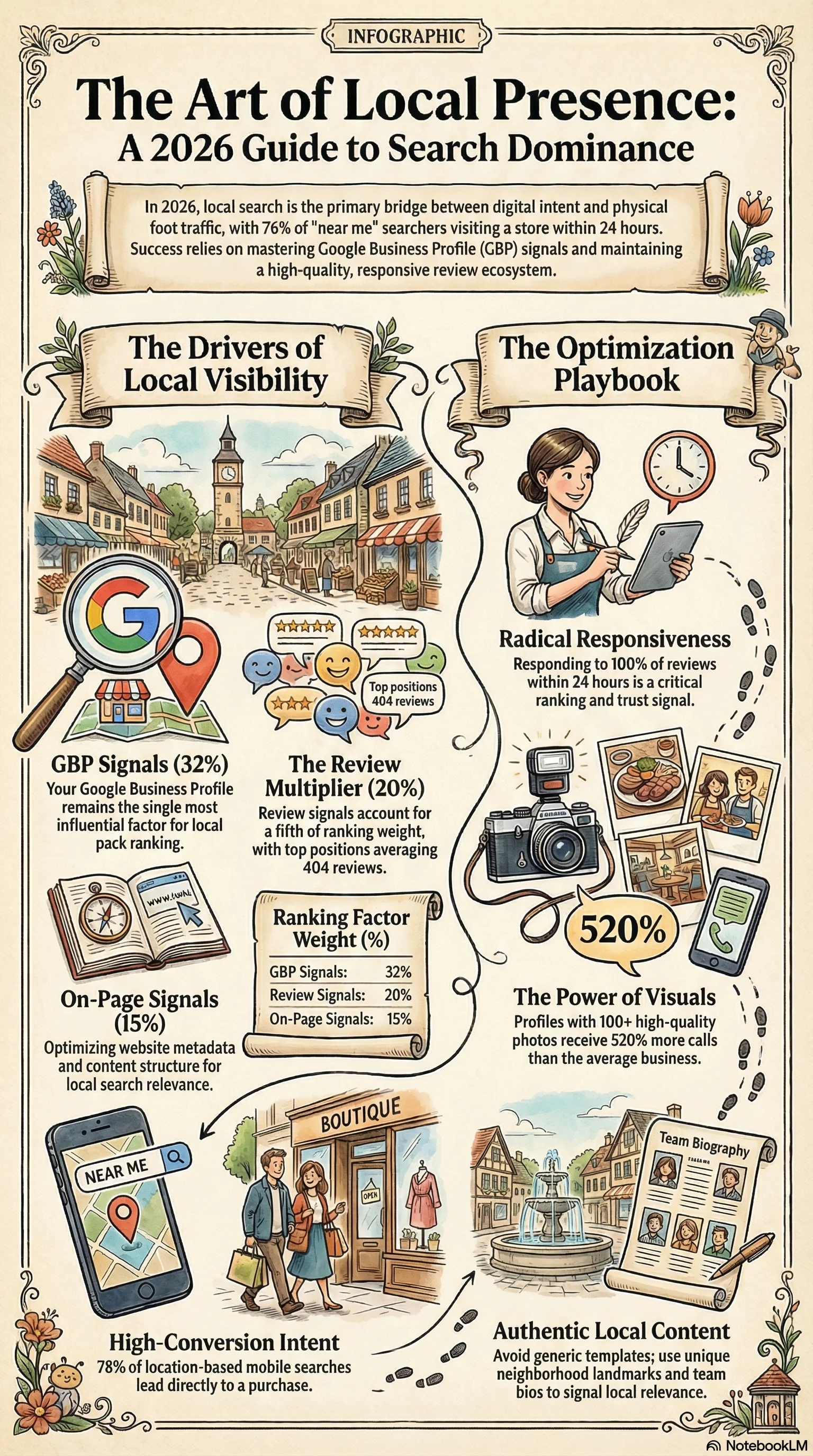
And these aren't casual browsers. 76% of people who search "near me" visit a business within 24 hours [2]. 78% of those local searches lead to a purchase [3]. This isn't hypothetical traffic — it's people with their wallets out, looking for someone to give their money to.
The question is whether that someone is you or your competitor down the street.
Local Search Behavior — The Numbers That Matter
Sources: Google, Search Engine Roundtable, SOCi, ReviewTrackers, SEO Tribunal
Source: Search Engine Roundtable
Source: Google
Source: Google
Source: SEO Tribunal
Source: SOCi
Source: ReviewTrackers
Most of this local search action flows through one place: the Map Pack (also called the Local Pack or the "3-Pack"). That's the block of three business listings that appears at the top of Google results when someone searches for something local — complete with a map, star ratings, hours, and a click-to-call button.
The Map Pack sits above the regular organic results. It's the first thing searchers see. And because it includes a phone number and directions right there, many people never scroll past it. For local businesses, ranking in the Map Pack is the single highest-value position in search.
Here's the good news: unlike competing for national keywords against billion-dollar companies, local SEO is a playing field where small businesses can genuinely win. Your competition is the other plumbers in your city, not every plumber on the internet. And the ranking factors favor things you can directly control — your Google Business Profile, your reviews, your local content, and your online reputation.
Mobile Is Where Local Happens
57% of local searches happen on mobile devices, and 88% of mobile local searchers visit a store within a week [3]. These are people on the move, searching from their phones while they're already out. If your business doesn't appear in local results on mobile, you're invisible to the majority of high-intent local searchers.
Let's break down exactly what moves the needle in local SEO — and how AI content tools are making it possible for one-person operations to compete with franchises that have entire marketing teams.
Google Business Profile: Your Digital Storefront
GBP signals account for 32% of local pack rankings — making it the single most influential factor in local search
Your Google Business Profile (GBP) is the foundation of everything in local SEO. According to Whitespark's 2026 Local Search Ranking Factors survey, GBP signals account for 32% of what determines your position in the local pack [1]. No other single factor comes close.
Think of your GBP as your digital storefront — except more people see it than your physical one. When someone searches "dentist near me" or "emergency plumber [your city]," your GBP listing is often the first interaction they have with your business. A complete, well-optimized profile doesn't just rank higher — it converts better.
Here's what the ranking factors look like across the board:
Local Pack Ranking Factors (Whitespark 2026)
Source: Whitespark 2026 Local Search Ranking Factors Survey
GBP optimization isn't complicated, but it requires attention to detail. Most local businesses fill in their name and phone number and call it done. The ones that rank in the Map Pack do significantly more:
Complete all profile fields
Name, address, phone, hours, website — every field filled signals legitimacy to Google
Select primary + secondary categories carefully
Your primary category is the single biggest GBP ranking factor — research what top competitors use
Post updates every 5–7 days with photos
Regular posts signal an active business and give Google fresh content to index
Respond to ALL reviews within 24 hours
Response rate and speed are ranking signals — and 88% of consumers prefer businesses that respond to all reviews
Add products/services with descriptions
Products and services sections create additional keyword-rich content on your profile
Upload 10+ high-quality photos
Businesses with 100+ photos get 520% more calls and 2,717% more direction requests than average
Enable messaging and Q&A
Engagement features signal to Google that your business is responsive and active
Keep hours accurate (especially holidays)
Businesses open at search time rank higher in local results — inaccurate hours can tank your visibility
The Open-At-Search-Time Advantage
One of the most overlooked findings from the Whitespark 2026 survey: businesses that are open at the time someone searches rank significantly higher in local results [1]. Google actively filters toward businesses that can serve the searcher right now. If your GBP hours are inaccurate — or if you're not listing extended hours you actually keep — you're losing rankings every hour you appear "closed" but aren't.
The AI opportunity here is in GBP posts. Google Business Profile lets you publish updates — essentially mini-blog posts that appear on your listing. Businesses that post every 5–7 days see measurably better rankings. But most small business owners don't have time to write a new post every week. This is where AI content tools shine: generating a weekly GBP post with a relevant photo, local mention, and call-to-action takes minutes instead of hours.
Local Keywords + AI: Creating Location Pages at Scale
How to build legitimate, high-ranking location pages — without triggering Google's doorway page penalty
Local keyword strategy is straightforward in concept: combine your services with your locations. "Emergency plumber in Westlake." "Family dentist near Downtown Austin." "Italian restaurant Lakewood." These are the searches your customers actually type.
The challenge is scale. If you're a plumber who serves 15 neighborhoods, you ideally want a dedicated page for each one. If you offer 8 services, that's potentially 120 unique pages. Creating those by hand is prohibitively time-consuming. This is exactly where AI content tools become transformative.
But there's a critical distinction between doing this right and doing it in a way that gets you penalized.
Google's SpamBrain Targets Template-Swapped Pages
Google's doorway page policy specifically targets pages that exist only to rank for specific search queries and funnel users to a single destination. The telltale sign: multiple pages where only the city or neighborhood name changes but the actual content is identical [9]. Google's SpamBrain algorithm has gotten remarkably good at detecting these template-swapped pages. The penalty? Your entire site can lose ranking — not just the doorway pages.
The difference between a doorway page and a legitimate location page comes down to one thing: genuine local value. Here's what separates the two:
Here's a concrete example. Say you're a plumber in Austin, Texas, and you serve multiple neighborhoods. A doorway page approach would be 15 copies of the same page with "Westlake" swapped for "Cedar Park" swapped for "Round Rock." Google catches this easily.
The AI-powered approach that actually works: use AI to research each neighborhood and generate genuinely unique content for each page. Your "Emergency Plumber in Westlake" page mentions that Westlake homes are predominantly built in the 1990s–2000s with PEX piping, that the area's hill country terrain means unique drainage challenges, and includes a testimonial from a Westlake homeowner. Your "Emergency Plumber in East Austin" page discusses the neighborhood's mix of historic bungalows with galvanized pipes and new construction, the common issues with older sewer lines in the area, and local infrastructure specifics.
Each page takes 10–15 minutes to create with AI assistance instead of 2–3 hours manually. But because you're feeding the AI real local knowledge — your experience, specific neighborhood details, past projects — each page provides genuine value that Google rewards.
Local Keyword Research in 15 Minutes
Start with a simple matrix: list your top 5 services down one side and your top 10 service areas across the top. That gives you 50 keyword combinations. Then check Google's "People Also Ask" for each combination — you'll find another 3–5 long-tail queries per combo. That's 150–250 target keywords in 15 minutes of research. AI tools can then help you create content for each cluster efficiently.
Reviews: Your Silent Sales Force
Review signals account for 20% of local pack rankings — and the businesses at the top average 404 reviews
Reviews are the second most important factor in local pack rankings at 20% of the total signal weight [1]. But their impact goes far beyond SEO. Reviews are the most powerful trust signal your business has online — more persuasive than any ad copy or marketing claim you could write yourself.
The data tells a compelling story about what reviews actually do for local businesses:
The Impact of Reviews on Local Business Performance
Sources: Widewail 2025, Whitespark 2026, UENI, BrightLocal
Widewail 2025
Whitespark 2026
BrightLocal
Womply
UENI
That last number is worth repeating: the average business in the top local pack positions has 404 reviews [12]. If you have 15 reviews and your competitor has 300, you're fighting with a significant disadvantage — no matter how well you've optimized everything else.
Building a review machine requires two things: a system for asking, and a system for responding.
Getting reviews systematically: The single best time to ask for a review is immediately after a positive interaction. A plumber who fixes a leak on a Tuesday should send a review request that evening — not a week later. The ask should be simple: a direct link to your Google review page, sent via text message (text gets 3–5x the response rate of email). Make it frictionless — one tap to leave a review.
Responding to reviews with AI: This is where AI becomes genuinely useful for small business owners. Responding to every review personally takes time most owners don't have. But response rate is a ranking factor — and 88% of consumers prefer businesses that respond to all reviews. According to Womply, businesses that respond to at least 25% of their reviews earn 35% more revenue on average. AI can draft personalized responses that reference specific details from the review, maintaining your voice while saving 30–45 minutes per day. You review and approve each response (takes 30 seconds), and the AI drafts the next batch.
The Review Velocity Effect
It's not just total review count that matters — Google also considers review velocity (how frequently you receive new reviews). A business that gets 5 reviews per week signals ongoing customer activity, which Google interprets as a healthy, active business. Businesses that got all their reviews two years ago and have gone quiet send the opposite signal. Consistency matters as much as volume.
Local Link Building & Citations
NAP consistency, citation building, and local backlinks — the technical foundation of local authority
Link signals (8%) and citation signals (6%) together account for 14% of local pack rankings [1]. While they're not as dominant as GBP or reviews, they're the foundation that makes everything else work.
NAP consistency — Name, Address, Phone number — is the unglamorous bedrock of local SEO. Every place your business is listed online (Google, Yelp, Facebook, industry directories, the Better Business Bureau) needs to show exactly the same business name, address, and phone number. Not "123 Main St" in one place and "123 Main Street" in another. Not "(512) 555-1234" in one listing and "512-555-1234" in another. Google cross-references these listings to verify your business information, and inconsistencies erode trust.
Beyond NAP consistency, local link building is where you can build a genuine competitive advantage. Unlike national link building (which often requires expensive PR campaigns or viral content), local links come from your community:
Local chamber of commerce memberships
High-authority .org backlinks plus networking opportunities
Sponsor local events / sports teams
Event pages and team sites link back to sponsors — local relevance signal
Guest posts on local news sites
Local news domains carry strong geographic authority signals
Local business directories (niche-specific)
Industry-specific directories send stronger signals than generic ones
HARO / journalist queries
Respond to journalist requests for expert quotes — earns high-DA backlinks
Local partnerships and co-marketing
Cross-promote with complementary local businesses for mutual link equity
The AI angle here: use AI to identify relevant local directories, draft outreach emails for guest posting opportunities, and generate the content for directory listings. What used to take a week of outreach work can be compressed into a day.
Schema markup is the final piece of the technical puzzle. LocalBusiness structured data tells Google exactly what your business is, where it is, and when it's open — in a machine-readable format. Sites with proper schema markup appear in rich results more often and can earn enhanced listings with star ratings, price ranges, and business hours displayed directly in search results [8].
<script type="application/ld+json">
{
  "@context": "https://schema.org",
  "@type": "LocalBusiness",
  "name": "Austin Emergency Plumbing",
  "image": "https://example.com/photos/storefront.jpg",
  "@id": "https://example.com",
  "url": "https://example.com",
  "telephone": "+1-512-555-1234",
  "address": {
    "@type": "PostalAddress",
    "streetAddress": "123 Main Street",
    "addressLocality": "Austin",
    "addressRegion": "TX",
    "postalCode": "78701",
    "addressCountry": "US"
  },
  "geo": {
    "@type": "GeoCoordinates",
    "latitude": 30.2672,
    "longitude": -97.7431
  },
  "openingHoursSpecification": [
    {
      "@type": "OpeningHoursSpecification",
      "dayOfWeek": ["Monday","Tuesday","Wednesday","Thursday","Friday"],
      "opens": "07:00",
      "closes": "18:00"
    },
    {
      "@type": "OpeningHoursSpecification",
      "dayOfWeek": ["Saturday"],
      "opens": "08:00",
      "closes": "14:00"
    }
  ],
  "priceRange": "$$",
  "aggregateRating": {
    "@type": "AggregateRating",
    "ratingValue": "4.8",
    "reviewCount": "247"
  },
  "areaServed": [
    { "@type": "City", "name": "Austin" },
    { "@type": "City", "name": "Round Rock" },
    { "@type": "City", "name": "Cedar Park" }
  ],
  "hasOfferCatalog": {
    "@type": "OfferCatalog",
    "name": "Plumbing Services",
    "itemListElement": [
      {
        "@type": "Offer",
        "itemOffered": {
          "@type": "Service",
          "name": "Emergency Plumbing",
          "description": "24/7 emergency plumbing repair"
        }
      },
      {
        "@type": "Offer",
        "itemOffered": {
          "@type": "Service",
          "name": "Drain Cleaning",
          "description": "Professional drain cleaning and unclogging"
        }
      }
    ]
  }
}
</script>Add this JSON-LD to your website's <head> section. Use Google's Rich Results Test to validate. Adapt the @type for your business — "Dentist", "Restaurant", "LegalService", etc. [7] [8]
The AI-Powered Local SEO Playbook
How a plumber, dentist, and restaurant each use AI to create local content that ranks — step by step
Let's make this concrete. Here's how three different local businesses can use AI content tools to build local search dominance — with specific content types for each.
Local Content Matrix — What to Create by Business Type
Each business type needs different content, but the AI-assisted workflow is the same
📍 Location Pages
"Emergency Plumber in [Neighborhood]" with local response times
📝 Blog Topics
"How to Prevent Frozen Pipes in [City]" seasonal guides
⭐ Review Content
Before/after project photos with customer stories
📱 Social Posts
Weekly plumbing tips + local weather-related warnings
📍 Location Pages
"Family Dentist Near [Landmark/Area]" with team photos
📝 Blog Topics
"Best Dental Insurance Accepted in [City]" comparison guides
⭐ Review Content
Patient smile transformations (with consent) + testimonials
📱 Social Posts
Oral health tips + community event participation
📍 Location Pages
"Best [Cuisine] Restaurant in [Neighborhood]" with menus
📝 Blog Topics
"Where to Eat in [Area]: Local Food Guide" with photos
⭐ Review Content
Chef stories, ingredient sourcing, seasonal menu highlights
📱 Social Posts
Daily specials + behind-the-scenes kitchen content
The plumber's playbook: Start with your most profitable services and busiest neighborhoods. Create a location page for "Emergency Plumber in [Neighborhood]" for your top 10 service areas. Each page gets unique content: typical plumbing issues in that area (older pipes in historic neighborhoods, slab leaks in areas with expansive clay soil), average response times to that location, and a real customer story. Then build a blog calendar around seasonal topics — "How to Winterize Your Pipes in [City]" in fall, "Preventing Slab Leaks During [City] Summer Heat" in June. AI drafts these; you add your professional experience and local specifics.
The dentist's playbook: Location pages focus on "Family Dentist Near [Landmark/Area]" — mention nearby schools, parking options, public transit access. Blog content targets the questions patients actually ask: "Does [Insurance Provider] Cover Invisalign in [State]?" or "Best Age for First Orthodontist Visit — [City] Parents' Guide." Use AI to generate a weekly GBP post highlighting a different service, team member, or patient success story. Add photos of your actual office, team, and community involvement.
The restaurant's playbook: Local content for restaurants centers on cuisine, experience, and discovery. Create pages targeting "[Cuisine Type] Restaurant in [Neighborhood]" with your actual menu, photos of your food (not stock images), and what makes your location special — the patio, the view, the history of the building. Blog content plays the long game: "Best Date Night Restaurants in [Area]" (yes, include your competitors — Google rewards comprehensive local guides). Use AI to generate daily social posts about specials and seasonal menus.
Your First 30 Days — Start Here
Week 1: Fully optimize your Google Business Profile (follow the checklist above). Set up a review request system.
Week 2: Research your top 5 service + location keyword combinations. Create your first 3 location pages with genuine local content.
Week 3: Publish your first blog post targeting a seasonal local topic. Start weekly GBP posts.
Week 4: Audit your NAP consistency across all directories. Add LocalBusiness schema to your website. Set up a content calendar for the next 90 days.
The pattern is the same regardless of industry: claim your GBP → optimize it completely → build location-specific pages with genuine local content → generate and respond to reviews systematically → create a steady cadence of local blog content → build local links through community involvement.
What's changed is the economics. Two years ago, a plumber who wanted to create unique content for 15 neighborhoods needed to hire a writer or spend weekends typing. Today, AI content tools let you generate a first draft for each page in minutes — and the critical step is adding your real expertise, local knowledge, and customer stories that make each page genuinely valuable.
The businesses winning in local search right now aren't the biggest. They're the most consistent. They're the ones publishing a new blog post every week, responding to every review, posting on GBP regularly, and building local content that actually helps the people searching for their services.
If you're looking to build that consistency without hiring a marketing team, that's what News Factory was built for. It automates the content creation pipeline for local businesses — generating location pages, blog posts, GBP updates, and social content at the cadence local SEO demands. You bring the local expertise and customer relationships. The AI handles the volume. The combination is what wins the Map Pack.
References
Primary sources cited in this article
- Whitespark — 2026 Local Search Ranking Factors
whitespark.ca/local-search-ranking-factors
Key data: GBP Signals 32%, Review Signals 20%, On-Page 15%. Businesses open at search time rank higher. - Google Think — "Near Me" Search Behavior Data
thinkwithgoogle.com — Mobile Location Searches to Store Visit Data
Key data: 76% of "near me" searchers visit a business within 24 hours. - Backlinko — Local SEO Statistics
backlinko.com/local-seo-stats
Key data: 88% of mobile local searchers visit within a week (Google). 78% of location-based mobile searches lead to purchases (SEO Tribunal). - SOCi — Consumer Behavior Index 2024
soci.ai/blog/local-seo-statistics
Key data: 80% of consumers search for local businesses weekly. - Search Engine Roundtable — 46% of Google Searches Have Local Intent
seroundtable.com/google-46-of-searches-have-local-intent-26529.html
Key data: 46% of all Google searches have local intent — nearly half of all queries. - Advice Local — 2026 Local Search Ranking Factors Breakdown
advicelocal.com/blog/2026-local-search-ranking-factors-maps-organic-ai
Detailed analysis of local ranking factor weights and optimization strategies. - BrightLocal — Local SEO Schema Templates
brightlocal.com
LocalBusiness schema templates and implementation guides for local businesses. - Google Search Central — LocalBusiness Structured Data
developers.google.com/search/docs/appearance/structured-data/local-business
Official Google documentation for LocalBusiness structured data markup. - Google Search Central — Doorway Pages Policy
developers.google.com/search/docs/essentials/spam-policies#doorway-pages
Google's official policy on doorway pages — what they are and why they result in penalties. - Widewail — Reviews and Local Pack Rankings (2025)
widewail.com
Key data: Businesses with 100+ reviews rank 20% higher in local packs. - Semrush — Local SEO Statistics
semrush.com/blog/local-seo-statistics
Comprehensive local SEO statistics and consumer behavior data. - UENI — How Reviews Impact Local SEO Rankings
ueni.com/blog/how-reviews-impact-local-seo-rankings
Key data: Top local pack positions average 404 reviews.
Article also available in: