What Are Long-Tail Keywords (And Why Big Companies Ignore Them)
The 91% of search queries that most businesses never think to target — and why that's your biggest opportunity
If you run a plumbing business and your entire SEO strategy is trying to rank for "plumber," you're fighting a losing battle. That keyword has tens of thousands of monthly searches — and every national directory, franchise chain, and SEO-savvy agency in the country is competing for it.
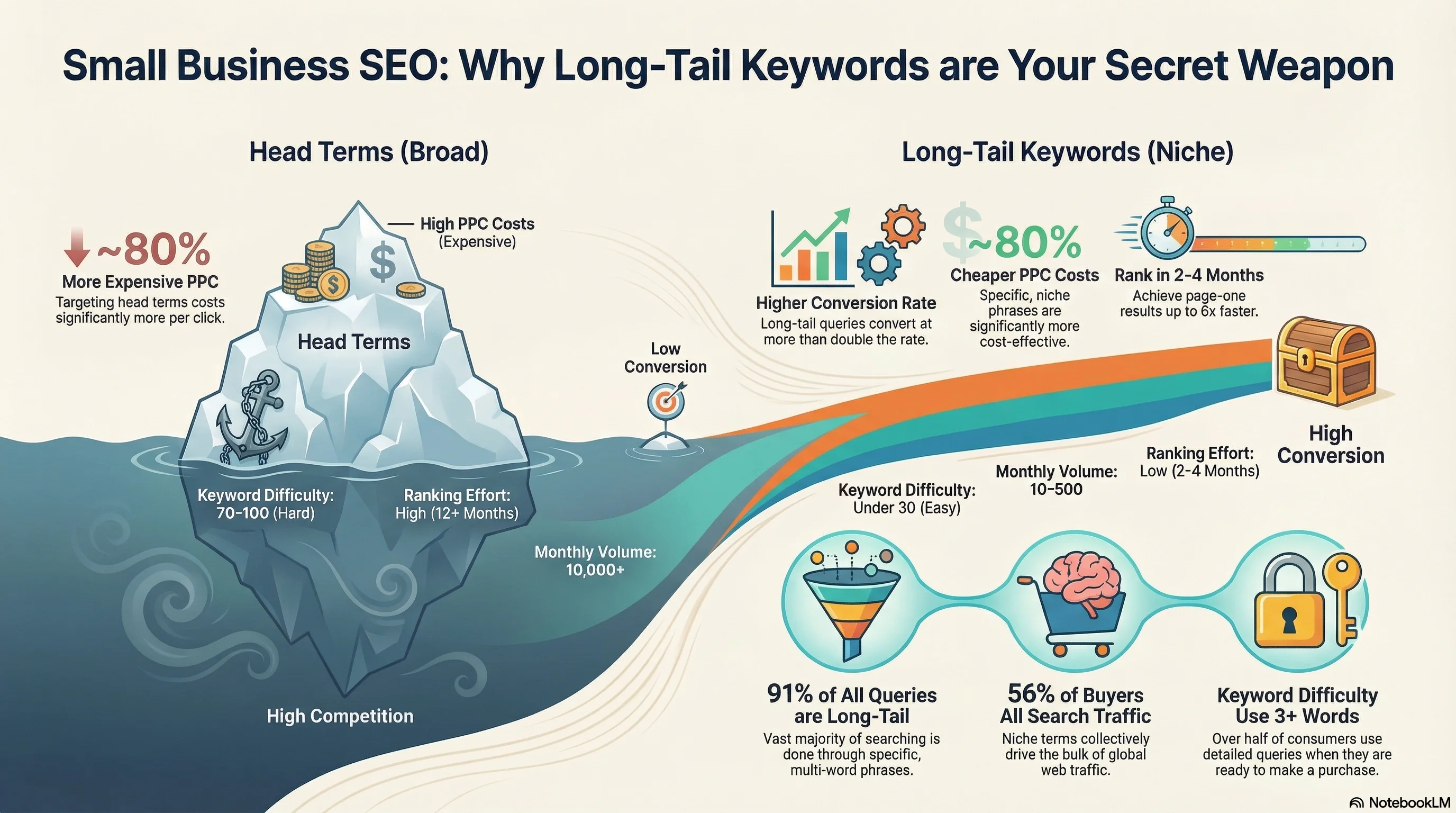
But here's what most small business owners don't realize: 91% of all search queries are long-tail terms [1]. These are the specific, often conversational phrases people actually type (or speak) when they need something: "why does my hot water run out after 5 minutes," "cost to replace copper pipes with PEX in old house," or "best CRM for real estate agents under $50/month."
Long-tail keywords are typically 3+ words, have lower search volume individually, and — crucially — have far less competition. Big companies ignore them because no single long-tail keyword moves the needle for a billion-dollar brand. But for a small business? A few hundred of these keywords, each bringing 50–500 visitors per month, can transform your online presence.
The Long Tail Is the Whole Tail
Think of it this way: "plumber" is a keyword war zone. But "licensed plumber for slab leak repair near me" — that's a keyword with 70 monthly searches, very low difficulty, and the person typing it is ready to hire someone right now. That's the long-tail advantage: less traffic per keyword, but dramatically higher intent and practically zero competition.
And the economics are compelling. Long-tail keywords have conversion rates 2.5x higher than head terms [4]. If you're running paid ads, they're roughly 80% cheaper [3]. And they take 2–4 months to rank instead of over a year [3]. For a small business with limited budget and limited patience, long-tail keywords are the closest thing to a cheat code.
The Numbers Don't Lie — Long-Tail Keyword Statistics
Head terms vs. long-tail: a side-by-side comparison that explains why small businesses should stop chasing vanity keywords
Before you invest another dollar in trying to rank for broad, competitive keywords, look at what the data actually says about head terms versus long-tail:
Head Terms vs. Long-Tail Keywords
Side-by-side comparison across key metrics
Head Term: 10,000+
Long-Tail: 10–500
92% of all keywords get 10 or fewer searches/mo — Ahrefs
Head Term: 70–100 (Hard)
Long-Tail: Under 30 (Easy)
Long-tail keywords typically have KD scores under 30 — Gitnux
Head Term: Baseline (1x)
Long-Tail: 2.5x Higher
Long-tail keywords convert at 2.5x the rate of head terms — Conductor
Head Term: $$$$
Long-Tail: ~80% Cheaper
Targeting long-tail keywords is ~80% cheaper than head terms — Gitnux
Head Term: 12+ months
Long-Tail: 2–4 months
2–4 months to rank for long-tail vs over a year for head terms — Gitnux
The pattern is clear: head terms have higher volume but are harder, more expensive, slower to rank for, and convert worse. Long-tail keywords flip every metric in your favor.
Here's what the overall search landscape looks like:
Long-Tail Keyword Statistics
Data from Backlinko, Ahrefs, Gitnux, and others
Source: Backlinko Google Keyword Study
Source: Ahrefs
Source: Gitnux
Source: WordStream
Source: Google / WordStream
Source: Circulate Digital
Two numbers stand out: 92% of all keywords get 10 or fewer searches per month [2], and 20–25% of daily Google searches have never been searched before [5]. The search landscape isn't a few big rivers — it's millions of tiny streams. And those streams collectively carry 70% of all search traffic [3].
Pages optimized for long-tail keywords also move up an average of 11 positions in search results, compared to just 5 for head terms [7]. And 12.3% of long-tail queries trigger featured snippets [6] — those prominent answer boxes that appear at the very top of Google. Long-tail content doesn't just rank; it gets premium real estate.
The AI Overview Factor
80% of keywords that trigger Google's AI Overviews have difficulty scores under 40 — exactly the long-tail range. This means long-tail content is both the most affected by AI Overviews AND the most important for getting cited by AI systems. If you're not creating content for these queries, AI will answer them using your competitors' content instead.
— Semrush AI SEO Statistics, 2026 [8]
Finding Gold — How to Research Long-Tail Keywords
A 5-step process anyone can follow, plus the free and paid tools that make it fast
You don't need an expensive SEO agency to find long-tail keywords. You need a systematic process and the right tools. Here's the 5-step methodology that works across every industry:
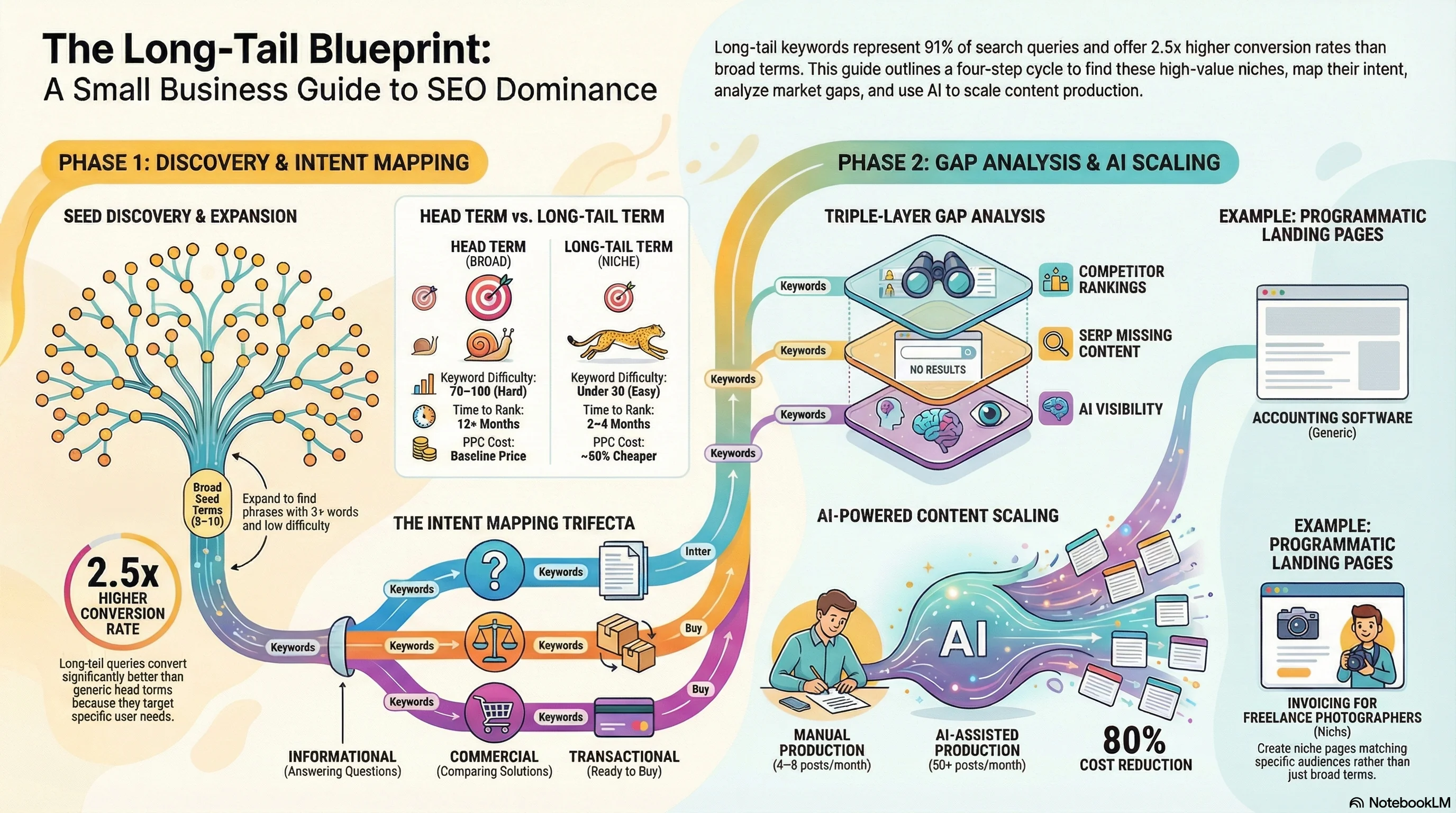
Seed Keyword Brainstorm
Start with 5–10 broad terms from your business. What do customers call your services? What do they ask about?
Expand with Tools
Run seeds through Ahrefs/Semrush or free tools. Filter by keyword difficulty under 30 and 3+ words.
Cluster by Intent
Group keywords by informational, commercial, or transactional intent. Each group becomes a content piece.
Map to Content
One page per cluster. Identify which are pillar pages and which are supporting cluster articles.
Prioritize by Opportunity
Score by: volume × inverse difficulty × business relevance. Target the highest-opportunity keywords first.
The tools you use depend on your budget. Here's an honest comparison:
Free Tools
Instant long-tail suggestions from real searches
Discovering question clusters and related queries
Finding queries you already rank for (positions 11–30 = quick wins)
Visualising questions people ask about any topic
Mapping "People Also Ask" question chains
Paid Tools
Content Gap tool, keyword difficulty, competitor analysis
Keyword Gap Analysis, AI Visibility Toolkit
Budget-friendly keyword research for small businesses
SERP-based clustering and intent classification
The Free Stack That Works
You can do serious long-tail research with zero budget. Start with Google Search Console to find queries you already get impressions for (positions 11–30 are quick wins). Use Google Autocomplete and "People Also Ask" to expand your list. Organize by intent. That's 80% of what paid tools do — for free.
One critical tip: 56% of buyers who search use queries of 3+ words, while only 7% use a single word [5]. When people are close to making a decision — hiring a plumber, choosing a lawyer, signing up for software — they search with specificity. That's where your long-tail content meets them.
Search Intent Mapping — Matching Keywords to Content
The same keyword needs different content depending on what the searcher actually wants
Finding long-tail keywords is step one. But the real skill is matching each keyword to the right type of content. A person searching "how to fix a leaking garbage disposal" wants a how-to guide. A person searching "emergency plumber near me" wants a phone number and a service page. Give them the wrong format and they bounce — no matter how good your content is.
Every long-tail keyword falls into one of four intent categories:
Informational
→ Blog post / How-to guideThe searcher wants to learn or understand something. Create detailed, helpful content.
Commercial Investigation
→ Comparison / ReviewThe searcher is evaluating options. Create comparison tables, pros/cons, recommendations.
Transactional
→ Service page / Landing pageThe searcher is ready to buy or hire. Create pages with CTAs, testimonials, pricing.
Navigational
→ Brand / About pageThe searcher is looking for a specific brand or site. Less relevant for long-tail strategy.
Here's how search intent mapping looks across three real industries:
Plumbing
Legal
SaaS
The critical mistake most small businesses make: they write blog posts for transactional queries and service pages for informational queries. If someone searches "how much does a personal injury lawyer charge upfront," they want a transparent, educational article — not a "Contact Us" page. Match the format to the intent, and your content will rank higher and convert better.
Plumbing
Legal
SaaS
Content Gap Analysis — Finding What Competitors Miss
Three methods to discover long-tail opportunities your competitors haven't touched
The fastest way to find profitable long-tail keywords isn't to brainstorm from scratch — it's to see what your competitors rank for and find the gaps they've left open. This is content gap analysis, and in 2026 it includes a crucial new dimension: AI visibility.
Competitor Keyword Gap
Use Ahrefs or Semrush "Content Gap" tool to find keywords your competitors rank for that you don't. Filter by 3+ words and KD under 30.
SERP Gap Analysis
For each target keyword, review the top 10 results. Identify what's missing — unanswered questions, missing sections, outdated information.
AI Visibility Gap (New in 2025–2026)
Use Semrush's AI Visibility Toolkit to find prompts where competitors are cited by LLMs but you aren't. Create content that answers those specific prompts.
The AI Visibility Gap is the newest and most important method. As Search Engine Land reported in February 2026: "AI optimization is just long-tail SEO done right. While humans continue to go to search engines for head terms, LLMs are sending long-tail search queries to search engines for answers. The fat head of the search curve is being replaced with a fat tail." [14]
This creates a feedback loop that works in your favor: ChatGPT uses Bing, Claude uses Brave, Gemini uses Google. When users ask conversational questions, the LLM generates a long-tail search query, finds your content, and cites it. Brands ranking for long-tail terms get cited by AI — which drives even more traffic and visibility.
The LLM-Search Feedback Loop
As more people use AI assistants, LLMs are generating exponentially more long-tail search queries on their behalf. The content that ranks for specific, detailed queries is what gets cited in AI answers. This makes long-tail SEO more valuable than ever — your content becomes the source material for AI-generated responses.
— Search Engine Land, Feb 2026 [14]
One often-overlooked gap analysis technique: check your own Google Search Console. Filter for queries where you get impressions (people see your site in results) but few clicks — especially in positions 5–20. These are keywords Google already associates with your site. A focused article targeting that exact query can jump from page 2 to page 1 with surprisingly little effort.
The AI Advantage — Scaling Long-Tail Content
How AI makes it possible for one person to target hundreds of long-tail keywords — and why that changes the competitive landscape
Here's the traditional problem with long-tail SEO: it requires a lot of content. If you've identified 200 profitable long-tail keywords across your topic clusters, that's 200 pieces of content. At 2–3 articles per week with a traditional writer, you're looking at 18+ months. For a small business owner wearing multiple hats, that's not realistic.
AI changes the math entirely. And the case studies prove it:
Local Plumbing Service (Austin, TX)
Keyword Strategy Shift
Initially used generic keywords like "plumbing services." After shifting to long-tail targeting ("emergency tankless water heater repair Austin" etc.), they saw significant traffic and conversion improvements.
Strategy: Replaced broad service pages with specific, question-answering content targeting long-tail queries with local modifiers.
Wave (SaaS)
Long-Tail Landing Pages
Created landing pages tailored to specific service + audience segment combinations. Instead of "free accounting software" they target "free invoicing software for freelance photographers."
Strategy: Programmatic landing page generation matching specific audience segments with specific product features.
Digital Harvest (Travel)
Organic Traffic Growth
Published 200+ AI-assisted blog posts in 2025 vs 6 in 2024. Used "niche framework" — one broad topic → 10–20 audience-specific articles.
Strategy: AI-assisted content production with audience segmentation. "Fun things to do in Albuquerque" became separate articles for families, DINKs, budget travelers, and weekday visitors.
Xponent21 (B2B SaaS)
Traffic Growth
4,162% traffic growth in under a year using cluster-based long-tail content system targeting specific problem-solution queries.
Strategy: Rapid cluster-based content ecosystem: flagship articles + glossary + FAQs + webinars, all cross-linked and targeting long-tail queries.
Sources: Austin plumbing via 97th Floor [11]; Wave via Semrush [10]; Digital Harvest [12]; Xponent21 [13].
The scaling numbers tell the story:
Traditional vs AI-Assisted Long-Tail Content
How AI collapses the timeline for comprehensive long-tail coverage
Articles per Month
Traditional: 4–8
AI-Assisted: 20–50+
Long-Tail Variations Covered
Traditional: 50–100/year
AI-Assisted: 200–500+/year
Time to 50+ Cluster Articles
Traditional: 10–14 months
AI-Assisted: 3–4 months
Cost per Article
Traditional: $200–$500
AI-Assisted: $20–$80
Digital Harvest's case study is the clearest example [12]. They went from 6 blog posts in 2024 to 200+ in 2025 — and organic traffic grew 159%. Their secret: the "niche framework." Take one broad topic and spin it into 10–20 audience-specific articles, each targeting a specific long-tail variation. Instead of one article on "fun things to do in Albuquerque," they created separate articles for families with toddlers, DINKs, budget travelers, and weekday visitors.
The same principle works for any industry. A law firm could turn "estate planning" into "estate planning attorney for blended families," "estate planning for small business owners with LLC," and "estate planning when you have property in two states." Each article competes in a smaller, more specific search space — dramatically easier to rank — while collectively building topical authority.
Volume Without Quality Backfires
Google's March 2024 update deindexed 1,446 sites mass-producing thin AI content. Google doesn't penalize AI content — they penalize unhelpful content regardless of how it was produced. The winning formula is AI velocity × human editorial judgment: use AI for first drafts at scale, then add real expertise, verify facts, and ensure every piece genuinely answers the reader's question.
— Search Engine Journal / Ian Nuttall analysis, March 2024; Google Search Central Blog (AI content policy)
As Commit Agency noted in their 2026 analysis: "A library of focused pages can outperform a few broad pages, especially when the SERP is crowded with ads, AI summaries and aggregator results. This is the compound effect." [9]
Meanwhile, organic search referrals to thousands of sites dropped by roughly a third between November 2024 and November 2025 [9]. The sites losing traffic are the ones with generic content that AI can easily summarize. The sites holding steady — or growing — are the ones with specific, actionable, long-tail content that offers more than a summary can provide.
Aleyda Solis put it best: "Target and focus more on answering the long-tail queries of your users. We are going to see a much bigger and more important impact from those as a consequence of AI overviews and personalised AI results." [15]
And Yotpo's 2026 guide frames the conversion angle perfectly: "Long-tail keywords are the difference between attracting a window shopper and connecting with a customer who has their credit card in hand." [16]
The businesses winning at SEO in 2026 aren't the ones with the biggest budgets — they're the ones systematically targeting hundreds of specific, long-tail keywords that big competitors consider too small to bother with. And with AI-assisted content tools, a single person can do what used to require a full content team.
If you're looking for a tool built specifically for this — one that generates quality, AI-assisted content at the cadence long-tail SEO demands, with automatic keyword targeting and editorial workflows — that's exactly what News Factory was built for. The strategy works whether you write everything yourself or use a tool. The important thing is to start targeting the long tail before your competitors do.
References & Sources
Primary sources cited in this article
- Backlinko — Google Keyword Study
backlinko.com/google-keyword-study
Key data: 91.8% of all search queries are long-tail terms. - Ahrefs — Long-Tail Keywords: What They Are & How to Target Them
ahrefs.com/blog/long-tail-keywords/
Key data: 92.42% of keywords get 10 or fewer searches per month; only 0.16% of keywords account for the majority of volume. - Gitnux — Long-Tail Keyword Statistics
gitnux.org/long-tail-statistics/
Key data: 70% of search traffic from long-tail; ~80% cheaper PPC; KD typically under 30; 2–4 months to rank; 20% more total keywords per page. - Conductor Academy — Long-Tail Keywords
conductor.com/academy/long-tail-keywords/
Key data: Long-tail keywords have conversion rates 2.5x higher than head terms. - WordStream — Long-Tail Keywords Guide
wordstream.com/long-tail-keywords
Key data: Long-tail keywords have lower volume but higher intent; 20–25% of daily Google searches are new (never searched before). - Circulate Digital — 45 Stats About Long-Tail Keywords (Dec 2025)
circulatedigital.com/blog/45-stats-about-long-tail-keywords/
Key data: Featured snippets appear for 12.3% of long-tail search queries. - Embryo — 30 Statistics About Long-Tail Keywords (March 2025)
embryo.com/blog/30-statistics-about-long-tail-keywords/
Key data: Pages optimized for long-tail keywords move up 11 positions on average vs 5 for head terms. - Semrush — 26 AI SEO Statistics for 2026
semrush.com/blog/ai-seo-statistics/
Key data: 80% of keywords triggering AI Overviews fall into 0–40% keyword difficulty range. - Commit Agency — How Long-Tail Keywords Boost SEO in 2026
commitagency.com/insights/how-long-tail-keywords-boost-seo-content-and-conversions-in-2026/
Key data: Organic referrals down ~⅓ globally (Nov 2024–Nov 2025); focused long-tail pages outperform broad pages. - Semrush — How to Choose Long-Tail Keywords (2025)
semrush.com/blog/how-to-choose-long-tail-keywords/
Wave SaaS case study — audience-segment landing pages for long-tail keywords. - 97th Floor — Long-Tail Keywords Glossary
97thfloor.com/articles/glossary/long-tail-keywords/
Austin plumbing service case study — long-tail keyword pivot results. - Digital Harvest — AI SEO Case Study: 144% Traffic Growth
digitalharvest.io/ai-seo-case-study-how-we-grew-organic-traffic/
200+ posts via AI in 2025 vs 6 in 2024; 159% organic growth; niche framework strategy. - Xponent21 — AI SEO Case Study: 4,162% Traffic Growth
xponent21.com/insights/ai-seo-case-study-engineering-top-ai-ranks/
4,162% traffic growth using cluster-based long-tail content system. - Search Engine Land — AI Optimization Is Long-Tail SEO (Feb 2026)
searchengineland.com/ai-optimization-long-tail-seo-469315
"The fat head of the search curve is being replaced with a fat tail." LLMs are sending long-tail queries to search engines at massive scale. - Majestic — Aleyda Solis: SEO in 2025
majestic.com/seo-in-2025/aleyda-solis
Long-tail queries growing in importance due to AI Overviews and personalized AI results. - Yotpo — Long-Tail Keywords Guide (2026)
yotpo.com/blog/long-tail-keywords-guide/
"Long-tail keywords are the difference between attracting a window shopper and connecting with a customer who has their credit card in hand."
Article also available in: