The Publishing Gap: Sites That Publish vs. Sites That Don't
The data is lopsided — and most small business websites are on the wrong side of it
Here's a stat that should bother you: companies that publish regular content get 55% more website traffic than companies that don't [1]. Not 5%. Not 10%. Over half more traffic — just from showing up consistently.
And that's the average. B2B companies publishing 9 or more pieces per month saw a 35.8% increase in yearly Google traffic, compared to just 16.5% for those posting 1–4 times monthly [2]. More than double the growth rate — from publishing more frequently.
Yet most small business websites sit quietly. Five pages — Home, About, Services, Contact, maybe a dusty blog from 2022. No new content. No news. No signal to Google that anyone's home. And then the owner wonders why they're invisible in search results.
The gap between sites that publish and sites that don't isn't subtle. It's a canyon. Let's look at what the data actually shows.
Publishing Frequency vs. Yearly Traffic Growth
Source: SeoProfy 2026, citing HubSpot data
Look at that bottom bar. Sites with no regular publishing? 3.1% growth. That's not growth — that's inflation. Meanwhile, the sites publishing 9+ times per month are growing at 11× that rate. The correlation between publishing frequency and traffic isn't a theory. It's math.
And it gets worse for the non-publishers. That 3.1% growth number assumes your competitors aren't also improving. When they publish and you don't, you're not standing still — you're actively falling behind. Search rankings are relative. Every article your competitor publishes that you don't is another chance for them to capture a search query you used to own.
53% of Traffic Comes From Organic Search
More than half of all website traffic comes from organic search [21]. For small businesses, that number is often higher — because most don't have big ad budgets. If you're not showing up in search results, you're missing the majority of potential visitors. And the single biggest factor in whether Google shows your site? Whether your site gives Google something worth showing.
Google's Freshness Signals: Why Active Sites Win
Google doesn't just index your content — it tracks how often you create it
Google's algorithm includes something called Query Deserves Freshness (QDF). It's been around since before the broader 2011 Freshness Update, and it does exactly what the name implies: when a topic is trending or evolving, Google pushes newer content to the top [5].
Here's how Amit Singhal, former Head of Google Search, described it:
"The QDF solution revolves around determining whether a topic is 'hot.' If news sites or blog posts are actively writing about a topic, the model figures that it is one for which users are more likely to want current information."— Amit Singhal, The New York Times, 2007
But QDF isn't just about breaking news. Google's 2011 Freshness Update expanded freshness signals across three categories: trending topics, regularly recurring events (elections, annual conferences, sports seasons), and frequently updated information — product reviews, "best of" lists, pricing data, how-to guides [6].
That last category is where does publishing news help SEO for small businesses. When you publish a timely article about a regulatory change in your industry, a local event, or a seasonal trend — you're activating freshness signals. You're telling Google's crawlers that your site is alive, maintained, and relevant.
The 5 Freshness Signals Google Tracks
Sources: Search Engine Land, Semrush, Search Engine Journal
Google checks when content was first published — newer articles get a freshness boost for time-sensitive queries
Sites that publish regularly get crawled more often — Google allocates more crawl budget to active sites
A steady stream of new pages signals an active, maintained website — not an abandoned digital brochure
How much new content vs. unchanged content exists on the site — higher ratios indicate relevance
Fresh content attracts fresh links — and new links are themselves a freshness signal to Google
There's a practical consequence most people miss: crawl budget allocation. Google doesn't crawl every site at the same frequency. Sites that update often get crawled more often. When you publish a new article, Google's bot notices the pattern and comes back sooner. When you haven't published in months, the bot visits less frequently — which means even when you do publish something new, it takes longer to get indexed and ranked.
News-style content has a specific advantage here. Google News, Top Stories carousels, and Discover feeds all favor fresh, time-stamped articles with a regular publishing cadence [8]. A small business website that publishes industry news and timely updates can appear in these prominent positions — real estate that's normally dominated by major publications.
News Content vs. Blog Content
There's a meaningful difference between news content and static blog content for SEO. A blog post titled "5 Tips for Home Maintenance" is evergreen but doesn't trigger freshness signals. An article titled "New Building Codes in [Your City]: What Homeowners Need to Know in 2026" is timely, news-driven content that activates QDF, attracts links from local sources, and signals to Google that your site covers current, relevant information. Both have value — but news content does more SEO work per article.
The Indexed Pages Effect: More Content = More Doors
Every article is another entry point — and the math is overwhelming
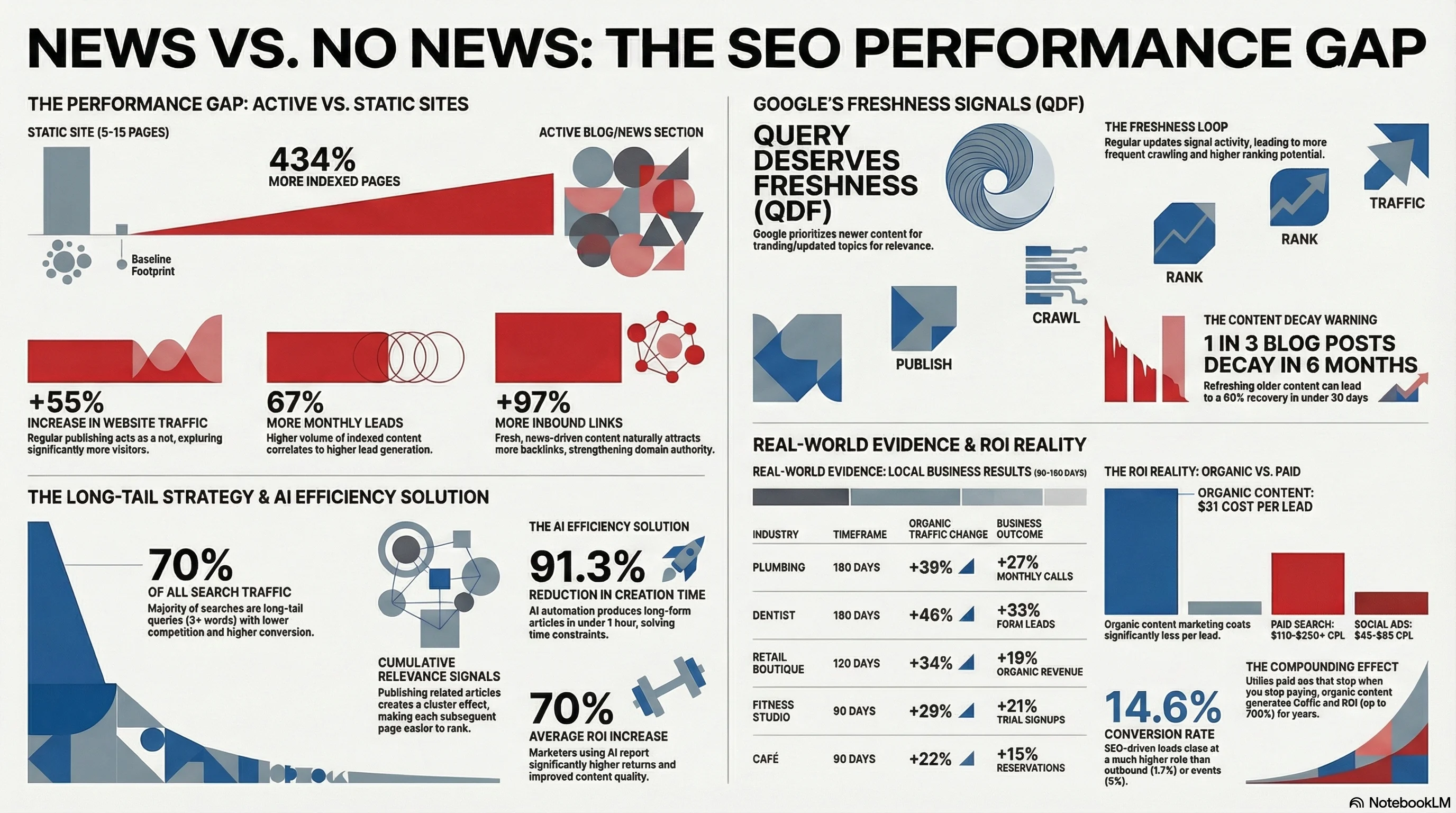
HubSpot's study of over 1,400 companies found a direct relationship that's hard to argue with: websites with active blogs have 434% more indexed pages than those without [1]. That's not a marginal improvement — it's a 4× expansion of your website's footprint in Google's index.
Think about it this way. A typical small business website has 5–15 pages. Home, About, Services, Contact, maybe a few service-specific pages. Each page can rank for a handful of keywords. That gives you maybe 30–50 keyword opportunities.
Now imagine you publish two news articles per week for a year. That's 104 new pages. Your site goes from 15 pages to 119 pages. Each article targets different keywords, answers different questions, covers different angles. Suddenly you have 500+ keyword opportunities instead of 50. That's 10× more chances for someone to find you through search.
The downstream effects compound from there:
55% more vs. Baseline
434% more vs. 5–15 pages
67% more vs. Baseline
97% more vs. Baseline
70% of all search traffic vs. Minimal coverage
Up to 700% vs. N/A
That 97% more inbound links number deserves special attention [1]. Nobody links to your About page. Nobody shares your Contact page on social media. But a well-written article about something useful or timely? That gets shared. That gets referenced. That earns backlinks — which are still one of Google's strongest ranking signals.
And then there's the long-tail effect. 70% of all search traffic comes from long-tail keywords — specific, multi-word phrases like "best plumber for old house pipes in Portland" rather than just "plumber" [12]. You can't capture long-tail traffic with five pages. You need dozens of pages, each covering specific topics, to cast a wide enough net. Regular publishing is how you build that net.
The 30+ Landing Pages Threshold
HubSpot's data shows that companies with 31–40 landing pages generate 7× more leads than those with only 1–5 [1]. You don't need 30 landing pages in the traditional sense — every news article, every how-to guide, every industry update functions as a landing page. It's a page where someone arrives from search and discovers your business.
Real Results: What Happens When Small Businesses Start Publishing
The numbers from businesses that made the switch — from artisan candles to local plumbers
Theory is nice. Results are better. Here's what actually happened when small businesses committed to regular content publishing.
Kalamazoo Candle Company — 747% Traffic Increase
A small artisan candle maker in Michigan. Before starting a content program, they had fewer than 2,000 organic visitors per month. They began publishing weekly SEO-optimized articles in April 2022 — roughly 81 pieces of content over two-plus years [7].
By July 2024: 16,945 organic visitors per month. A 747% increase.
But the headline number only tells part of the story. Their search traffic doubled from July 2023 to July 2024 alone — a 95% increase from 34,700 to 67,500 search sessions. They ranked for 4,581 niche keywords, with 517 of those in Google's top 10. Their collections page saw an 833% increase in organic search traffic.
The owner, Adam McFarlin, put it simply:
"We don't have to spend money on Google ads because of the work that Amanda is doing with Search Engine Optimization. There's not a lot of people that can just take ownership over something and make it good."— Adam McFarlin, Owner, Kalamazoo Candle Company
Allen Brothers — 75% Organic Traffic Growth
Allen Brothers, an eCommerce food brand, invested in strategic SEO blog content and saw a 75% increase in organic traffic with 123% more organic clicks [9]. This wasn't a massive company with a big marketing team — it was a focused content strategy built around what their customers actually searched for.
Five Local Businesses — Automated Content Results
Rocket Rank tracked five local businesses using automated blogging in 2025 [10]. The results across different industries:
Local Business Results — Automated Content Publishing
Source: Rocket Rank 2025 (anonymized case studies)
Traffic
+38%
New Keywords
~120
Business Impact
Monthly calls +27%
Traffic
+22%
New Keywords
~45
Business Impact
Reservations +15%
Traffic
+34%
New Keywords
~85
Business Impact
Organic revenue +19%
Traffic
+46%
New Keywords
~150
Business Impact
Form leads +33%
Traffic
+29%
New Keywords
~60
Business Impact
Trial signups +21%
The pattern across all five is consistent: meaningful traffic gains within 90–180 days, new keyword rankings numbering in the dozens to hundreds, and — most importantly — actual business outcomes. More calls. More reservations. More revenue. Not just vanity metrics.
The key finding from the Rocket Rank study: the most effective approach combined consistent publishing cadence + local keyword clustering + internal linking. It wasn't about publishing the most content — it was about publishing the right content on a reliable schedule.
Timelines Are Real — Don't Expect Overnight Results
Every case study above took time. The Kalamazoo Candle Company's 747% growth happened over two years. The local businesses saw first meaningful results in 30–90 days for long-tail keywords and 90–180 days for local pack improvements. News content SEO is a compounding strategy, not a quick fix. The businesses that win are the ones that start and don't stop.
Content Decay: Why Standing Still Means Falling Behind
Every piece of content you've published is slowly dying — and your competitors are making it happen
Here's the thing about not publishing: it's not a neutral position. Content decay is real, measurable, and relentless.
Ahrefs defines content decay as "the gradual, often invisible decline of a page's organic traffic and rankings over time" [15]. It happens to every page on every website. The only question is how fast, and whether you're doing anything about it.
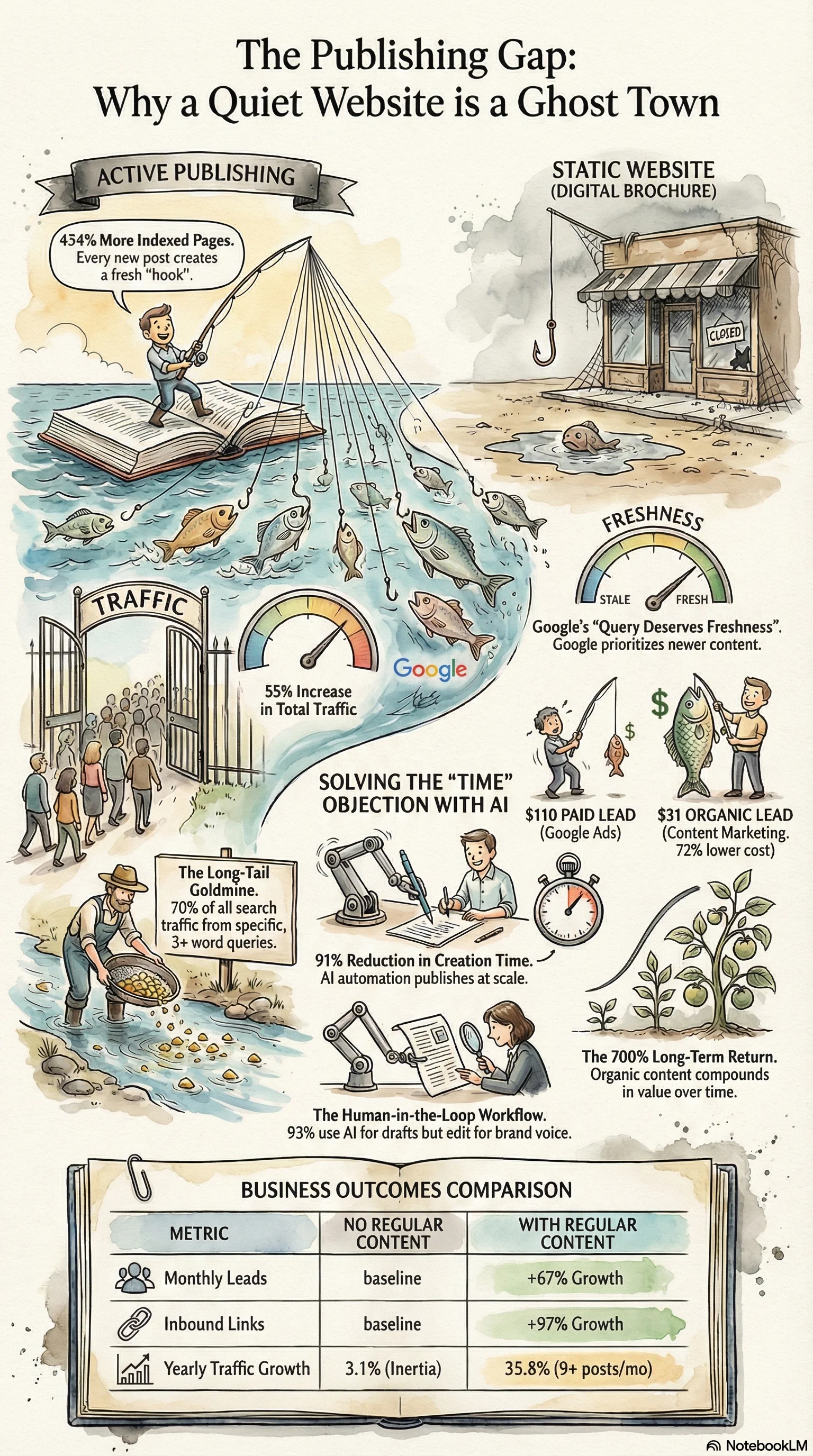
The numbers are sobering: 1 in 3 blog posts shows signs of decay within just 6 months [16]. That article you published in January? By July, there's a one-in-three chance it's already losing rankings. Not because it got worse — because the world moved on.
Competitors publish better content
Someone writes a more thorough, more current version of your article. Google has a better option to show searchers. Your page drops.
Search intent shifts
What people want when they search changes over time. Your article might answer last year's version of the question, not today's.
Information becomes outdated
Statistics change. Regulations update. Best practices evolve. Content with old data loses trust signals.
Links decay
External sites linking to you change URLs, get taken down, or restructure. Your backlink profile erodes over time.
Algorithm updates shift what Google values
Google rolls out hundreds of algorithm changes per year. Content that ranked under old rules may not rank under new ones.
The good news: refreshing outdated articles recovers up to 60% of lost traffic in under 30 days [16]. Content decay is reversible — but only if you're paying attention and actively maintaining your content library.
Regular publishing fights content decay in four ways. New content offsets declining traffic from aging posts. Fresh articles create a pipeline of new entry points. A publishing cadence forces regular review of existing content. And new articles can internally link to and revitalize older posts — passing fresh link equity to pages that need a boost.
This is the quiet argument for news content on your small business website. It's not just about the traffic each article brings directly. It's about keeping your entire site alive in Google's eyes. An active site with regular updates signals ongoing maintenance and relevance. A static site signals abandonment — and Google treats it accordingly.
The Time Objection Solved: AI Makes This Achievable
You know you should publish. You don't have the time. Here's what changed.
Let's be honest about the real obstacle. Most small business owners already know content marketing works. They've read the stats. They've seen competitors rank above them. The problem isn't awareness — it's time.
Nearly 80% of small business owners write content themselves because they can't afford dedicated writers [3]. Without help, a single long-form article takes 2–3 hours for 38% of marketers [3]. When you're running a business, answering calls, managing employees, and handling customers — who has 3 spare hours to write a blog post?
This is where the landscape shifted. AI didn't just make content creation slightly faster. It fundamentally changed the economics.
Source: Semrush 2024
Source: Semrush 2024
Source: MediaMonk
Source: Semrush 2024
Source: Semrush 2024
Source: Kibo Commerce
That first number is the key: 67% of small business owners and marketers already use AI for content marketing or SEO [3]. This isn't early-adopter territory anymore. If you're not using AI to help with content, you're in the minority — and you're competing against people who are.
The time savings are real: 36% of marketers using AI spend less than 1 hour writing a long-form article, compared to the 2–3 hours it takes without AI [3]. And 91.3% of businesses report reduced content creation time overall [4].
But here's what matters more than time savings: the quality data. 79% of businesses report that content quality actually improved when they started using AI assistance [3]. This isn't about pumping out garbage faster. AI handles the research, the structure, the first draft — freeing the human to focus on what they're actually good at: their expertise, their experience, their knowledge of their customers.
The Content Marketing ROI Math
Content marketing generates 3× more leads at roughly 62% lower cost than outbound marketing [18]. SEO leads close at 14.6% vs. 1.7% for outbound leads [18]. And unlike paid ads — which stop working the second you stop paying — content marketing compounds. An article published today generates traffic next month, next year, and beyond. The cost-per-lead drops as your content library grows. SEO delivers up to 700% ROI as a long-term strategy [2].
The modern approach isn't "let AI write everything and walk away." 93% of marketers review and edit AI content before publishing [3]. The workflow looks like this: AI generates a draft based on keyword research and your topic brief. You review it, add your expertise and brand voice, and approve it. Automated scheduling publishes it on cadence. The whole process takes 30–45 minutes instead of 3 hours — and you can realistically maintain a publishing schedule that moves the SEO needle.
That's the real unlock. It's not about whether news content SEO works — the data on that is overwhelming. It's about whether you can actually sustain the publishing cadence required to get results. With AI-assisted content creation, the answer changed from "not without hiring someone" to "yes, you can do this yourself."
If you've been putting off content marketing because you don't have the time, the bandwidth problem is solved. Tools like News Factory automate the entire pipeline — from trending topic discovery to draft generation to scheduled publishing — so you can maintain the consistent news content cadence that Google rewards. You provide the domain expertise and 15 minutes of review time. The platform handles the rest.
The question is no longer whether you can afford to publish regularly. It's whether you can afford not to.
References
Primary sources cited in this article
- HubSpot — Blogging Statistics & Indexed Pages Study
blog.hubspot.com/marketing/business-blogging-in-2015
Key data: 55% more traffic, 434% more indexed pages, 97% more inbound links, 67% more leads. - SeoProfy — 119 SEO Statistics for 2026
seoprofy.com/blog/seo-statistics
Key data: 35.8% traffic increase for 9+ posts/month. SEO delivers up to 700% ROI. - Semrush — 96 Content Marketing Statistics (2024)
semrush.com/blog/content-marketing-statistics
Key data: 67% use AI for content, 80% write their own content, 93% review AI content before publishing. - Magai / MediaMonk — AI Automated Content Creation
magai.co/ai-automated-content-creation
Key data: 91.3% of businesses report reduced content creation time with AI. - Search Engine Land — Query Deserves Freshness (QDF) Guide
searchengineland.com/guide/query-deserves-freshness-qdf
Google's freshness algorithm and how it prioritizes newer content for trending topics. - Search Engine Journal — Google Freshness Algorithm History
searchenginejournal.com/google-algorithm-history/freshness-algorithm
How the 2011 Freshness Update expanded freshness signals beyond news to recurring events and updated info. - Emerald Creative Content — Kalamazoo Candle Company SEO Case Study
emeraldcontent.com/blog/seo-blogging-case-study
Key data: 747% organic traffic increase, 4,581 keywords ranked, 833% collections page growth. - Semrush — News SEO Guide
semrush.com/blog/news-seo
News SEO definition, freshness signals, and how Google News/Discover favor regular publishers. - Inflow — Allen Brothers Content Case Study
goinflow.com/blog/allen-brothers-content-case-study
Key data: 75% organic traffic increase, 123% more organic clicks from strategic content. - Rocket Rank — 5 Local Business Automated Blogging Case Studies
userocketrank.com/blog/5-real-world-case-studies
Key data: 22–46% traffic gains across 5 industries, 30–180 day timelines. - Orbit Media Studios — Annual Blogger Survey (2024)
orbitmedia.com/blog/blogging-statistics
Key data: 48% publish 2–4 times/month, frequency correlates directly with results. - Keywords Everywhere — Long-Tail SEO Statistics
keywordseverywhere.com/blog/long-tail-seo-secrets
Key data: 70% of all search traffic comes from long-tail keywords. - AIOSEO — Long-Tail Keywords & Organic Traffic
aioseo.com/how-to-find-long-tail-keywords
Key data: 54.31% of search queries contain 3+ words. - Semrush — Fresh Content SEO Guide
semrush.com/blog/fresh-content
How freshness signals work and practical strategies for keeping content current. - Ahrefs — Content Decay
ahrefs.com/blog/content-decay
"Every piece of content you've ever published is slowly dying" — why regular publishing combats decay. - Clearscope — What Is Content Decay and Why It Matters for SEO
clearscope.io/blog/what-is-content-decay
Key data: 1 in 3 posts decay within 6 months, refreshing recovers 60% of traffic in under 30 days. - IMPACT — Blogging Statistics
impactplus.com/blogging-statistics
Comprehensive blogging statistics supporting the 55% traffic advantage. - SalesHive — B2B Lead Generation Benchmarks
saleshive.com/blog/b2b-lead-benchmarks
Key data: Content marketing = 3× more leads at 62% lower cost. SEO leads close at 14.6% vs. 1.7% outbound. - Emulent — Cost Per Lead by Channel (2026)
emulent.com/resources/average-cost-per-lead-by-channel-and-industry
Key data: Organic channels cost 61% less with 2× conversion rate vs. paid. - Robotics & Automation News — Small Business SEO 2026
roboticsandautomationnews.com
"Refreshing content sends signals to search engines that the business is still active and relevant." - SE Ranking — SEO Statistics 2026
seranking.com/blog/seo-statistics
Key data: 53% of all website traffic comes from organic search.
Article also available in: