Why a System Beats Hustle
Consistency is an operating system, not a burst of willpower
Most niche sites do not fail because the owner cannot write. They fail because the owner cannot write every week, forever, on top of everything else. The average blog post already takes 3 hours and 48 minutes to produce, and that is before you have monitored your niche, chosen what is worth covering, checked that it is true, and pushed it to the channels where your readers actually are. Do that solo and the math turns hostile fast.
The publishers who hold a rhythm without a newsroom do one thing differently: they run a repeatable operating system instead of relying on inspiration. Every step below has a single job and a one-line "what to do," so the whole loop fits on an index card. The point is not to publish more thin posts faster. It is to make consistent, genuinely useful publishing something a system carries, so a bad week does not break your cadence.
Insight
The 7-Step Operating System
Seven self-contained steps, each with a one-line what-to-do
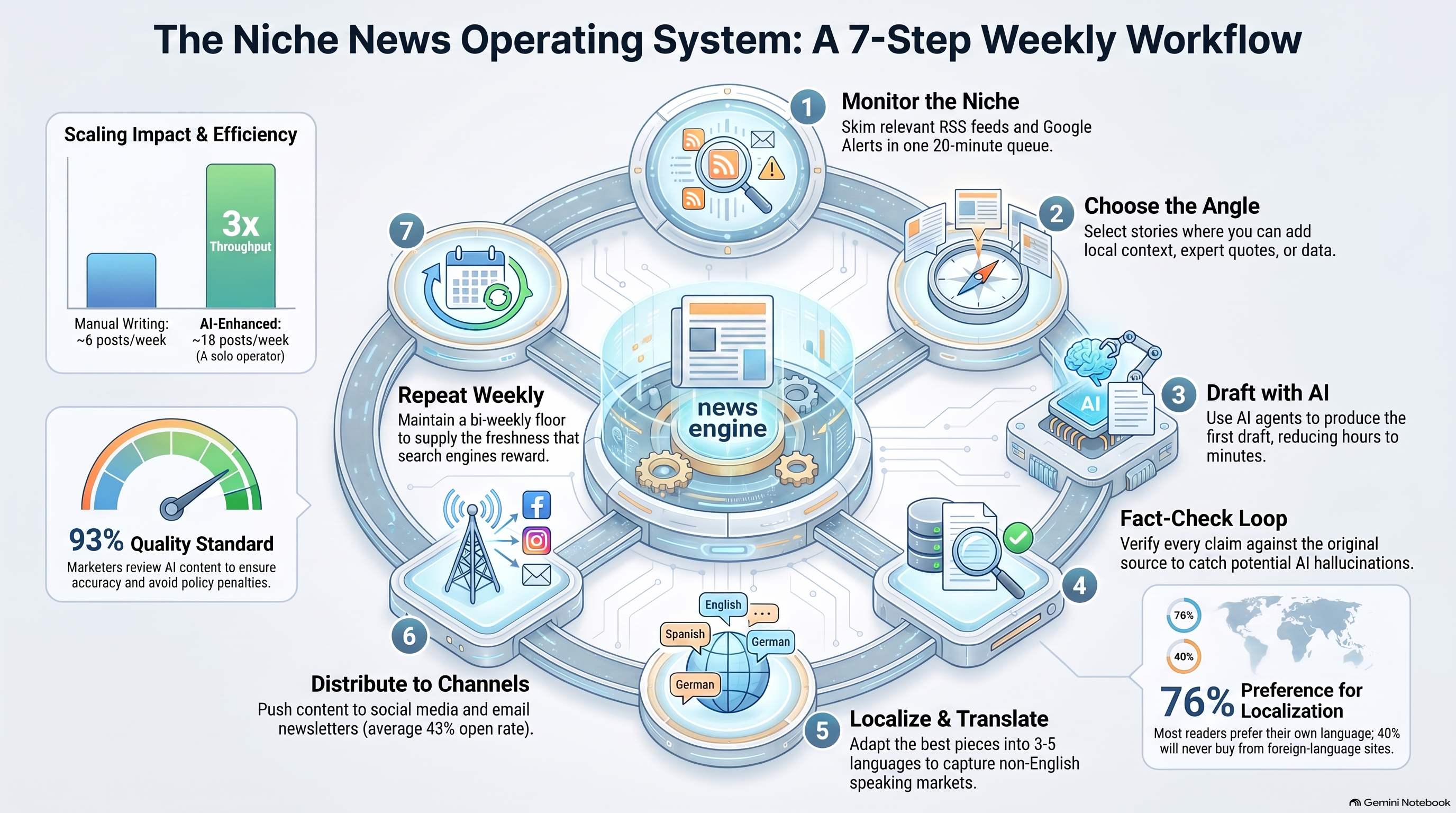
This is the whole system. Read each step as a standalone instruction: the bold line is what to do, the paragraph is how. Run them in order the first few weeks, then let them overlap once the rhythm is muscle memory.
Monitor your sources
What to do: Pull every relevant feed into one queue you can skim in 20 minutes.
Aggregate your niche with an RSS reader (Feedly is free for up to 100 sources, Inoreader for up to 150), add Google Alerts for keywords, and optionally a news API pull. Dedupe everything into a single shortlist so you are reacting from one screen, not ten open tabs.
Select the angle
What to do: Keep only stories where you can add something the source did not.
For each candidate, decide the distinct angle: local, niche-expert, contrarian, or data-led. Kill anything you could only rewrite verbatim. Roundups, interviews, and original research are less common and more effective, and adding expert quotes roughly doubles the odds of strong results.
Draft with an agent
What to do: Let AI produce the first draft from your angle and sources, not from a blank prompt.
Feed the agent your chosen angle plus the primary sources. Marketers who use AI report spending under an hour on a long-form draft, versus two to three hours writing manually. The agent handles structure and speed; you still own the judgment about what is worth saying.
Run the fact-check loop
What to do: Verify every claim against the original source before anything goes live.
Even strong models fabricate facts in roughly 1 in 20 to 1 in 10 summaries, so a human check against the source is not optional. This is why 93% of marketers review AI content before posting. Add an editor pass: a formal editing process correlates with success.
Publish in multiple languages
What to do: Localize your best pieces into 3 to 5 languages with light human review.
76% of shoppers prefer to buy in their own language and 40% will never buy from a site in another language. Machine translation plus a quick native review, not raw output, protects a large share of an audience you are otherwise invisible to.
Distribute deliberately
What to do: Push each post to social and your newsletter the moment it is live.
90% of content marketers use social to distribute and 73% use email newsletters. A niche newsletter in the blogger and media categories averages a 43% open rate. Search is now the hardest channel to win, so owned channels carry more of the load.
Repeat on a weekly cadence
What to do: Fix the same loop to the same days so output never depends on motivation.
Bi-weekly is the floor for content performance; monthly is less effective than ever. A repeatable weekly rhythm supplies the freshness Google's rater guidelines reward and stops the cadence collapse that kills most solo sites.
The Monitoring Layer, Concretely
The tools that turn a chaotic niche into one skimmable queue
Step 1 lives or dies on tooling. You want every source funneling into one place you can scan in the time it takes to drink a coffee. These four cover almost every solo setup, and each has a free tier big enough to start today.
Source-Monitoring Tools for a Solo Publisher
Free tiers and the one feature that sets each apart
| Tool | Free tier | Standout feature |
|---|---|---|
| Feedly | Up to 100 sources | Leo AI summarizes and filters your feed |
| Inoreader | Up to 150 subscriptions | Powerful saved search and permanent archive |
| NewsBlur | Up to 64 sites | Trains on your taste to highlight or hide stories |
| Google Alerts | Unlimited keywords | Free email alerts for any topic or brand |
Recommendation
Where Bloggers Actually Use AI in the Workflow
Share of bloggers using AI for each task (Orbit Media, 2024)
The Throughput Reality Check
What one person can realistically ship, solo versus with agents
Be honest about the numbers before you promise yourself a daily cadence. Writing manually, a long-form post runs two to nearly four hours. Marketers who draft with AI report finishing the same length in under an hour. That gap is the entire reason "at scale" is even possible for one person, but only if the fact-check loop in the next section keeps pace.
Time to Produce One Long-Form Article
Minutes per article, manual versus AI-assisted drafting
Translate that into weekly output and the picture is stark. A solo operator writing by hand realistically sustains around six posts a week at full time before quality and burnout catch up. The same operator using AI for drafting, with a human fact-check and edit on every piece, can plausibly hold roughly three times that. Treat these as grounded estimates from the time-per-article data, not promises.
Realistic Posts Per Week, Solo
Sustainable weekly output before quality suffers (grounded estimate)

Warning
The Fact-Check Loop That Keeps You Safe
The non-negotiable step between fast drafting and losing trust
Speed without verification is how AI publishing blows up. Independent benchmarking shows even strong models fabricate facts when summarizing a source, at rates from under 2% for the best to well into double digits for weaker ones. When you are repurposing news, that means a meaningful share of unedited drafts will contain a confident, wrong claim. This is why 93% of marketers review AI content before it goes live, and why you should too.
How Often Models Fabricate When Summarizing
Hallucination rate summarizing a source document (Vectara HHEM, May 2026)
The loop itself is simple and fast once it is a habit: extract every factual claim, check each against the original source, flag anything you cannot verify, then run a quick editor pass for voice and structure. Formal editing correlates with success, and it is the cheapest insurance you can buy against the one wrong number that costs you a reader's trust.
Common Failure Modes
The three traps that sink most scaled niche sites
Scaling content has three well-worn ways to go wrong, and all of them are avoidable if you name them up front. Each card below pairs the trap with the fix.
Scaled content abuse
Google's March 2024 policy targets pages mass-produced to game rankings, by automation or humans, that do not help users. Violations can drop you out of results entirely.
Fix: Cap output at what your edit loop can genuinely verify. Every page needs a real angle and first-party oversight.
Thin AI rewrites
A draft that only restates the source is indistinguishable from duplicate content and gets the same or worse results than doing nothing.
Fix: Add original angle, quotes, or data to every piece. If you cannot add value, skip the story.
Burnout and cadence collapse
Solo operators carry research, writing, editing, and ops. Compared with a decade ago, half as many bloggers publish multiple times a week and twice as many publish only monthly.
Fix: Systematize the boring middle and fix the loop to set days so publishing never depends on willpower.
Warning
The Copy-Pasteable Weekly Workflow
One repeatable loop, mapped to days you can actually keep
Here is the whole system as a week you can paste into your calendar. It targets a sustainable stream of niche posts plus a Friday newsletter, and it respects the fact-check loop so throughput never outruns verification. Adjust the volume to your edit capacity, keep the shape.
Monitor and shortlist
Skim Feedly, Inoreader, Google Alerts, and a news API pull. Dedupe into a queue and pick roughly 20 stories where you can add a distinct angle.
Angle and source
Define the unique angle for each story, gather one or two primary sources or an expert quote, and draft AI-assisted outlines.
Draft and fact-check
Generate first drafts, verify every claim against the original source, run an editor pass, and add original images or quotes.
Localize
Machine-translate the top pieces into 3 to 5 target languages with a light native review before they publish.
Publish and distribute
Stagger publishing across the day, push to social, send the weekly newsletter, and refresh one or two older top posts for freshness.
Recommendation
You do not need a tool to run this system, and you do not need a team either. You need a loop you can repeat when the week gets busy, honest limits on how much you can verify, and the discipline to keep human judgment on what to cover and whether to publish. If holding that rhythm across several languages is the part that keeps slipping, an agentic system like News Factory is built for exactly that job, while you keep the final say.
References & Sources
Available in other languages